

Biomaterial mulching mat
Lack of effective methods to control weed growth
Summary
We tested the effectiveness of a biomaterial mulching mat to control weed growth through the blocking of sunlight in Bali, Indonesia.
Why we rated it this way
While the biomaterial mulching mat can suppress weed growth, it is less effective than the commercially available mat.
The problem
What we found
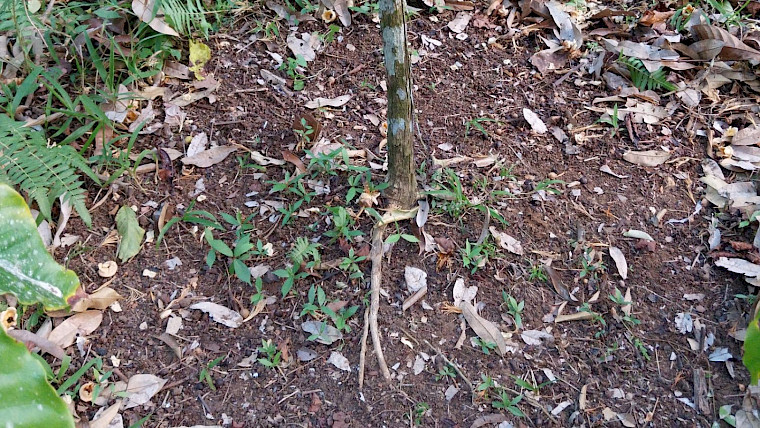
Invasive weeds such as rhizomatous, perennial grasses, and annual seed-producing weeds have a detrimental impact on the productivity of coffee plantations. These weeds intensively compete with coffee plants, consuming nutrients at a rate twice as much as the coffee plants. This competition for nutrients results in a significant decrease in the overall yield of coffee plants, leading to a yield decrease of 35% (from 12.5 quintals per hectare to 7 quintals per hectare). Furthermore, weeds contribute to increased pest infestations on coffee plants and increase the risk of coffee tree disease.
To address the negative impacts of weeds, there is an available and effective tool available commercially - mulching mats. Typically made from nonwoven fabric with a circular shape and black in color, these mats prevent weeds from receiving sufficient sunlight, causing them to wilt. Applying mulching mats is a straightforward process – they are simply placed on top of the soil.
However, the mats are not available in Bali and need to be sourced from abroad which significantly increases the cost, making them prohibitively expensive for farmers. A locally available, and similarly effective solution is needed to control weed growth.
The solution
What we tested
The initial concept for this solution originated from the Fab Island Challenge, organized by the Fab City Foundation in Bali in October 2022, which aimed to tackle local challenges by bringing together international and local multi-disciplinary teams. One of the winning teams in collaboration with Kopernik developed the initial concept to assist smallholder farmers to address weed-growth.
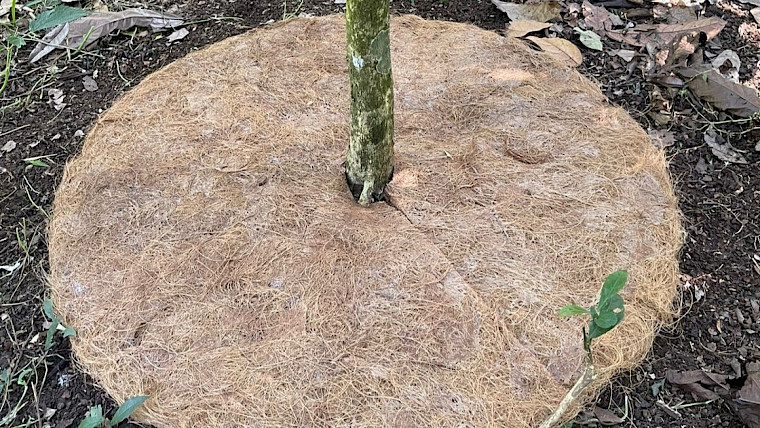
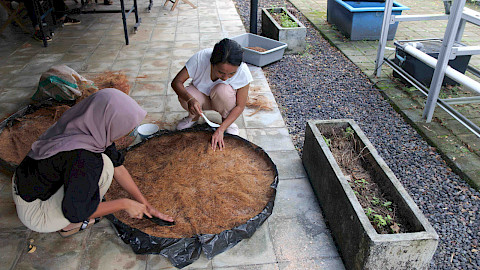
Following the design of the initial concept, we developed a prototype of a mulching mat made from coconut fiber (bio-mat). The design was inspired by the commercially available mulching mats that block sunlight from reaching the soil, leading to weed suppression, moisture retention, and nutrient preservation. Coconut fiber was selected as a material as it is widely available. To assess its effectiveness, we conducted an in-house experiment comparing weed growth (or lack thereof) under a bio-mat, to a commercially available mat through visual observation.
Project design
How we ran it
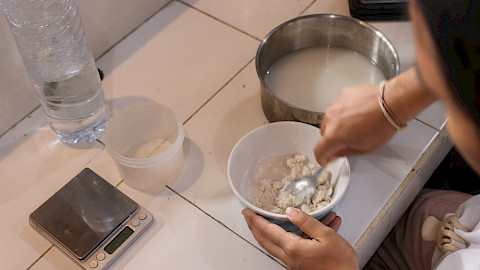
This in-house experiment was conducted over the duration of three weeks in May - June 2023, during which we focused on exploring biomaterials (fiber), identifying the ideal adhesive formula, and testing weed suppression capacity. After testing small batches, we concluded that the optimal combination of materials and adhesive formula consisting of coconut fiber and glue made from 30 grams of alginate, 75 grams of glycerol, and 1000 ml of water. This formula is suitable for creating a one-meter diameter biomaterial mulching mat with a thickness of 2.5-3 cm.
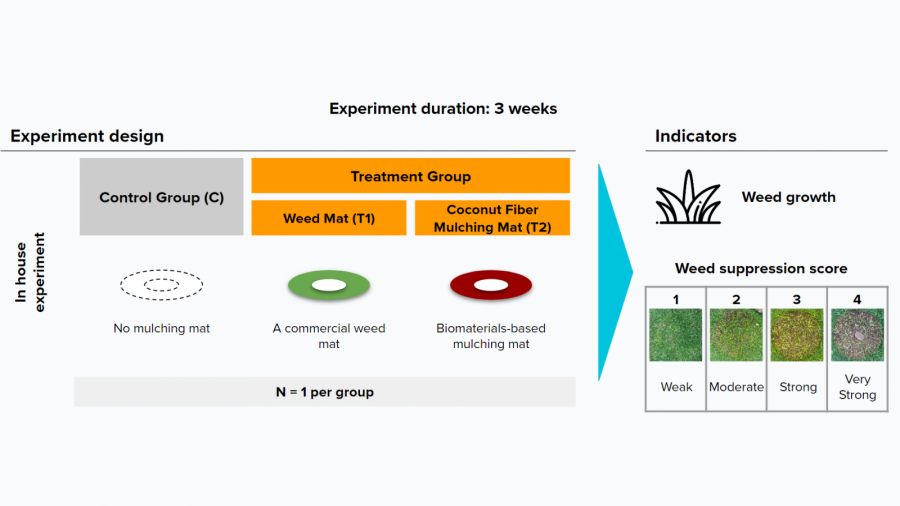
To assess its effectiveness, or weed suppression ability, we placed the mat on soil that already had grass growing on it with the following setup:
Control Group (C): grass area without a weed mat
Treatment 1 (T1): the grass area covered with commercially available weed mat (made from a nonwoven fabric)
Treatment 2 (T2): the grass area covered with a biomaterial mulching mat (made from coconut fiber)
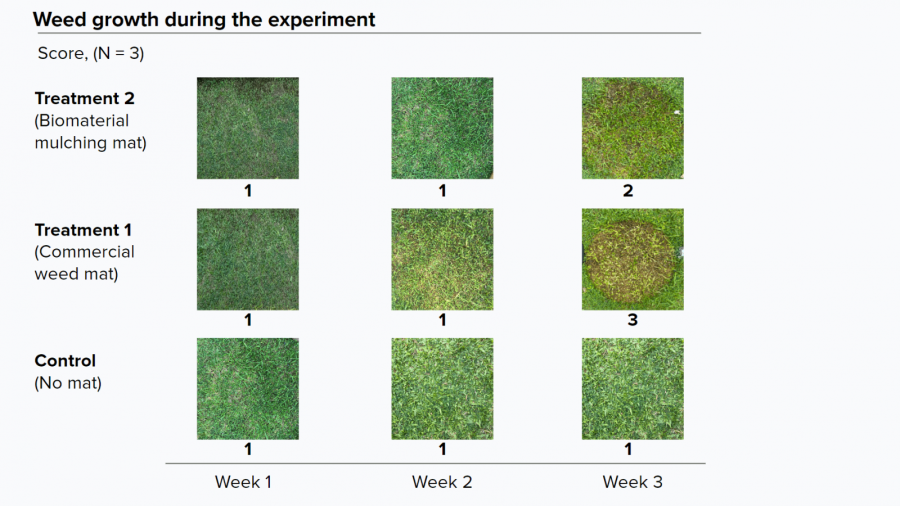
To monitor grass growth, we observed and assessed the grass growth on a weekly basis. The assessment utilized a subjective scale ranging from 1 to 4, based on weekly photos of the grassed areas which were covered by the mats. The scale used was as follows:
Score 1 (weak): no wilting on grass areas
Score 2 (moderate): some wilting on grass areas
Score 3 (strong): a significant portion of wilting on grass areas
Score 4 (very strong): entire covered grass area is wilting
The technology
Results
What we learned
By the end of the three-week period, the biomaterial mulching mat achieved a score of 2, indicating its moderate ability to suppress weeds. The biomaterial mulching mat was only able to suppress weeds in some grassed areas, particularly in the upper part of the grass area it covered. In contrast, the commercial mat has a score of 3, showing significant suppression of weed growth across the entire covered area. The areas covered by the commercial mat exhibited extensive browning of the grass, or withering. This may be due to the heat absorption by the black color of the mat, making the surface sufficiently hot to dry the grass out. Meanwhile in the control group (C) where no mat was used, grass growth remained unaffected.
Based on these results, we concluded that the weed suppression capacity of the biomaterial mulching mat is not as robust as that of the commercially available mat. However, the biomaterial mulching mat shows some potential for further testing in a real coffee farming setting.
Conclusion
This experiment found that while the biomat led to some suppressed weed growth, the commercial mulching mat was substantially more effective. However, even though the effectiveness of weed suppression was not on par with the commercial one, coconut fiber biomats could potentially provide a low-cost alternative for farmers. The mulching mat will therefore be considered for further testing in actual coffee farming settings.