

Ergonomic Weaving Tool (3)
Discomfort and pain during the warping and weaving process
Summary
We tested the ergonomic impact of the adjusted weaving tool for women weavers in Adonara and Lembata, East Nusa Tenggara.
Why we rated it this way
The tool significantly reduced pain during warping and weaving. The adjusted ergonomic weaving tool was also easy to use for warping and weaving.
The problem
What we found
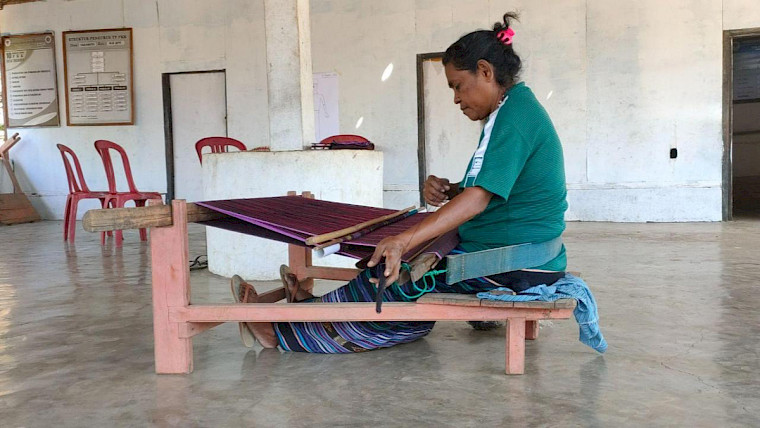
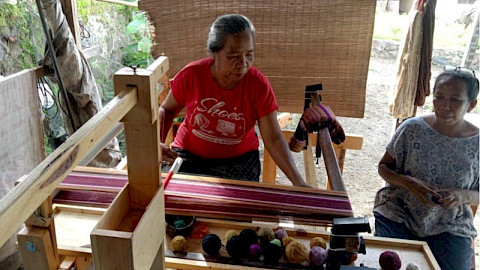
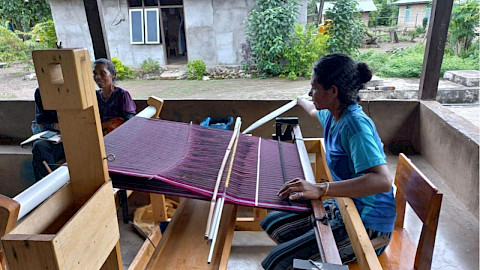
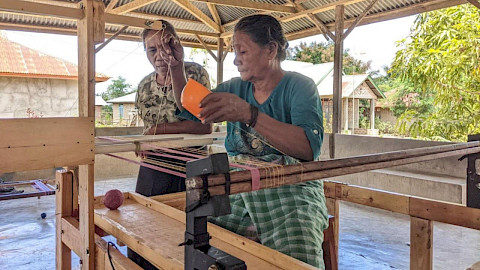
Weaving using a grounded traditional weaving tool with a back-strap loom has resulted in prolonged discomfort and pain throughout the entire body leading to musculoskeletal problems especially in the lower back, hip, and leg areas. In order to improve the weaving experience and alleviate pain without altering the traditional process, we developed an ergonomic weaving tool (EWT) that underwent several iterations.
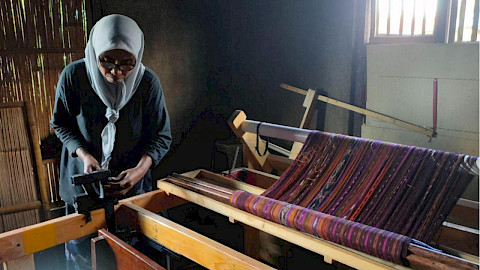
During the prototyping stage, we removed the tension control on the backstrap loom and substituted it with a swing arm and lever mechanism. The tool was elevated above the ground to facilitate a better sitting position during weaving. We discovered that the EWT prototype was user-friendly and produced woven cloth with ease while reducing pain.
In the pilot testing stage, we improved the tool with a pair of rotator blocks as requested by weavers to allow for switching between warping and weaving modes. We found that the tool was easy to use for warping and was able to reduce pain during weaving. However, the design of the rotator block impeded and slowed down the movement of the beater piece or surit, which led to weavers not using the ergonomic weaving tool for the weaving process.
The solution
What we tested
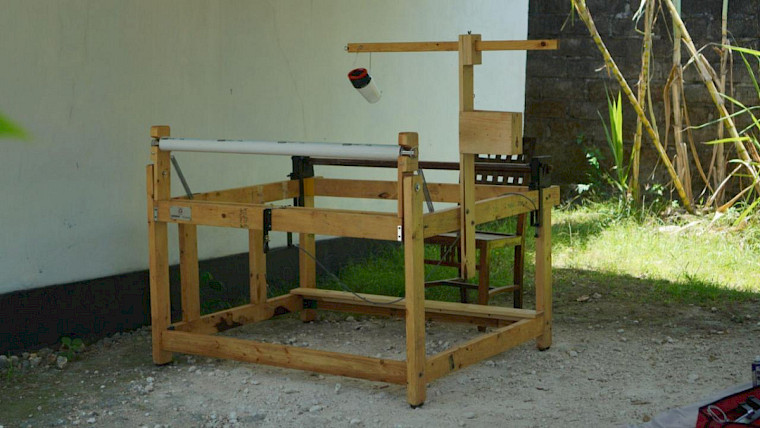
The result of the pilot testing phase indicated that the design and material of the rotator block needs to be modified. To address this issue, we adjusted the rotator block by making it slimmer than the previous design used in the pilot testing, allowing more space for the beater piece or surit to move more smoothly. Additionally, we replaced the wooden blocks with hollow iron pieces to make the tool more sturdy.
Aside from the rotator block, no modifications were made to the frames, loom, posts, and lever mechanism of the EWT. Thus, the design of the EWT remained the same as the prototype version. We then distributed 5 adjusted EWTs to weavers in Adonara and the 4 adjusted EWTs to Lembata for further testing.
Project design
How we ran it
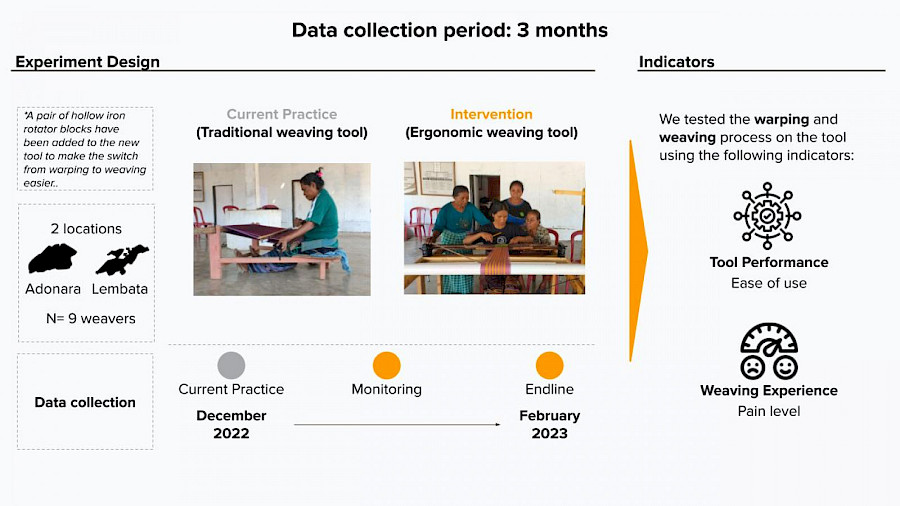
As in the pilot stage, we observed and measured indicators of two activities involved in the weaving process, namely warping or neket, which is the process of combining yarn to form a base, and weaving, which involves interlacing the warp and weft to create fabric.
In total, 9 weavers participated in this stage. The weavers in Adonara and Lembata have different approaches to performing warping and weaving activities. All 5 weavers in Adonara can perform both warping and weaving, while in Lembata, only 1 weaver can warp, 2 weavers can weave, and 1 can both warp and weave. Therefore, we combined the data for warping from 7 weavers and the data for weaving from 8 weavers during the data collection process.
Data was collected over three months from December 2022 to February 2023. The data consisted of baseline information on the current practice of using the traditional weaving tool, monitoring data and an endline data of using the adjusted EWT.
During the process of data collection, some weavers stated that they did not continuously use the adjusted EWTs in January and February, which resulted in missing data. Therefore, for consistency, we only analysed the complete data set available from 4 weavers for warping and 3 weavers for weaving.
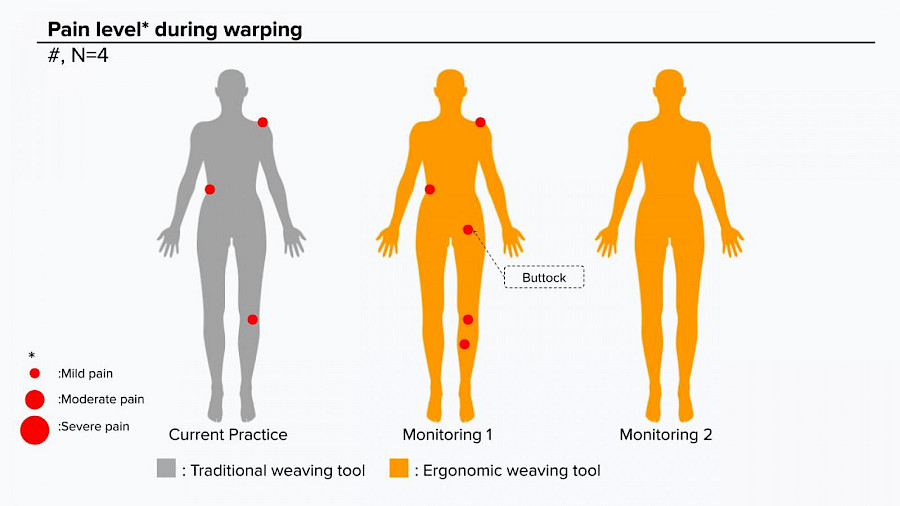
We worked with a local coordinator to support the data collection process in each location. The local coordinator interviewed each weaver regarding their frequency of using the adjusted EWTs, level of ease of use, and pain level score in different body parts. We simplified the pain levels from the ten-point scale in the previous experiment into a three-point scale (mild, moderate and severe) to help weavers articulate their pain level more easily .
The technology
Results
What we learned
Ease of use and pain level during warping:
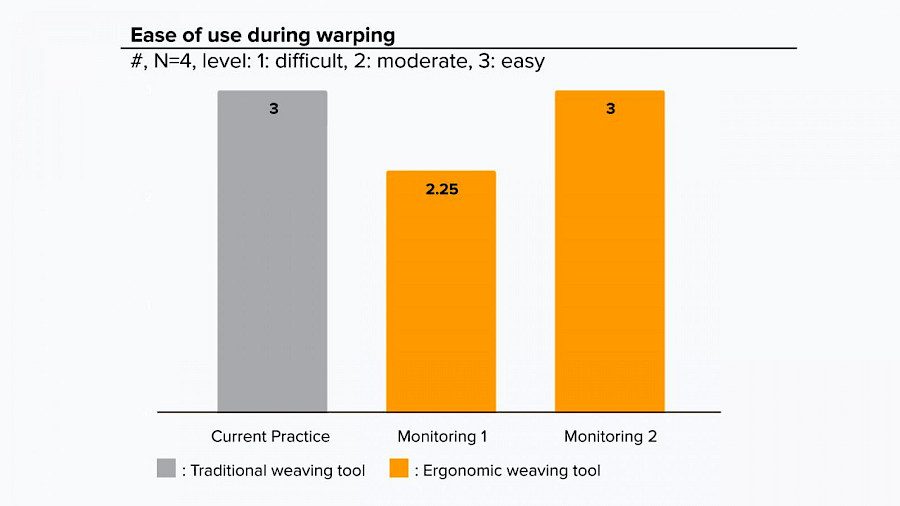
During the first month of the data collection period, the adjusted EWT was initially found to be less user-friendly for warping in comparison to the traditional tool. However, as time progressed, weavers gradually found it easier to use and eventually found it to be as easy to use as the traditional tool for warping. A similar trend was observed in terms of pain levels. At the start of the intervention, weavers reported experiencing the same level of pain in the same position. One weaver mentioned experiencing mild pain from sitting on the wooden bar-stool due to the base of the stool being too small for her body size. However, by the end of the data collection period, none of the weavers experienced any pain in their body.
Ease of use and pain level during weaving:
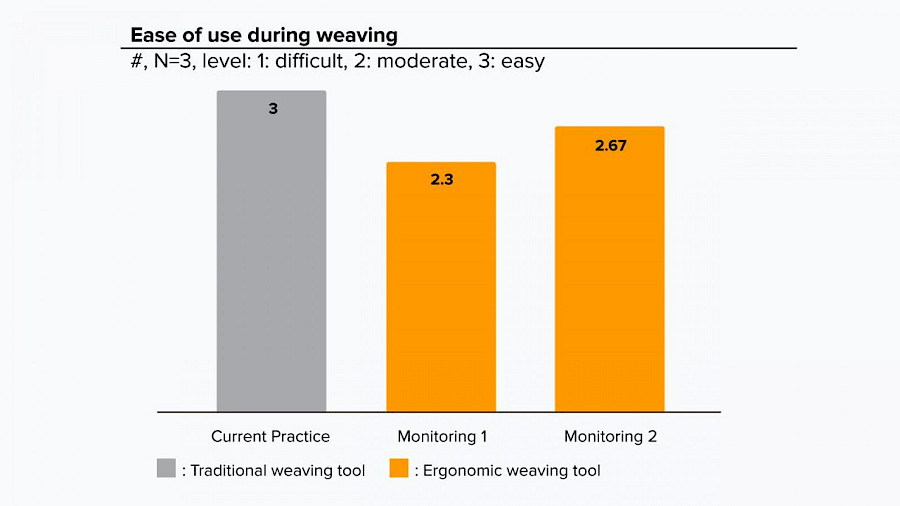
The initial findings showed that weavers found the adjusted EWT more difficult to use for weaving compared to the traditional tool. Weavers needed time to adjust to the new features of the tool and to unlearn their habits of using the traditional tool. During the adoption process, we observed a learning curve among the weavers. In January, the weavers tested the adjusted EWT by weaving small scarves instead of a larger woven fabric. Once they completed the scarves, they had a positive impression of the tool and started making regular-sized woven cloth in February. The more they used the tool, the more comfortable the weavers became, and there were no complaints about the rotator blocks. Although they reported that the adjusted EWT was still not as convenient as the traditional tool, there was nonetheless an increased ease-of-use score.
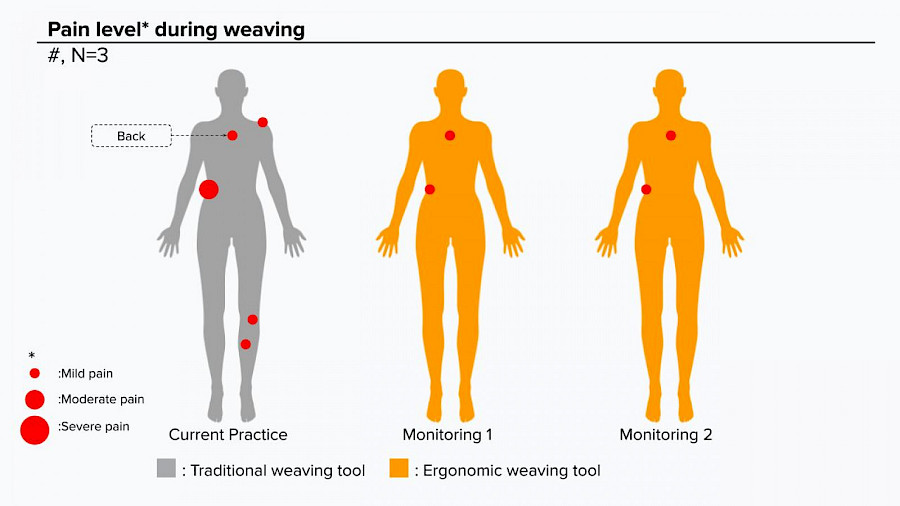
Regarding the pain levels, weavers experienced moderate pain in their hip area while using the traditional tool, as well as mild pain on their shoulders, backs, knees, and calves. After using the adjusted EWT, the weavers no longer experienced pain in their shoulders, knees, and calves. They also experienced less pain on their hips and mild pain on their backs.
Conclusion
The final experiment confirmed that the latest version of the adjusted EWT, which had undergone multiple stages of testing including prototyping and pilot testing, was as effective and as easy to use for warping and weaving as the traditional tools. Additionally, the adjusted EWT was found to eliminate pain during warping, and significantly reduce pain during weaving, particularly in the hips and legs area.
Additional considerations
There was a noticeable difference in weaving practices between the weavers in Adonara and Lembata. The weavers in Adonara work individually using their own traditional weaving tools at home, whereas the weavers in Lembata work together in a group and have collective weaving activities every Friday in the village hall. This led to a difference in the placement and location of the EWTs. In Adonara, the 5 EWTs were placed in 5 weavers' homes, while in Lembata, the 4 EWTs were placed in the village hall.
In this experiment, we found that the churn rate (or the number of weavers who stopped using the ergonomic weaving tool) in a weaving group setting in Lembata was lower (25%) than in an individual setting in Adonara (40%). We observed that the churn rate might be associated with the placement and accessibility of the tools.
Regular collective weaving activities in the same location in Lembata provided weavers with opportunities to learn and adopt the new tool effectively. They can learn from each other and the local coordinator, who was present to offer assistance. We observed that weavers in a group setting were more creative in coming up with potential solutions for troubleshooting the tools, which motivated them to use the adjusted EWTs continuously.
On the other hand, weavers who used the adjusted EWTs individually at home in Adonara might have faced more challenges in adapting to the tool. Each weaver might only rely on the local coordinator, who is considered to be the only person with knowledge about the adjusted EWTs in their village. Unfortunately, the local coordinator's visit was scheduled to be weekly or could be less frequent depending on both parties' availability. Any difficulties that were not immediately addressed might have demotivated weavers from using the adjusted EWTs continuously, leading to a higher churn rate in this setting.