

Fan-Filter Unit to Improve Air-Quality
Low indoor air quality as a result of smoke from forest fires
Summary
We tested the efficacy of a locally assembled Fan-Filter Unit (FFU) and an imported SmartAir FFUs to improve indoor air quality as a result of smoke and haze from forest fires.
Why we rated it this way
Both the locally assembled Fan-Filter Unit (FFU) and the imported FFU were effective in improving air quality during a simulation of haze-like conditions.
The problem
What we found
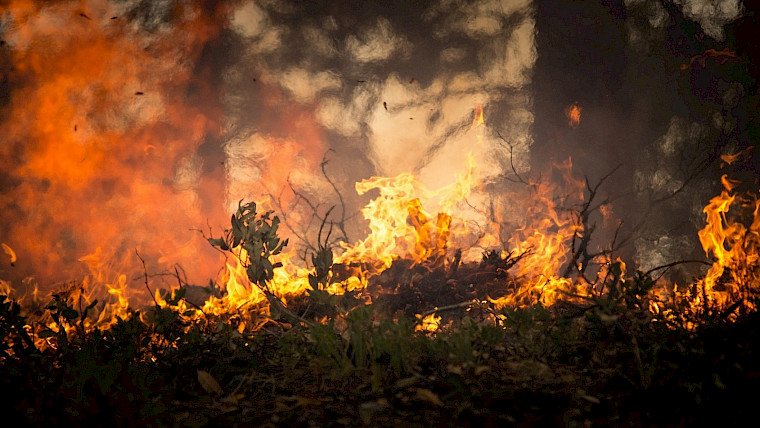
Forest fires are an annual problem in parts of Sumatra and Kalimantan. These fires cause heightened levels of air pollution, commonly referred to as “haze”. The particularly severe haze event of 2015 resulted in more than 43 million Indonesians exposed to smoke from these fires, leading to half a million cases of acute respiratory infections and an estimated 100,000 premature deaths. Short term exposure to haze causes widespread respiratory, eye, and skin ailments. The long-term health impacts from prolonged exposure to haze are not yet known, but experts predict they will be significant. Therefore, there is a need to protect people from toxic particulate matter by creating pollution-free spaces during haze conditions.
The solution
What we tested
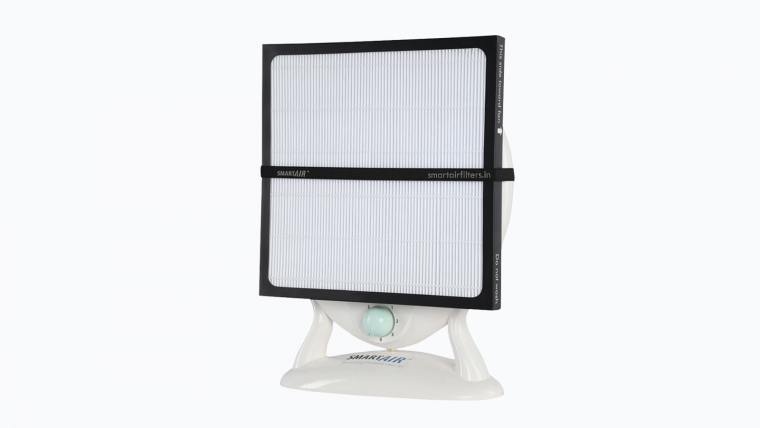
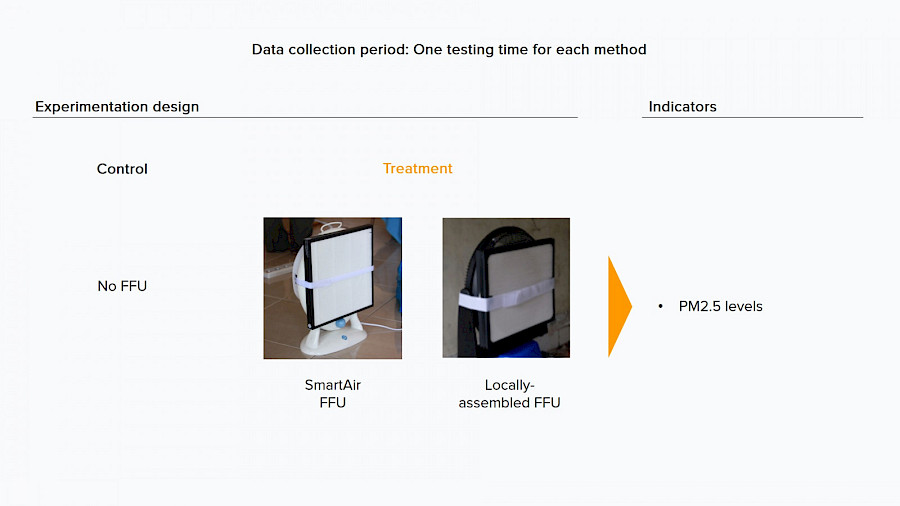
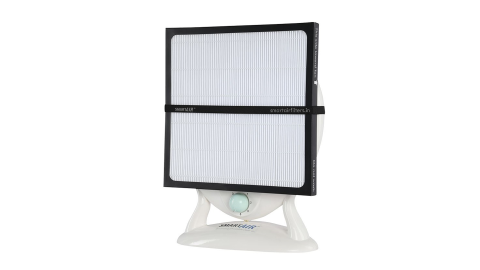
We compared the effectiveness of a locally assembled Fan-Filter Unit (FFU) to an imported SmartAir Fan-Filter Unit to reduce exposure to dangerous forest fire haze. To determine the effectiveness of the FFU, we measured the PM2.5 levels in a room fitted with the FFU (treatment) and in a room without the FFU (control).
Project design
How we ran it
In July 2017, we conducted a test at Kopernik’s office in Ubud, Bali. While we designed the experiment to include field tests in Palangka Raya, Central Kalimantan, we were unable to implement this component due to frequent power outages in Palangka Raya.
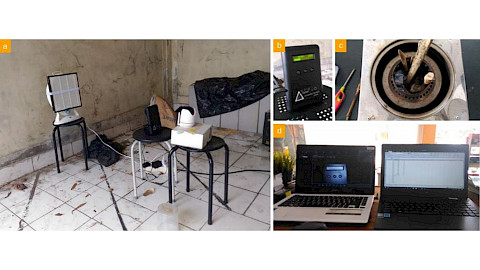
The test assessed the FFU’s performance in removing smoke from an enclosed space by measuring PM2.5 levels. The tests were conducted in Kopernik’s 30m3 office garage. Ventilation holes were sealed to the extent possible and the garage door was kept closed. Three separate tests were performed; 1) No FFU (control), 2) with the SmartAir FFU, and 3) with the locally assembled version of the FFU
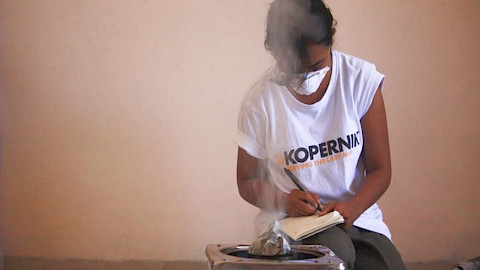
To measure the FFU performance, heavy smoke was generated inside a closed room by burning paper and wood using a cookstove in order to simulate haze-like conditions. A particle counter device, the Dylos DC1100 Pro Air Quality Monitor, was used to detect and to measure PM2.5. Monitoring was done continuously throughout the duration of the test for 2.5 hours.
The technology
Results
What we learned
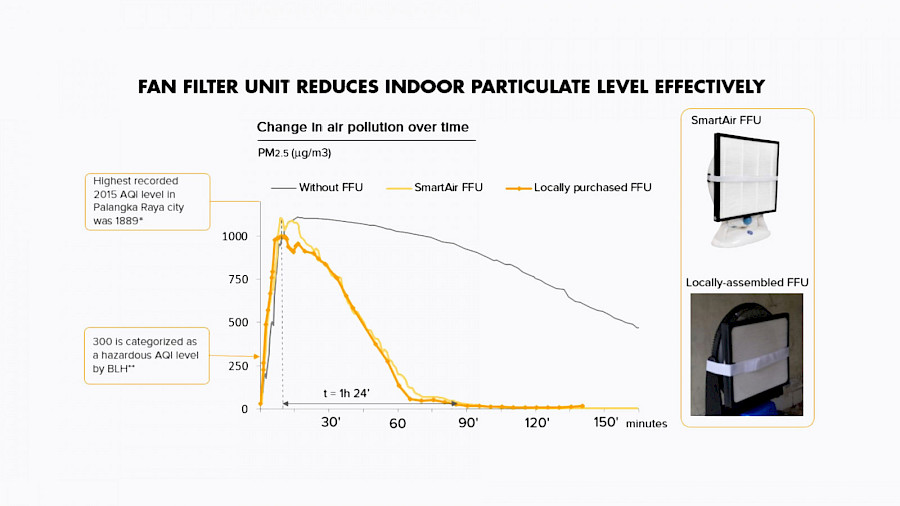
Based on the tests, the PM2.5 levels were plotted along a time-series and compared for each test scenario. The graph indicates that both FFUs were able to restore the air quality levels to the initial conditions in the room, removing 100% of particulate matter within one hour and 25 minutes. Over the same period of time, with the test conducted in the same room without the FFU unit, there was a reduction of only 21% of particulate matter. The preliminary test therefore suggests that the FFU is five times more effective in removing particulate matter as compared to no measures being taken.
Conclusion
The overall experiment concluded that both locally assembled FFU and imported FFU effectively reduced PM2.5 to safe levels within one hour and 25 minutes.
Additional considerations
While the FFUs were effective in removing PM2.5, it is important to note that this result was obtained during a simulation of haze-like conditions. We therefore do not yet know the effectiveness of both FFUs in real haze conditions during forest fires. In terms of cost, there was no significant difference between the two units with the locally assembled FFU costing US$75 and the imported SmartAir FFU US$76. Access to stable electricity supply will also be needed for the kit to work. An alternative electricity source is likely to be needed given the unstable supply of electricity in targeted areas.
Read more
Project profile
Reports and references
Ningrum, Nanis Sakti. (2017). Providing Disaster Relief: Haze Emergency Kits Phase One Project Report.