

Reusable Menstrual Pad
Low school attendance
Summary
We distributed ready-made reusable menstrual pads to female middle school students in East Sumba, East Nusa Tenggara, Indonesia to test the impact of alternative menstrual product access on school attendance during menstruation, as well as their satisfaction with the product. We observed no impact on school attendance because non-attendance at school due to menstruation was already low to begin with 97 percent of respondents stated that they were “satisfied” or “very satisfied” with the product and 81 percent would use it regularly.
This experiment resulted in two additional findings regarding economic benefits of purchasing reusable pads as well as menstrual product waste reduction. In terms of economic benefits, despite some savings that can be made from investing in reusable pads, these may not be sufficiently significant because single-use disposable pads are widely available and affordable in the area. The positive environmental impact of using reusable pads however, can be significant due to a reduction in single-use menstrual product waste.
Why we rated it this way
We hypothesized that access to reusable menstrual pads would increase female students’ school attendance during menstruation. However, contrary to available data which indicated that school non-attendance due to menstruation was a significant problem, our baseline data showed that school non-attendance due to menstruation was not a major concern in that location as female students only missed 0.5-2 days of school per year. Despite this finding, we identified two other important findings from the experiment: 1) there need to be some economic incentives to shift from using disposable to reusable pads; 2) Using reusable pads can result in environmental benefits through significant menstrual waste reduction
The problem
What we found
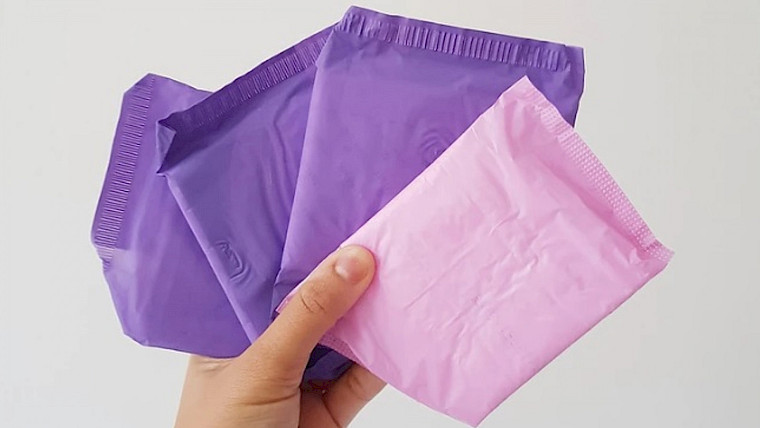
In 2005, the World Bank published a report which suggested that female students, especially during their period, might be absent from school due to inappropriate sanitation facilities and that providing gender-specific facilities can be a way to improve female students’ school attendance. However, other researchers contradict this finding regarding the relationship between menstruation and female students’ school attendance. Research conducted by Oster and Thornton (2010) concluded that menstruation had little impact on school attendance in Nepal, and the provision of menstrual cups yielded no improvements. In rural Indonesia, 17 percent of students surveyed said they missed at least 1 day during their last period due to difficulties related to menstrual health management (Burnet Institute, 2015). The contradictory research on menstrual health management led Kopernik to better understand the situation firsthand, and we conducted a small-scale randomized trial in East Sumba, with the GG Pad - a reusable pad produced in West Java.
The solution
What we tested
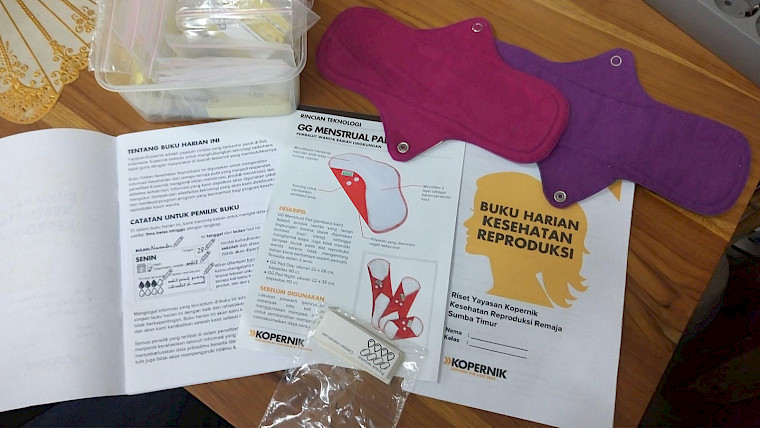
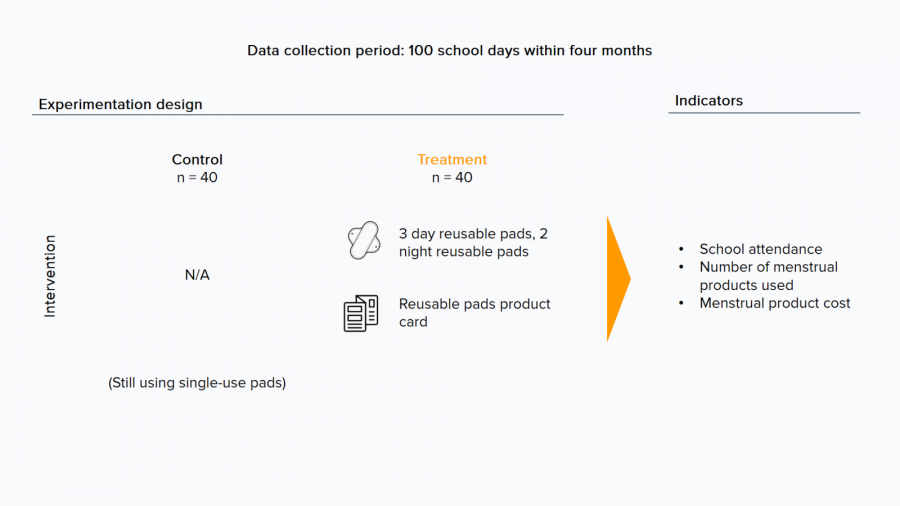
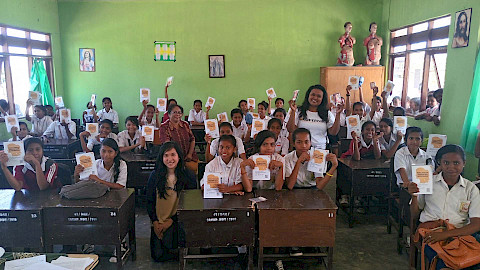
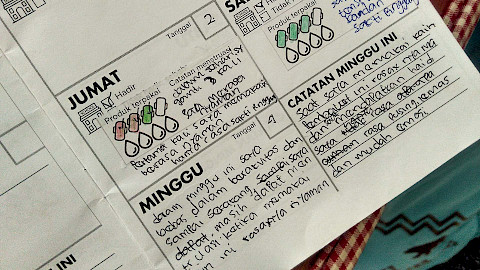
We distributed 5 reusable pads (3 day pads and 2 night pads), a product card and a Student Diary to 80 female students in grades 7, 8, and 9. We divided the students into two groups of 40, control and treatment, where the control group received the reusable pads only after the data collection while the treatment group received the reusable pads before the data collection. These reusable pads (which are not locally available) were an alternative to the single-use pads which were widely available in the area. We conducted a baseline survey to measure school attendance, costs, and menstrual waste produced. We recorded the length of menstruation time, school attendance (self-reported and formal school records), as well as other menstrual product(s) used.
Project design
How we ran it
The research was conducted over 100 days, starting in July 2016, at which point we conducted baseline surveys and randomly assigned 80 female students to one of the two groups, control and treatment. The treatment group received the reusable pads and product information at the start of the project (data collection) while the control group used their usual menstrual hygiene products during the experiment. Both groups were distributed a Student Diary at the start of the project alongside a baseline survey. After the experiment period, we also distributed the reusable pads to the control group.
The technology
Results
What we learned
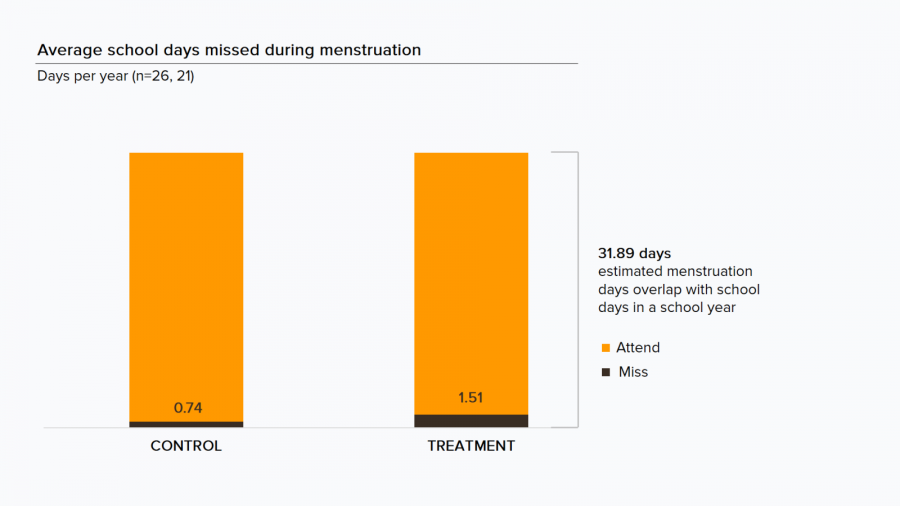
We found the experiment to be inconclusive in terms of impact on school attendance during menstruation, because this was not an issue in this particular project location. On average, the number of school days missed due to menstruation were low for both the treatment and control groups. Students in the control group missed on average less than 1 day per year, and students in the treatment group missed around 1.5 days per year. These results were far lower to our previous assumptions made based on available research.
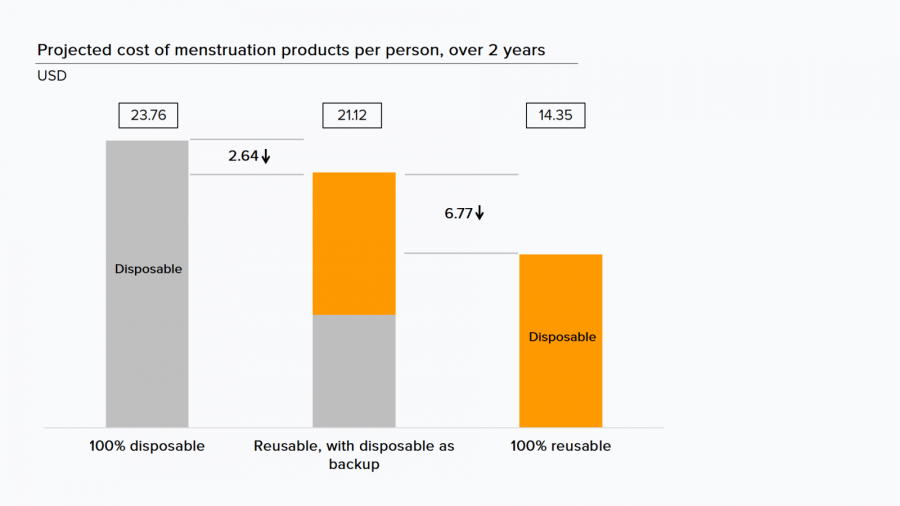
In terms of cost, a two-year projection indicates a IDR125,153 (~US$9.41) cost reduction if a student fully switches to using reusable pads. We concluded that this amount of savings is insufficiently rewarding for students with low purchasing power given the high up-front investment required to purchase the reusable pads at a cost of IDR190,800 (~US$14.35). Contributing factors to the small amount of savings included the low cost and availability of single-use pads, students supplementing the reusable pads with additional single-use pads and the high price of the reusable pads (which includes shipping costs as the pads are not available locally).
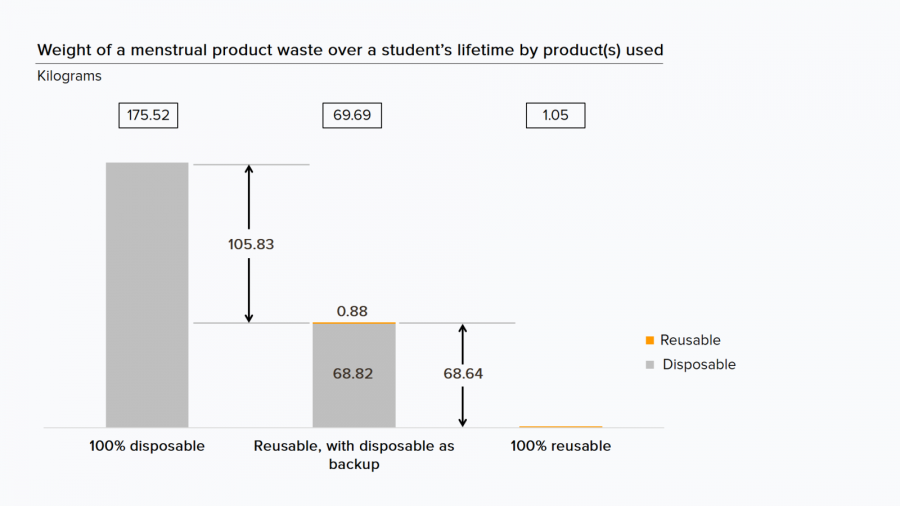
In terms of reducing environmental waste from using single-use pads, a female student can reduce her menstrual product waste by approximately 106 kilograms over her lifetime, when mostly using reusable pads and supplementing these with single-use pads. When fully switching to reusable pads, she could reduce menstrual product waste by 174.47 kilograms.
Conclusion
Our experiment concluded that access to reusable pads did not increase school attendance but this is because there was low school absence due to menstruation in the first place. We also found that economic savings from reusable pads were very small due to the high up-front investment costs of reusable pads. As for reducing menstrual product waste, there are significant environmental benefits from switching from single-use to reusable menstrual products.
Read more
Project profile
Reports and references
Kristanto, Lana. (2017). Promoting Menstrual Health: GG Pads Product Testing Project Report.
Kopernik Insights
Kristanto, Lana. Reusable Sanitary Pads in Indonesia may be Too Expensive to be Economically Attractive. Kopernik. May 23, 2017