

Small Scale Coffee Bean Size Sorter (2)
Time-intensive coffee bean sorting process
Summary
We tested the efficiency of small-scale coffee bean sorters to increase sorting capacity for smallholder coffee farmers in Tabanan, Bali, Indonesia.
Why we rated it this way
The small-scale coffee bean sorters were found to be 29.5% more efficient than manual sorting, allowing farmers to sort more beans in the same amount of time. Farmers continued using the sorters after the experiment concluded.
The problem
What we found
Coffee beans grown at higher altitudes tend to be more dense than those at lower altitudes, and range in size and quality. When beans of varying sizes are roasted together, this can result in inconsistent roasting levels: with some beans being over-roasted, while others are not sufficiently roasted due to the uneven distribution of heat during the roasting process. The inconsistent roasting level impacts the coffee's taste and flavor. This is why buyers are willing to pay a 5.6% higher price for coffee beans that are sorted into even sizes. (The Specialty Coffee Association of America (SCAA) has established a classification standard for specialty-grade green coffee, where a deviation of a maximum of 5% above or below the indicated size is acceptable.)
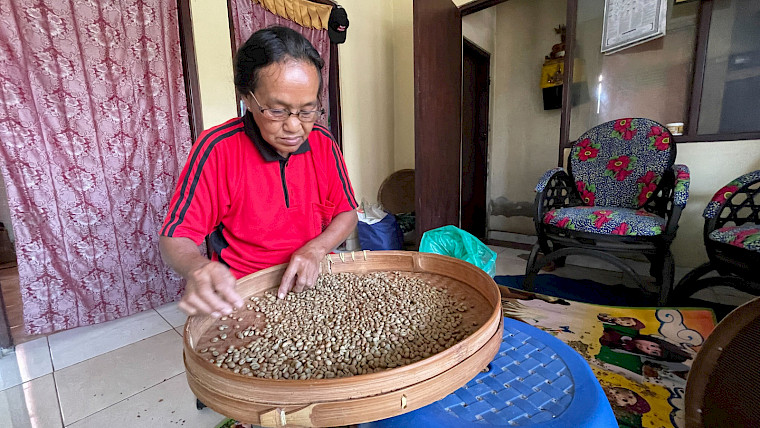
The 570 robusta coffee farmer households in Tabanan, Bali, currently do not sort their beans by size, only focusing on the removal of defective beans and debris (such as coffee husks, small sticks, and stones). They do this manually, one bean at a time, by hand. This process is time-consuming and limits a potential increase in their income, if the beans were sorted by size. Efficient large-scale machinery to sort coffee beans is available on the market but this is not accessible by average smallholder farmers, largely due to cost. There is a need for smaller scale and more affordable tools that are effective in sorting coffee beans.
The solution
What we tested
To address this challenge, we previously conducted an in-house experiment to test the effectiveness of small-scale tools in sorting coffee beans by size, with a target error rate of no more than 5%. We also compared user convenience and feedback to identify user preferences between a small-scale sorting tool with a square handle and one with a circular handle. The results of the in-house experiment showed that a small-scale sorting tool with a circular handle met the target error rate and was preferred by users for its comfort and ease of use.
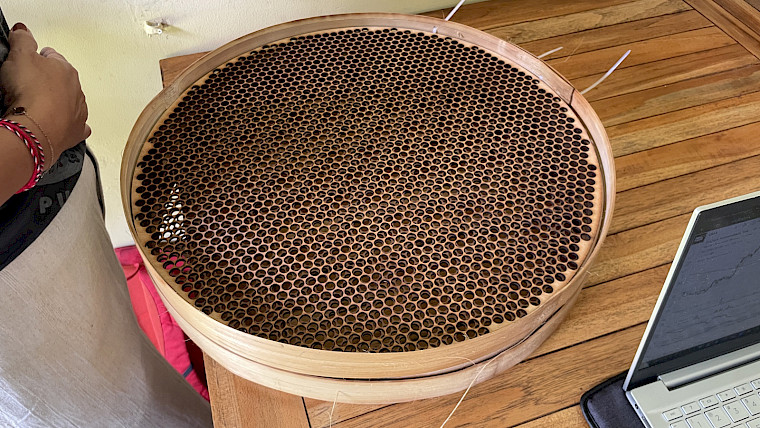
Following our previous in-house experiment, we carried out a field experiment in Tabanan, Bali, to compare the coffee sorting speed between the traditional manual method and using a small-scale coffee bean sorter. The coffee bean sorter features two layers of sorting screens with different hole diameters to separate beans into three size categories: >8mm, 8-6mm, and <6mm.
We hypothesized that this small-scale sorter could accelerate the coffee sorting process while ensuring evenly sorted beans.
Project design
How we ran it
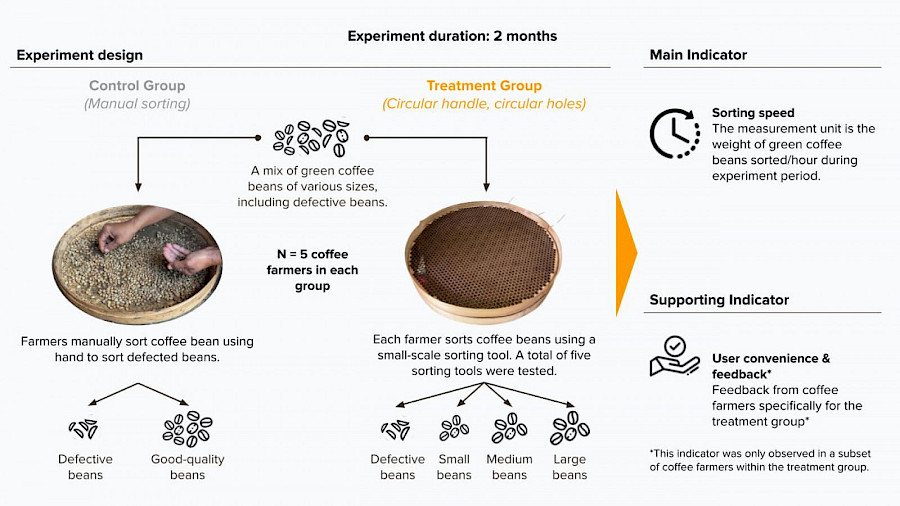
We tested the efficiency of the small-scale coffee bean sorter in reducing the time needed to sort coffee beans. First, we randomly selected 10 coffee farmers who manually sort coffee beans to participate in this experiment. After the selection process, these 10 farmers were divided into two experimental groups as follows:
- Control Group: 5 coffee farmers to manually sort coffee beans (hand-picking).
- Treatment Group: 5 coffee farmers to use the small-scale coffee bean sorters.
When using the small-scale coffee bean sorter, farmers began by arranging the screens with the largest holes on top. They then poured approximately 500 grams of mixed-size coffee beans, including defective beans, onto the top layer for each batch. Next, the farmers shook the sorter for about 30 seconds, allowing the beans to separate into different layers based on their diameter. After sorting, the farmers double-checked the top two layers to manually remove any defective beans that might have been missed.
Both groups performed sorting activities for 2 months, with weekly monitoring of their sorting speed. We collected weekly data on the following:
- the total amount of coffee sorted (in kg),
- the number of days spent sorting coffee beans (days),
- the number of hours spent sorting coffee beans per day (hours).
We then calculated the sorting speed by dividing the total average amount of coffee sorted by the total average hours spent sorting. This allowed us to determine the average amount of coffee sorted per hour (kg/hour) and compare sorting speed between groups.
Additionally, since small-scale coffee bean sorters are a new technology for the farmers, we also interviewed several of them to gather feedback on the prototypes, specifically regarding ease of use and material durability.
Results
What we learned
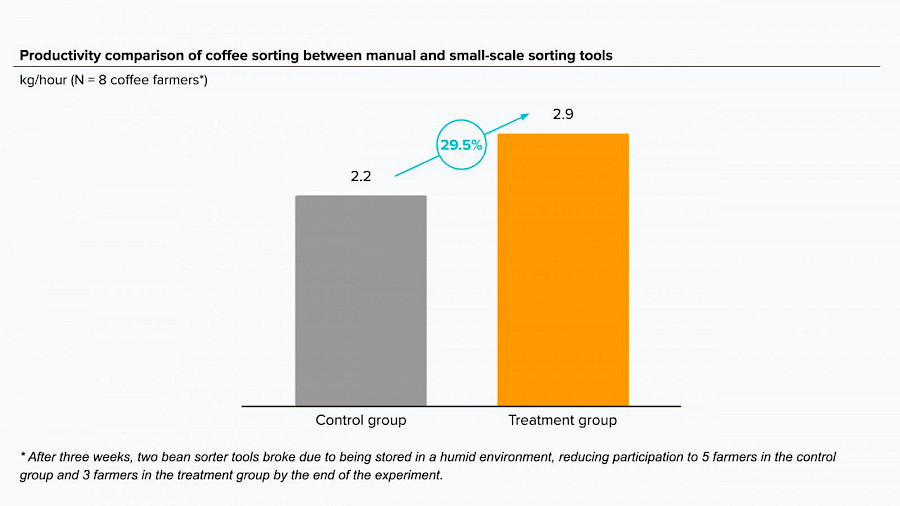
From the results of the field experiment, farmers using the small-scale coffee bean sorters were able to sort 2.9 kg of coffee beans per hour, which is 560 grams more than the 2.2 kg sorted manually. This represents a 29.5% reduction in sorting time.
The primary factor contributing to this increase in sorting speed is that debris and broken coffee beans, which are generally smaller than the good-quality beans, are immediately separated and fall into the lowest layer of the coffee bean sorter. As a result, farmers spend less time manually picking out debris mixed with the good-quality beans.
Update as of end of November 2024: Follow-up observations revealed that three of the five provided coffee bean sorters remained in good condition and were being regularly used by farmers. Furthermore, there was growing interest among farmers in increasing the availability of these tools to benefit more farmers.
Conclusion
The small-scale coffee bean sorters have successfully reduced the time required for sorting by 29.5%. With this tool, debris and broken coffee beans are immediately separated during the sieving process, reducing the need for farmers to manually sort through debris and damaged beans.
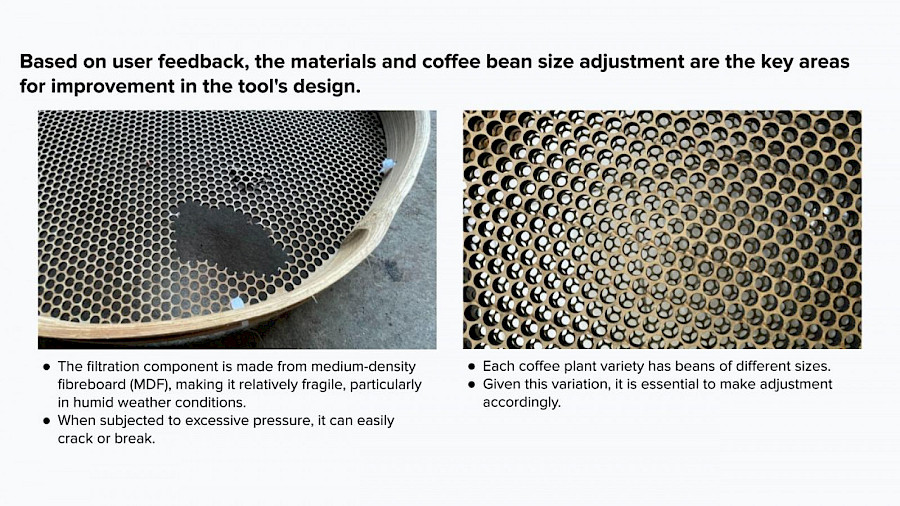
For future development, careful consideration is needed regarding the materials used to manufacture the tool. Additionally, measuring the sample coffee beans to be sorted is important for determining the appropriate hole sizes for the sorting screen.
A few months after the experiment, three of the five coffee bean sorters remained in good condition and were being used regularly by farmers. Furthermore, there was growing interest among farmers in increasing the availability of these tools.
Read more
Kopernik Insights
Small Scale Coffee Bean Size Sorter (1) - Solutions Catalog