

Turning palm oil waste into organic fertilizer
Lack of affordable fertilizer
Summary
We tested the quality of organic fertilizer made from oil palm empty fruit bunches (OPEFB) and its effectiveness to improve the soil quality of smallholders’ farmers’ plantations in Sanggau, West Kalimantan. The result was that the organic fertilizer made of OPEFB contained a sufficient amount of nutrients for the soil, however, the application of the fertilizer did not result in an improvement in soil characteristics. This could be due to the fact that continued application over a longer period of time is required (i.e., between six to 24 months ) to see meaningful improvement in soil characteristics.
Why we rated it this way
Inconclusive: Short period of fertilizer application did not result in significant changes in the soil characteristics.
The problem
What we found
Indonesia is the largest producer of palm oil in the world. In 2018, Indonesia contributed 57% of the 72 million tonnes of palm oil produced globally.
While 46% of national palm oil production is attributable to smallholder farmers, Kopernik’s Unmet Needs research in 2018 found that smallholder farmers in Sanggau, West Kalimantan, were not using sufficient fertilizer to improve the soil condition, as they could not afford to purchase the required fertilizer. The lack of nutrition in the soil makes it difficult for the oil palm to achieve optimum productivity. While the Ministry of Agriculture provides subsidized fertilizer through each of its regional departments, the use of the subsidized fertilizer is limited due to the complex administrative procedure to obtain it. Therefore, an alternative fertilizer that is accessible and effective in improving the soil condition is needed to support the local farmers.
The solution
What we tested
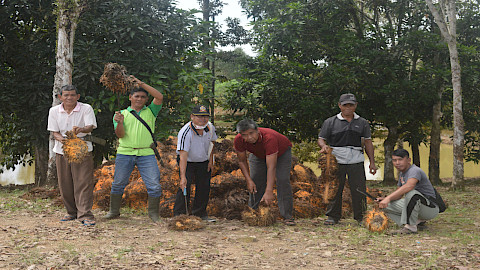
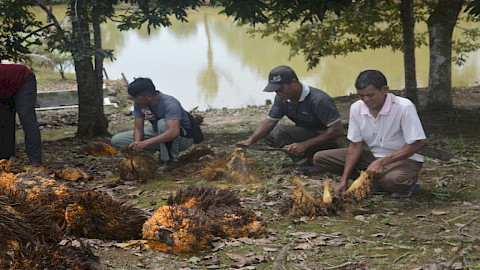
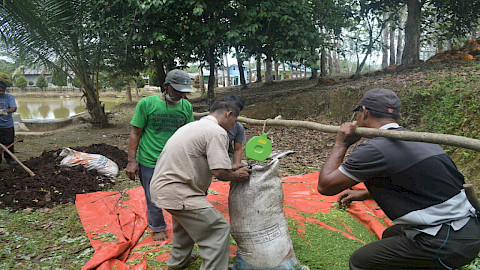
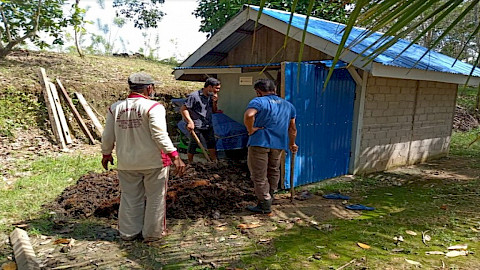
Kopernik supported farmers through a series of training sessions on how to produce organic fertilizer out of palm waste (oil palm empty fruit bunches - OPEFB) as the main component and other locally available materials to address this problem. OPEFB is abundant and contains the basic nutrients found in conventional fertilizers, such as Nitrogen, Carbon, Potassium, and Phosphorus. To assess the potential of the fertilizer made out of OPEFB, we tested 1) the fertilizer quality, and ii) observed the change in the soil condition of the smallholder farmers’ plantation where the fertilizer was applied, during a three months period.
Project design
How we ran it
1. Production and assessment of organic fertilizer quality
In partnership with the smallholder farmers in Sanggau, we conducted a series of composting processes during 34 days using the recommended materials, which included 5 tonnes of empty fruit bunches, 0.5 tons of green waste, and 0.5 tons of chicken manure. Once the compost was ready to use, we measured several parameters, including pH, Carbon content, Macronutrients (Nitrogen, Phosphorus, Potassium), and moisture content which are the parameters articulated in the Ministry of Agriculture of the Republic of Indonesia regulation on organic fertilizer quality standards (Peraturan Menteri Pertanian No. 261/KPTS/SR.310/M/4/2019).
2. Assessment of fertilizer effectiveness in improving soil condition
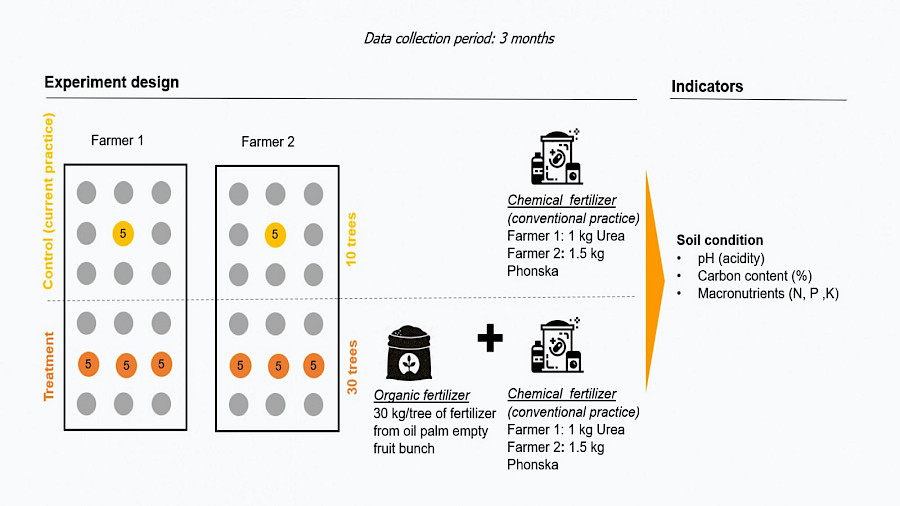
An experiment was conducted between February and June 2021 at two farmers' demonstration plots with mature oil palm trees, in order to observe the impact of organic fertilizer on the soil condition. We selected farmers who we observed were currently applying insufficient amounts of chemical fertilizer based on the application guidelines. The farmers were applying insufficient amounts of fertilizer due to its high cost or the difficulty in accessing subsidized fertilizer. .
Of the 40 trees available for the experiment, the Kopernik team first identified 35 trees that had similar characteristics in terms of age and leaf composition. The 35 trees were then randomly assigned to be part of the treatment group (30 trees) and control group (5 trees). 30 trees in the treatment group received applications of organic fertilizer in addition to the conventional fertilizer application, and five trees (control group) received the usual amount of conventional fertilizer applied by the farmers.
In early February, the trees in the treatment group received an application of organic fertilizer made out of OPEFB prior to the application of the conventional chemical fertilizer which was applied at the end of February. We took soil samples prior to the organic fertilizer application and then additional samples were taken three months after applying the chemical fertilizer to monitor the soil characteristics. We then measured the pH, Nitrogen, Phosphorus, Potassium, and organic carbon levels in the laboratory.
The technology
Results
What we learned
1. Quality of the organic fertilizer
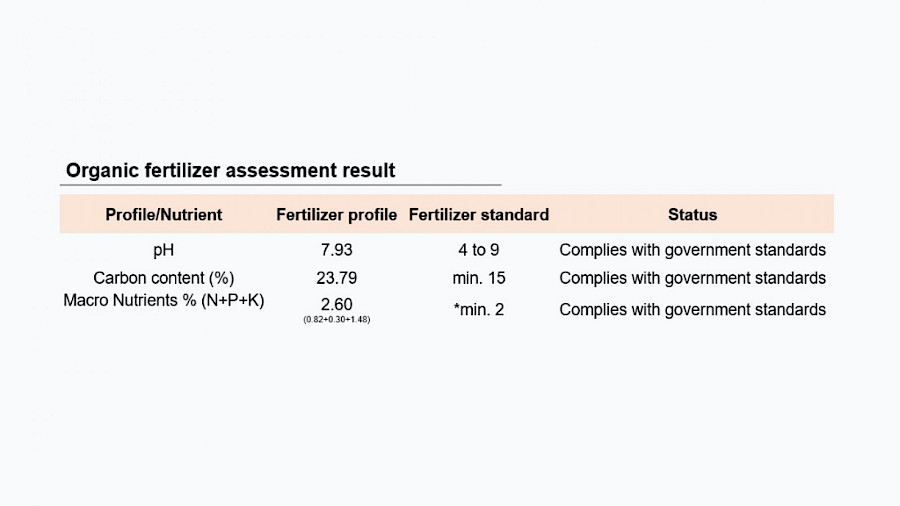
We produced 2 tonnes of organic fertilizer from 6 tonnes of raw materials. The organic fertilizer produced contained the standard characteristics of organic fertilizer, including having a solid structure with black color and being odorless. Laboratory analysis of the fertilizer characteristics showed that the organic fertilizer complied with the national standards in terms of the pH (7,93), Carbon content (23,79), and macronutrients (NPK; 2,6) levels.
2. Fertilizer effectiveness
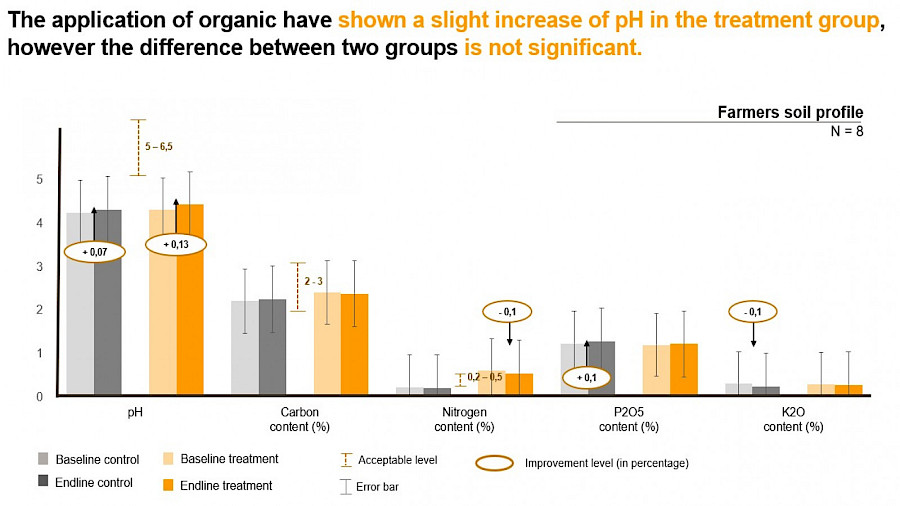
The initial characteristic of the farmers' plantation soil showed that both soils were red-yellow podzolic and not considered suitable for oil palm plantation due to low pH levels, clay structure, and low nutrients. The addition of organic fertilizer did not lead to any significant improvement in the soil characteristics compared to the control group during the three months of observation. This could be due to the original soil characteristics which make nutrient absorption slow, thus requiring a longer application period which may result in more significant improvements.
Conclusion
The fertilizer made of the palm oil fruit bunches as the main component produced good quality fertilizer. The application of the fertilizer to the soil showed, however, no significant improvement after a three-month period. In order to improve the condition of the soil, the application of more fertilizer for a longer period is likely to be required.
Additional considerations
1. Independent application by farmers
Some of the training participants (whose trees were not part of the experiment) made their own fertilizer and applied it to their farms. Anecdotally, one training participant reported the application of the organic fertilizer to immature trees (1-4 years old) which resulted in a more lush and healthy-looking leaf color, and a faster fruition period, compared to his neighbors’ trees of similar age
2. Affordability
The production of palm oil waste fertilizer costs IDR 3,600/kg, whereas the current price of commercial organic fertilizer varies, ranging from IDR 5,000 to 36,000/kg, making it a cheaper option. If the fertilizer is found to improve soil conditions, the application of organic fertilizer could also reduce the amount of chemical fertilizer used.
3. Waste management and environmental impact
During the dissemination event, some local milling companies expressed interest in collaborating with smallholder farmers to make organic fertilizer from OPEFB. They currently have no facilities to process the oil palm waste and are discarding the empty fruit bunches on unused land, which is not a sustainable solution in the long run because it releases harmful, fast-acting methane gas (greenhouse gas), which has 24 times the warming potential of CO2.
4. Soil improvement
The OPEFB contains nutrients that support soil nutrition. Additional materials such as green waste, manure, and microbial starter as part of the composting process enhance nutrients in the organic fertilizer. Organic fertilizer can improve soil structure and provide good pores to produce more positive bacteria in the soil. It also balances pH levels in the soil.