

Improving Drying Processes: The Solar Bubble Dryer Phase One
Aug 16, 2016 Project Leader abdulrachman Duration: Three Months
Kopernik Solutions provided a sub-grant to a trusted partner organisation who is implementing this project.
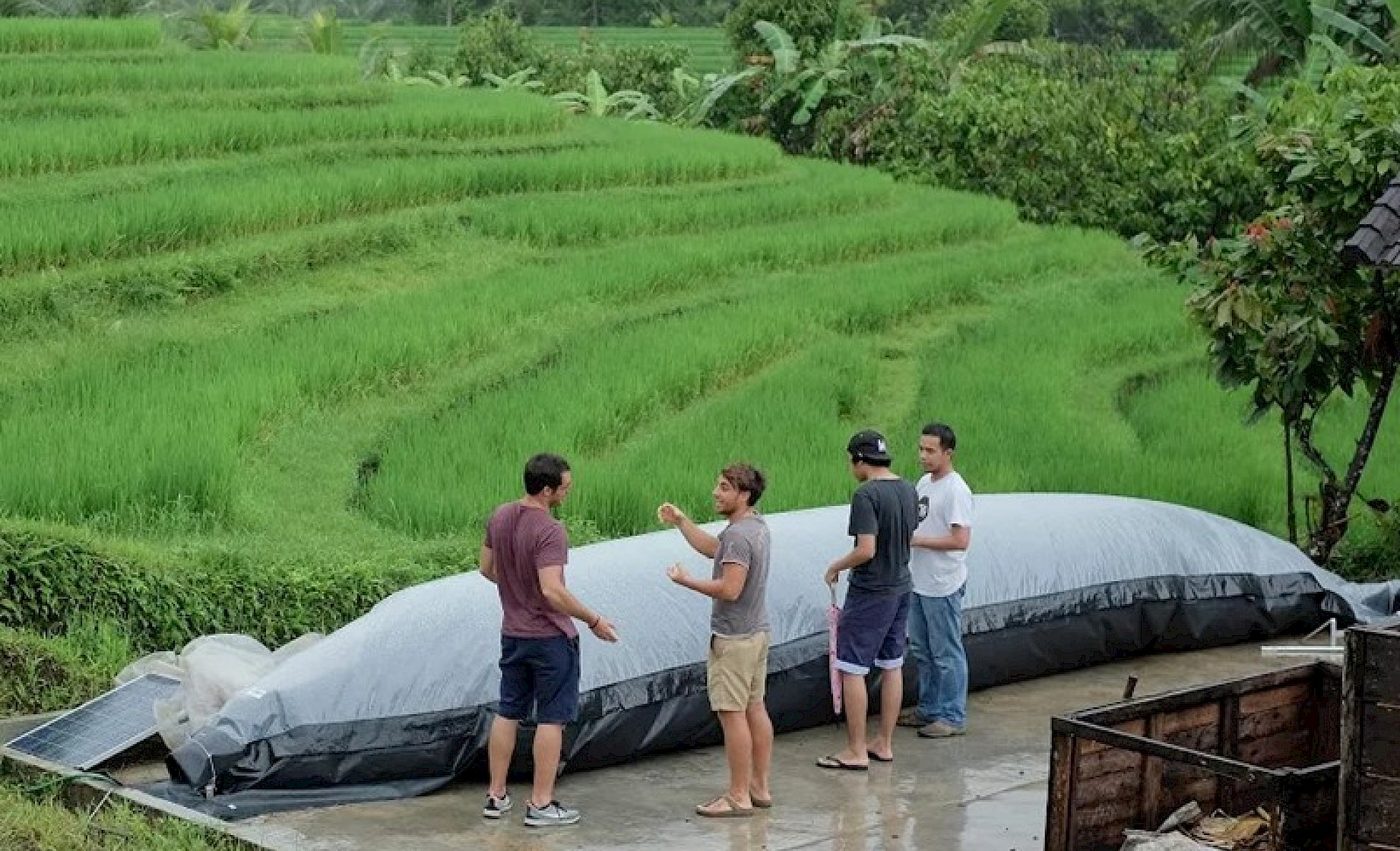
Kopernik is testing a solar 'bubble' dryer to speed up the post-harvest drying process for cacao beans.
Project type
- Test Potential Solutions
- 9. Industry, Innovation & Infrastructure
Partners

The problem
Fermented and dried cacao beans have a higher value compared to raw cacao beans, but most smallholder farmers in Tabanan don't have access to the tools required for this process.
In our previous experiment using a three-tiered fermentation box and a solar dryer with cacao farmers in Tabanan, Bali, we found that the humidity level inside the solar dryer was too high due to the weather conditions and due to the material used for the roofing of the dryer. The plastic sheeting leaked during the rainy season which made the drying environment even worse.
The fermentation technique and solar drying facilities we first experimented with did not actually produce a better dried product compared to traditional methods.
The solution
We are testing a solar bubble dryer to speed up the drying process and tackle the water leakage and humidity problems we faced in the previous experiment. The solar bubble dryer has a transparent polyethylene cover that is resistant to UV rays and water. It also has a blower fan (ventilator) to maintain an optimum humidity level.
In this experiment, we will test the quality and efficiency of the drying process, which is divided into two different methods with equal quantities of fermented cacao beans:
FSD (Floor Solar Dryer) - drying the cacao using traditional open air drying methods;
SBD (Solar Bubble Dryer) - drying the cacao with the solar bubble dryer.
We will collect the following information daily from each drying method and measure the following variables over the course of one drying period (approximately eleven days):
the moisture level of the cacao beans;
the temperature (Celcius);
the appearance of the cacao beans;
the flavour characteristics of the cacao beans; and
the drying period needed to reach optimum moisture level.
At the conclusion of our research, we will analyze the results from each drying method, determining how long it took to achieve the optimal moisture level of cacao beans which is 6-8%.
The expected impact
We are working with a cacao processing unit and its members in Tabanan Bali who we hope will benefit from a higher income from a more efficient drying process for their harvests. This project is one of Kopernik’s experimentation projects, a series of small-scale, low-investment tests of simple ideas with the potential to reduce poverty.
The project results
In Angkah Village, Tabanan Regency, Bali, Kopernik conducted an experiment to learn whether the Solar Bubble Dryer (SBD) can improve the drying process for cacao beans and increase the quality of the finished product. Tabanan Regency is the second largest cacao producer in Bali, after Jembrana Regency. The farmers here often face difficulties in performing the drying process because the current Floor Solar Drying (FSD) method is dependant on the weather and vulnerable to contamination by dust and animals.
Kopernik hypothesized that the Solar Bubble Dryer would help farmers dry their cacao beans faster and increase the quality of the beans, but in fact the data disproved this hypothesis. Our findings were:
- The SBD performed the same as the FSD method, reaching the moisture level of 7% at almost exactly the same time;
- The SBD was also weather dependant and didn’t operate at a faster drying pace because it used a solar panel to power its fan. Heavy rain during the first three days of our experiment meant the solar panel did not store enough energy to keep the fan operating and caused the bubble to deflate;
- The SBD’s drying process was also affected by flooding as the position of the fan outlet was too low. In addition, water was able to get inside the bubble in heavy rain which damaged the produce.
On day five, Kopernik recorded that under sunny conditions and devoid of technical problems, the SBD dried the cacao beans 2.5 times faster than the FSD method. Kopernik believes that the technical problems experienced could be overcome and were influenced by the poor weather conditions typical in areas where the SBD is likely to be used. This has been taken into account as part of the evaluation.
The broader impact
Download the project report above to read more
Show project location
Project cost
| Type | Description | Amount |
|---|---|---|
| Project Implementation & Technology | Costs associated with project coordination and the technology | $4,472 |
| Monitoring & Evaluation | Costs associated with data collection and analysis | $501 |
| Administration Fee | Cost of transferring payments internationally, processing online donations (5%) and a contribution to Kopernik's operational costs (15%) | $995 |
| Total | $5,968 |
01 / 01