

Black Soldier Fly (BSF) larvae as Alternative Feed for Catfish
Increasing price of animal feed
Summary
We tested the effectiveness of using BSF larvae as an alternative feed for catfish compared to conventional pellets in Bali, and analyzed the cost and profit potential for farmers.
Why we rated it this way
BSF larvae were found to be a profitable alternative feed for catfish compared to the conventional pellets commonly used.
The problem
What we found
Catfish (Clarias sp) is a species of fish in high demand for human consumption in the Indonesian market. According to the Ministry of Marine Affairs and Fisheries of Indonesia, catfish production reached 348 thousand tons in 20201, making it the second largest farmed fish in Indonesia after tilapia. This high production requires a large amount of feed. The Feed Conversion Ratio (FCR) of catfish is around 1.8:12, meaning that it takes about 1.8 kg of feed to generate 1 kg of catfish meat. Catfish can consume a wide range of feed, and can be cultivated with relatively low technologies.
Farmers typically use pellets, which usually consist of fishmeal, soybean meal, wheat, and rice. Pellets are widely used in the fish feed industry due to their high protein content. However, Indonesia still has to import its ingredients, resulting in a rising domestic price over the years3. Since 2018, the feed price has increased by 32% and reached $1,581 per metric ton in June 20224, while the fish price has not matched the increasing price of pellets.
The solution
What we tested
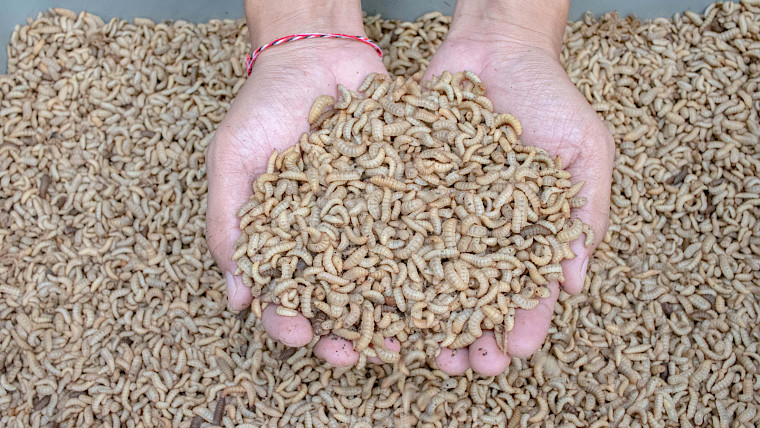
To address the rising cost of animal feed, Kopernik in collaboration with Magi Farm, conducted an experiment to evaluate the effectiveness of using BSF larvae as an alternative feed for catfish compared to conventional pellets. To understand its effectiveness, we measured the weight gain of catfish fed BSF larvae and compared it to the weight gain of catfish fed pellets, and then conducted a profit & loss analysis for catfish farmers.
Project design
How we ran it
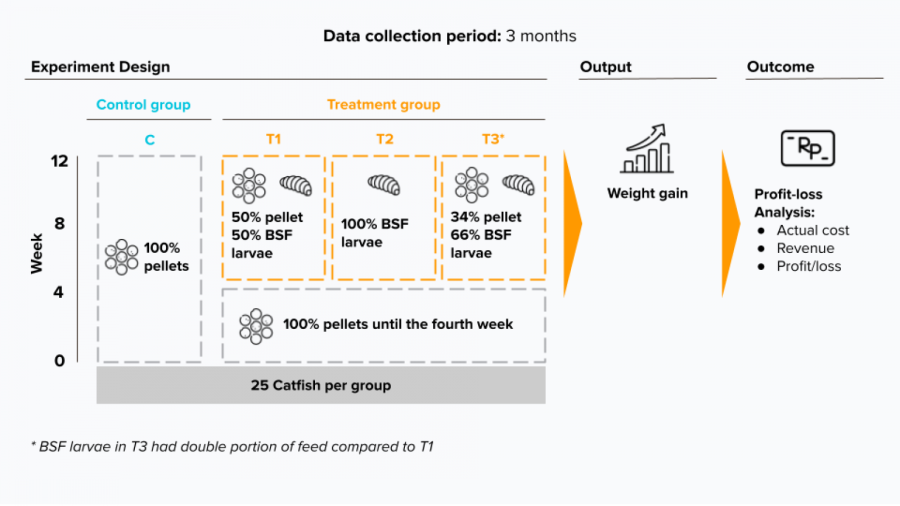
We tested the effectiveness of BSF larvae as alternative feed for catfish by measuring the weight of catfish from four groups with the following feed composition:
- Control group (C): pellets (current feed practice, 100%) - 25 catfish
- Treatment 1 (T1): pellets and BSF larvae, in the same amounts (50%/50%) - 25 catfish
- Treatment 2 (T2): BSF larvae (100%) - 25 catfish
- Treatment 3 (T3): pellets and double the amount of BSF larvae to T1- 25 catfish
Each feed combination was fed to 25 catfish (a total of 100 catfish). We collected data weekly on fish weight as well as the costs incurred for each group. This experiment was conducted between April to June 2022.
Note: We fed the fish with BSF larvae from the fifth week of the experiment when the catfish were large enough to consume the larvae. For the first four weeks, until they reached the required weight the fish in all four groups were fed exclusively with pellets.
The technology
Results
What we learned
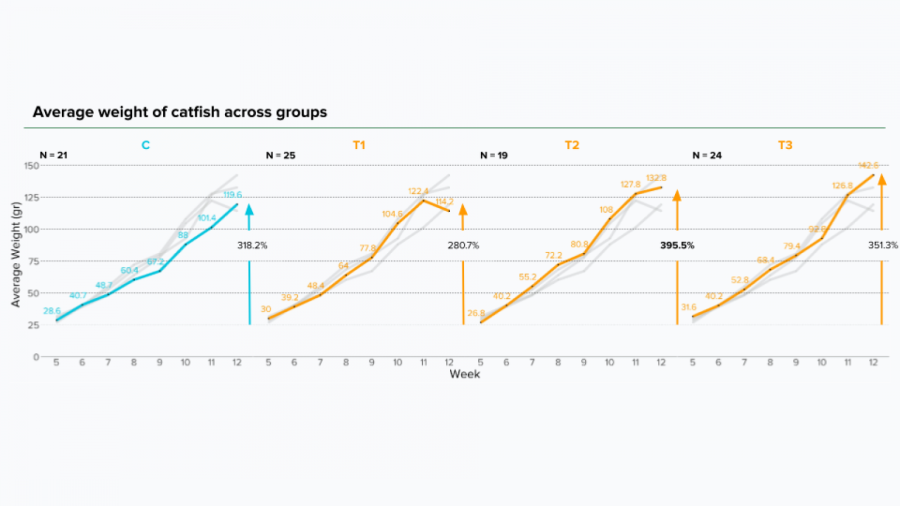
We found that BSF larvae were effective in increasing the weight of catfish. This was indicated by the average weight of fish in the treatment group T2 (i.e. fed only with BSF larvae after the fifth week) during the 7th week of data collection, which increased up to 395.25%, the heaviest among all groups.
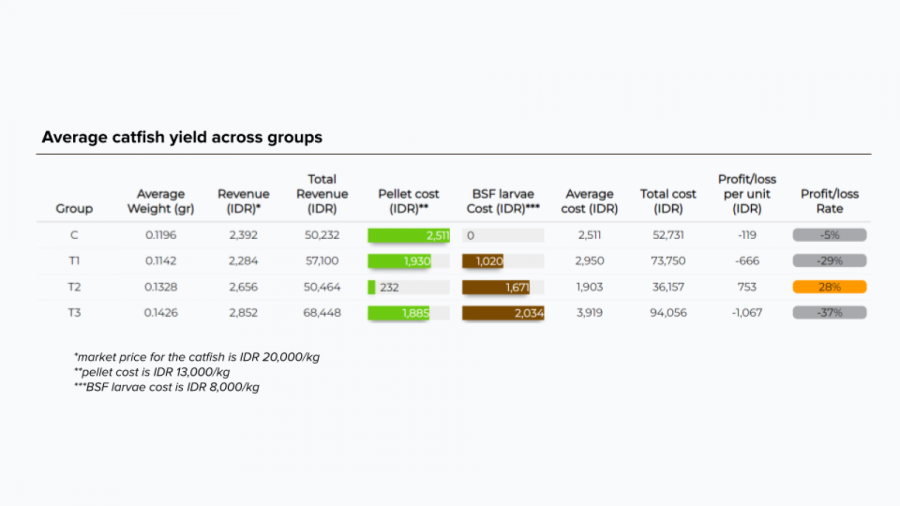
The experiment also showed that feeding catfish with BSF larvae (treatment group T2) can be more economical for farmers, as the average revenue exceeded the average total cost, resulting in a 28% profit ratio. However, the result showed that high revenue does not necessarily result in higher profit, as seen in treatment group T3. Although feeding catfish with a combination of pellets and double the amount of BSF larvae (treatment group T3) obtained the largest revenue (IDR 2,852/fish) amongst the four groups, it resulted in the largest loss of -37% due to the high cost of the combined feed. These calculations take into consideration the uneven count of fish in each group at the end of the experiment (see additional considerations below, regarding the loss of fish during the experiment).
Conclusion
This experiment found that BSF larvae are a viable alternative feed to pellets (current feed for catfish). At the prevailing price during the experiment, BSF larvae as cat fish feed were found to be more economical compared to pellets, resulting in a 28.35% increase in profit for farmers.