

Evaporative Desalination System
Limited access to drinking water, despite abundant saline water nearby
Summary
We tested the effectiveness of a solar water desalination technology to fulfill the daily needs of drinking water for families in Likotuden village, Flores.
Why we rated it this way
The solar water desalination technology was able to generate fresh water to fulfill the daily average drinking water needs of families in Likotuden village.
The problem
What we found
Access to fresh water continues to be a problem for a significant number of families in Indonesia where approximately 32.3 million of the population lacks access to clean and safe water sources. As one of the poorest and driest parts of the country, East Nusa Tenggara suffers from water shortages, where around 30 percent of the population has no access to clean drinking water. Families in Likotuden village, Flores, have limited access to drinking water to fulfill their daily needs (10 litres per family per day on average). The nearest water sources are seawater and brackish groundwater, which they often consume for daily use.
Innovative technologies such as water desalination units are needed to provide clean drinking water to the people living in remote islands such as the communities in Likotuden village.

The solution
What we tested
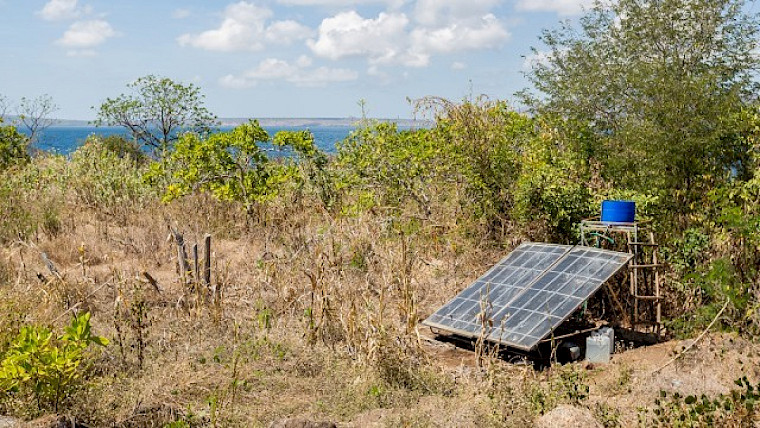
Kopernik tested the Carocell 3000 Water Purifier, a solar-powered water desalination technology, as a means of producing clean drinking water from seawater, groundwater, or contaminated and polluted water. We tested the effectiveness of the desalination technology in producing potable water to meet the basic water needs of people in Likotuden village by measuring the volume of water produced per day.
Project design
How we ran it
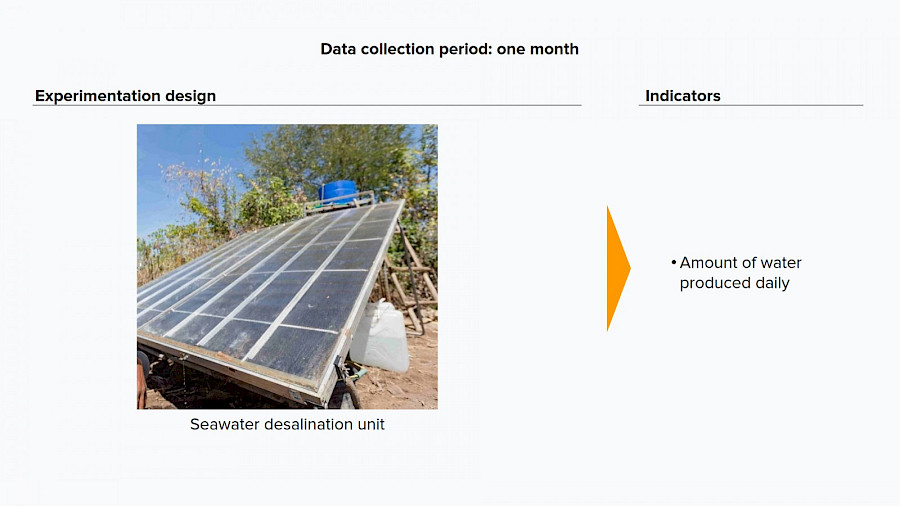
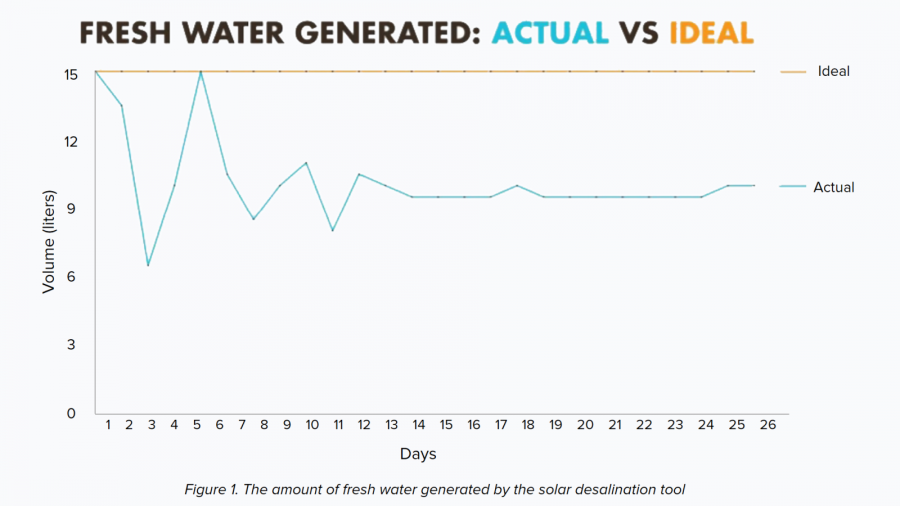
We tested the performance of the desalination unit by measuring the amount of water produced per day over a 26-day period in November 2017.
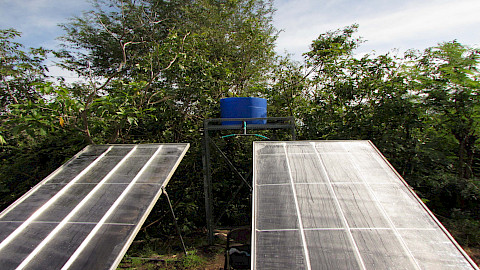
As the desalination process is strongly influenced by exposure to sunlight, we positioned the unit to get direct sunlight without any shade from surrounding buildings or trees.
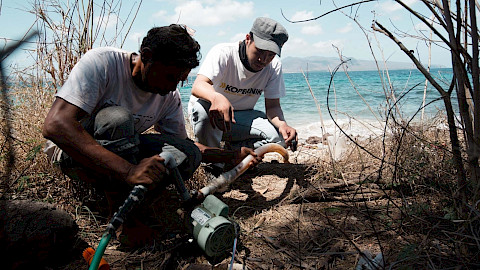
The setup also required a pump to push the seawater into the water tank through a piping system, which was then fed into the desalinator using gravity pressure.
The technology
Results
What we learned
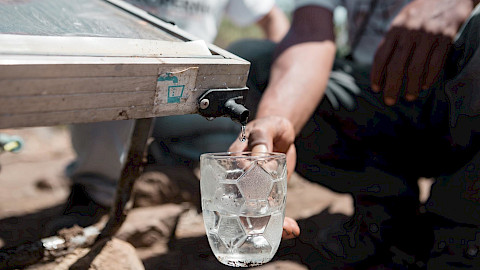
We found that the solar desalination units could, on average produce 10 liters of fresh water from 30 liters of seawater per day. The amount produced is sufficient to meet the daily drinking needs of one family.
Conclusion
The result of the experiment showed that the evaporative desalination technology was able to generate on average 10 liters of fresh water per day which fulfills the daily average drinking water needs of one family in Likotuden village.
Additional considerations
In terms of the product operational requirements, the desalination unit needs to be operated under certain conditions as outlined below, which means that there is a level of complexity in installing and operating the technology.
As the location of the desalinator was 130 meters away from the sea (the nearest water source), there was a need to install an electric pump and 130 metres of pipe, which required significant technical knowledge and financial resources.
The desalinator required a water tank to collect seawater (through the pump and pipe system) to feed water into it. The water pump’s hose had to be submerged in seawater at all times to enable sustained water supply even during low tide. In this experiment, however, the pipe and pump were placed in such a way that water could only be collected during high tide.
The desalination technology requires an upfront investment of US$250.00, excluding the water pump and pipes that cost approximately US$50.00. This is a significant financial investment for a household that typically lives on US$4.47 a day (91 cents per person/day) as is the case in Likotuden village.
Taking into consideration the upfront investment costs of the product and its shipping cost (not including water pump, pipes and tank), the cost of water per litre from this technology is US$0.048 (assuming a product life cycle of 3 years), which is significantly cheaper than locally available gallon water (US$0.425 per litre), but more expensive than water sold via water delivery truck (US$0.015 per litre) in the area.
Read more
Project profile
Reports and references
Rachman, Abdul. (2016). Turning Saltwater Into Freshwater: Solar Desalination Project Report