

Incentive and Sanction System to Promote Waste Sorting Behavior
Low levels of awareness and waste-sorting behavior at the household level
Summary
Kopernik tested an incentive and sanction system to promote household waste sorting behavior in Banjar Penestanan Kelod, Ubud, Bali.
Why we rated it this way
Implementing an incentive and sanction system marginally increased household waste sorting behavior
The problem
What we found
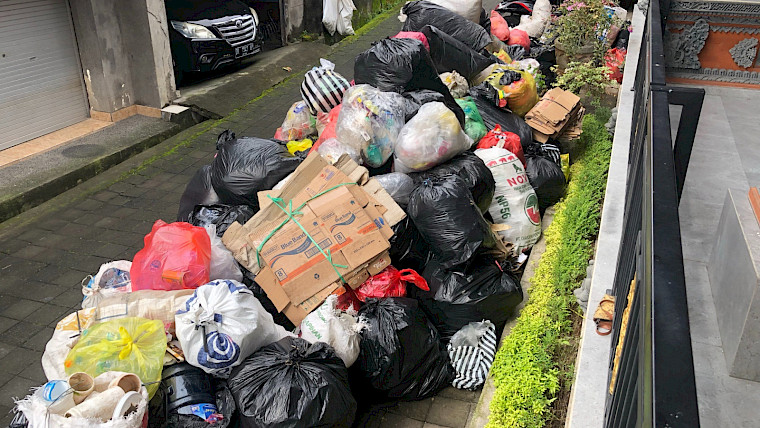
The waste management system in Indonesia is only capable of managing 49% of its waste (KLHK, 2021). The rest ends up in the environment or in landfills, many of which have reached maximum capacity, including the landfill in Suwung, Bali (Ana & Bagus, 2021).
One of the most effective methods to reduce the volume of waste that goes to landfill is to sort waste and separate the organic and recyclable waste at its source. Sorting waste at the source requires the participation of individuals at the household level (Wang & Zhang, 2022). However, the level of waste sorting in Indonesia is low due to a lack of awareness about its importance as well as on correct sorting methods, and the lack of availability of waste management infrastructure (Somma, 2020). Therefore, in order to encourage more individuals to engage in the sorting of their waste at the household level requires increasing awareness and creating an effective system to support waste sorting behavior.
Banjar Penestanan Kelod in Ubud District, Gianyar is a village that is committed to reducing the amount of waste that goes to landfill. The village has established a waste bank for its recyclable waste, but participation in the waste bank system by village residents remains low and household level sorting of waste is not taking place.
The solution
What we tested
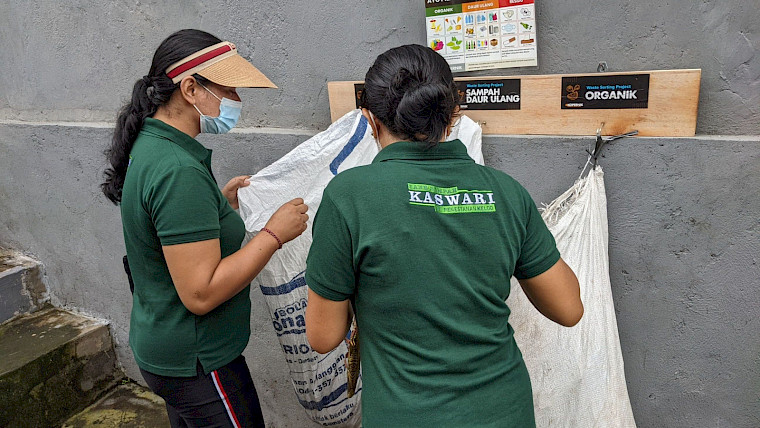
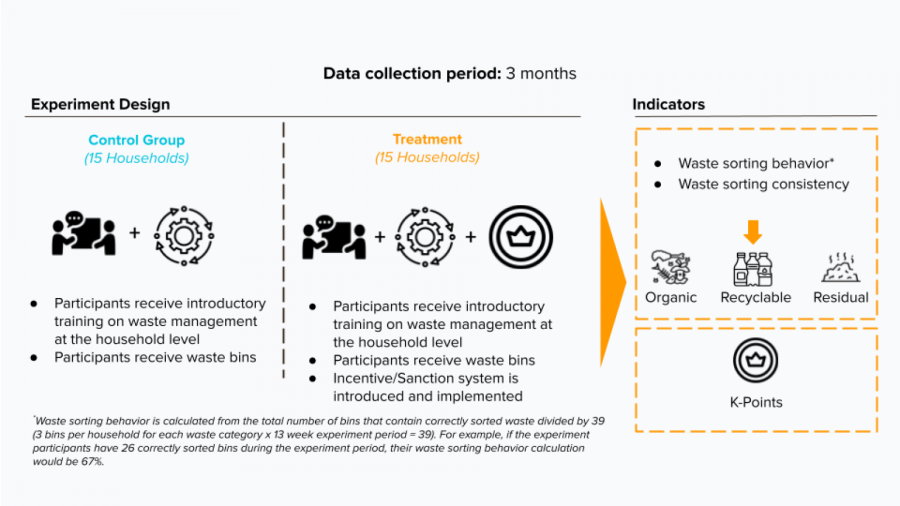
Kopernik tested the effectiveness of an incentive and sanction system in Banjar Penestanan Kelod to change individual behavior and increase the level of waste sorting at the household level. During the implementation of the incentive and sanction system, we compared the level of waste sorting between two groups of households, those in a treatment group (where the incentive and sanction system was implemented), and those in a control group (where the system was not implemented), by monitoring their sorting practices of organic, recyclable, and residual waste.
Project design
How we ran it
The design of this experiment was inspired by the Nudge Theory and Prospect Theory.
The Nudge Theory is a behavioral concept that centers around the idea that shaping the environment can influence the behavior of people. In the context of this experiment, to encourage change, nudges, such as an incentive and sanction system, could increase waste sorting behavior. One example of a village that has successfully used nudges through an incentive and sanction system is Taro Village in Tegallalang District, Gianyar. A recent Village-level regulation (perarem) in Taro village states that if households do not sort their waste, they will be fined 10kg of rice and their waste will not be collected by the village waste collection system. This regulation has been effective in increasing the levels of waste separation, and improving overall waste management in, and cleanliness of, the village and as a result Taro Village is considered to be a role model for waste sorting practices in Bali (Budiarta, 2021).
Nudge theory was popularized by Richard Thaler and Cass Sunstein through their book titled “Nudge: Improving Decisions About Health, Wealth, and Happiness”. Nudge theory aims to change people’s behavior without having to restrict their choices. An important feature of nudge theory is that the intervention to change the behavior should be easy and cheap to avoid by people - thus not putting any economic constraint on them (Thaler & Sunstein, 2009). On the other hand, Prospect Theory was developed by Daniel Kahneman and Amos Tversky in 1979 (Kahneman & Tversky, 1979) to explain why people tend to avoid losing something. Prospect theory states that humans, in general, tend to experience greater pain from losing an amount (of money) as compared to the pleasure experienced from gaining the very same amount. Meaning, that the pain experienced by losing IDR 10,000 is greater than the pleasure of gaining IDR 10,000.
Inspired by these two theories, we designed and introduced a point system (K-points) to implement an incentive and sanction system for this experiment. Participants could gain K-Points (by sorting their waste) or lose K-Points (by not sorting). We expected that participants would want to avoid losing their K-points, which would result in increased levels of waste sorting.
The experiment was conducted between November 2021 and January 2022, over a period of 13 weeks. Two groups participated in this experiment with 30 participants in total. The participants were not randomly chosen - they were selected by the head of the Family Welfare Program (PKK) in the village, who selected 30 households and divided them into 2 groups of 15.
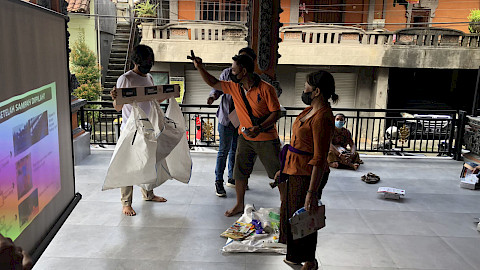
Prior to this experiment, the households did not have any waste sorting facilities, nor had they participated in any waste sorting training. The experiment was set up as follows:
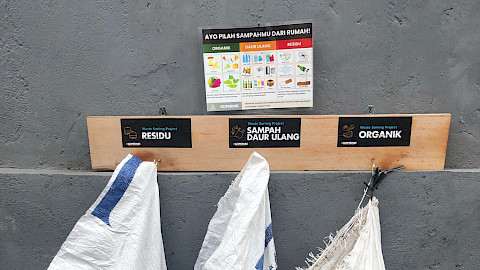
- Control group (Group A, 15 households): Participants received introductory training on waste sorting, and were provided with three waste bins for each waste type (organic, recyclable, residual). No incentive/sanction system was introduced.
- Treatment group (Group B, 15 households): Participants received the same introductory training on waste sorting as the control group (this training was conducted separately to prevent any spillover effect), the same three waste bins, and were introduced to the incentive/sanction system.
During the training, we distributed a poster explaining different waste categories (organic, recyclable, and residual) to both the control and treatment groups. The experiment started right after the training was completed. After the experiment concluded, we measured and compared the sorting rate of three types of waste (organic, recyclable, and residual) by households in the control and treatment group that would then lead to retaining or losing their K-points.
Incentive and sanction system: K-points
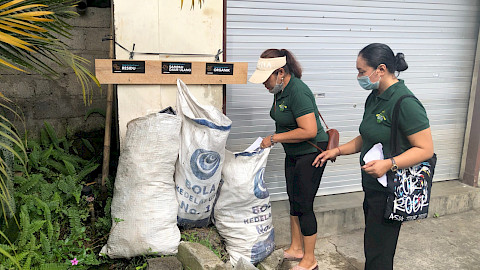
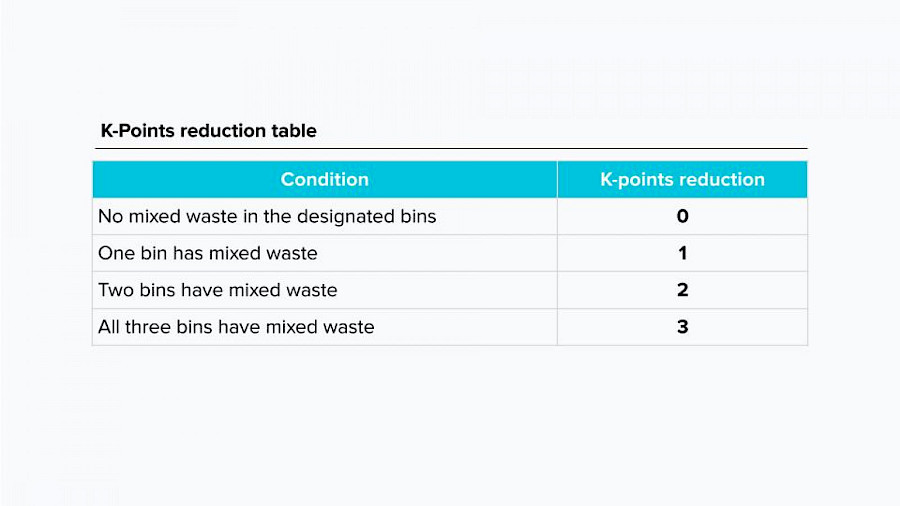
We created the K-Point system as a method to measure the waste sorting behavior of the participants. At the beginning of the experiment, each household in the treatment group received 40 K-points. The points each household retained by the end of the experiment could be redeemed for groceries at the end of the experiment (the higher the number of points, the more groceries can be redeemed). Each week, waste bank staff visited the households to monitor the sorted waste and update their K-point balance. K-points were reduced if the participants mixed the waste and did not sort it correctly.
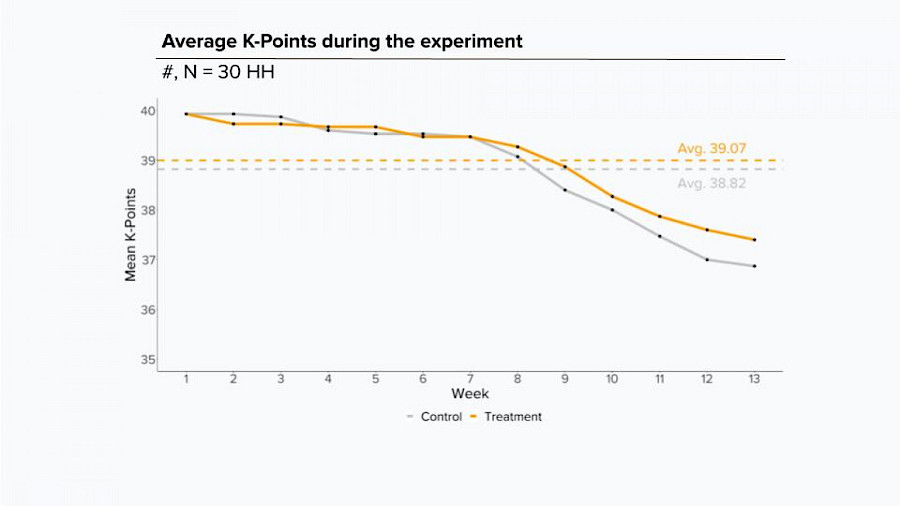
While the control group did not use the K-point system, we also measured using hypothetical K-points for the control group for comparison purposes. The points were assigned can be seen in the result graphs.
Partners involved in the experiment
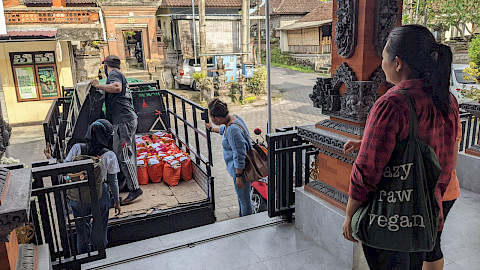
We engaged and partnered with various groups in the village and the neighboring area; Rumah Kompos Padangtegal processed the organic waste collected. The local waste bank staff monitored the sorted waste at each household, and collected the recyclables. The residual waste was transported to landfill.
The technology
Results
What we learned
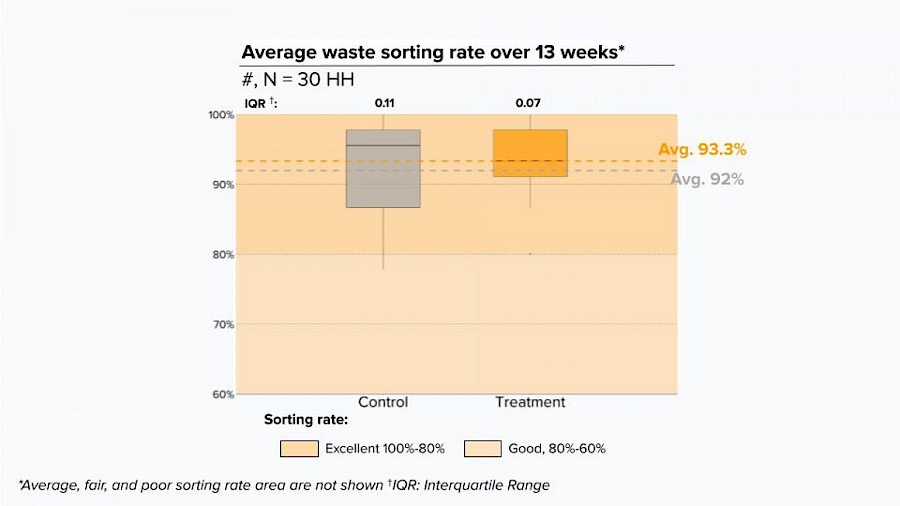
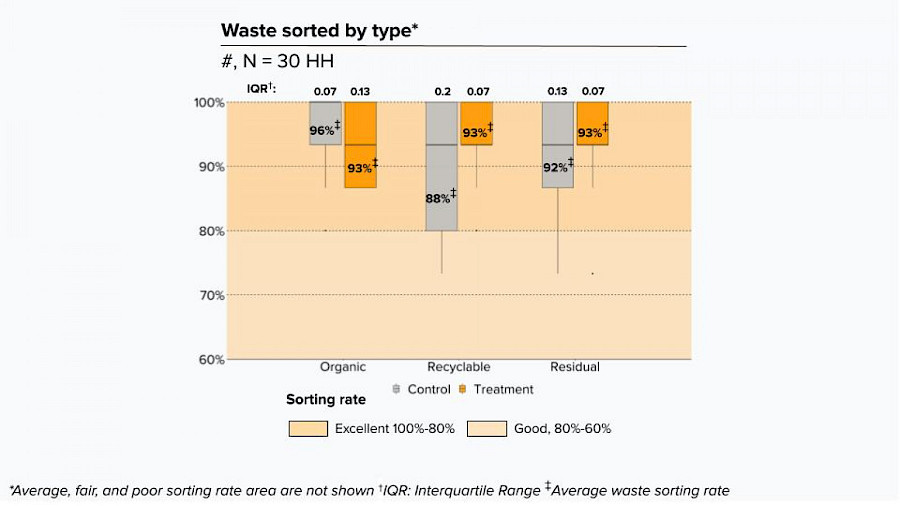
The treatment group had a slightly higher average sorting rate (93.3%) compared to the control group (92%), and the treatment group sorted waste more consistently (IQR value 0.07)* compared to the control group (IQR value 0.11). Statistically, this is not a significant result with a p-value of 0.6.
When we compared the sorted waste based on the waste categories, the treatment group performed more consistently in sorting residual and recyclable waste (IQR value 0.07 vs 0.2 for recyclable waste, and 0.07 vs 0.13 for residual waste ). On the other hand, the control group performed better in sorting organic waste (IQR value 0.07 vs 0.13 for the treatment group). The average of waste sorting behavior in all waste categories across groups was very high (88% - 96%).
In terms of K-points, the treatment group had slightly higher average K-points at the end of the experiment (39.07) compared to the control group (38.32). This result shows that both the control and treatment groups performed well in terms of waste sorting behavior during the experiment. Between the eighth and the eleventh week, there was a sharp decrease in waste sorting performance across both groups. This was likely caused by a series of religious ceremonies that increased the volume of waste in general, which resulted in more sorting errors. It is notable that the treatment group performed slightly better in waste sorting behavior during this period.
*The waste sorting consistency can be seen in the Interquartile range (IQR). The higher the IQR, the higher the variance in behavior, meaning less consistency.
Conclusion
The implementation of an incentive and sanction system did not result in a significant difference in waste sorting behavior at the household level between the treatment and control groups. Although the treatment group performed slightly better and sorted their waste more consistently, the difference between each group was very small. Therefore the impact of the incentive/sanction system was not significant and both the control and treatment groups sorted their waste effectively.
However, even without an incentive and sanction system, introducing simple waste management infrastructure (training, bins and posters) was sufficient to encourage people to sort their waste at the household level. This suggests that people are willing to sort their waste without any incentives as long as basic infrastructure is provided.