

Plastic Bottle Drip Irrigation System
Crop failure during the dry season
Summary
We tested whether the plastic bottle drip irrigation system can help farmers in Flores to grow crops during the usually barren dry season.
Why we rated it this way
The experiment found that the plastic bottle irrigation system enabled farmers to grow peanuts in the dry season using less water but resulted in a slightly lower yield than the normal watering method.
The problem
What we found
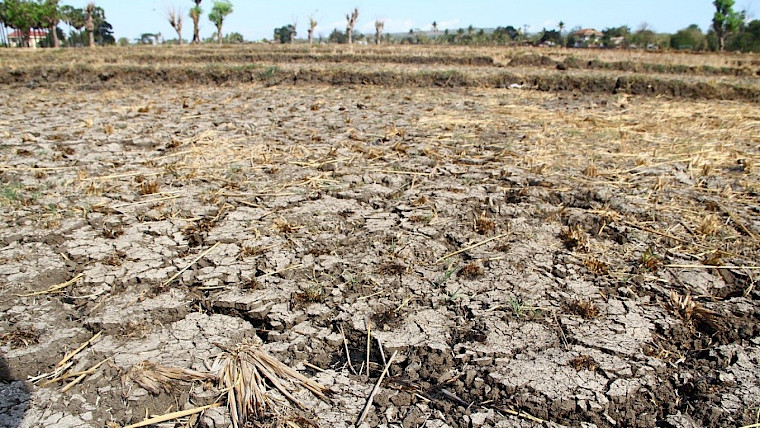
Farmers in Flores, East Nusa Tenggara generally cannot grow crops during the dry season due to a lack of rainfall and access to irrigation systems. As a result, around 1.5 million people in East Nusa Tenggara struggle with food insecurity because much of the agricultural land is idle during the dry season. An irrigation solution is needed so that crops can continue to be cultivated during the dry season, in order to improve the food security of people in East Nusa Tenggara.
The solution
What we tested
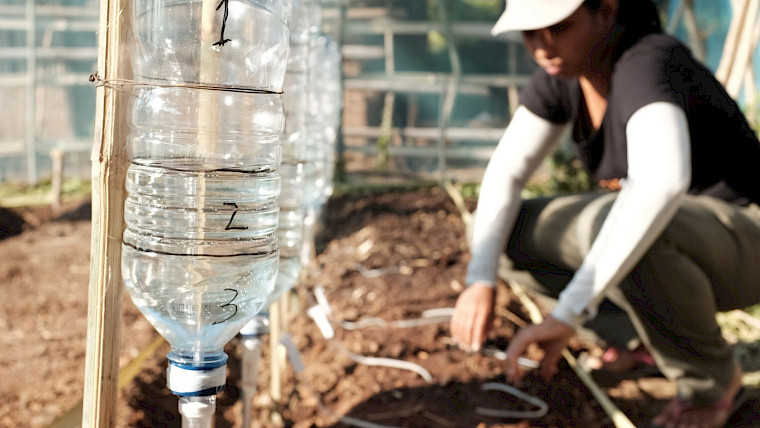
Studies have been conducted on the use of advanced drip irrigation technology for agriculture in arid and semi-arid regions in countries such as Morocco and India. Findings have shown that these systems are quite complex, requiring continuous technical support and significant capital investment - posing a major challenge for farmers with low incomes in remote locations. To address these challenges, Kopernik tested a different approach using a simple irrigation system made from used plastic bottles - a “do-it-yourself” or “DIY” system that is more affordable and accessible. This system is based on the same principles of drip irrigation, allowing water to drip slowly onto the roots of plants, minimizing evaporation and reducing the amount of water needed for irrigation.
Project design
How we ran it
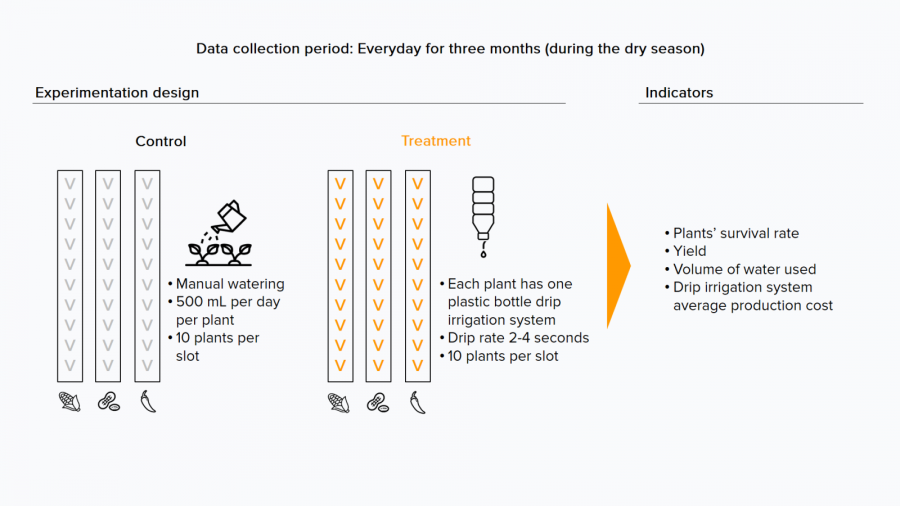
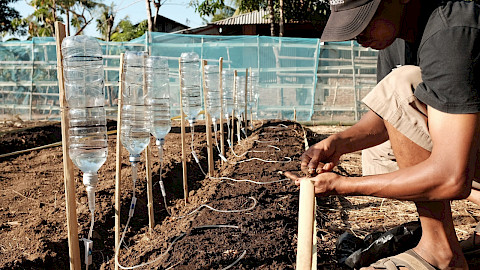
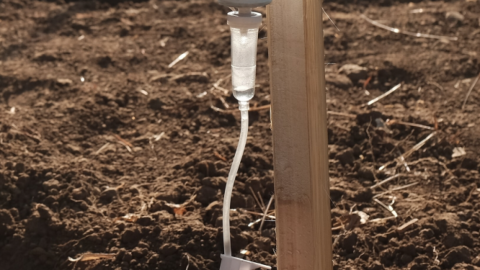
We built and tested 30 drip irrigation units using 1.5 liters plastic bottles, connected to a hose and flow regulators that were repurposed from an intravenous (IV) set. One plot consisted of ten plastic bottle units watering one plant each (treatment group) with a capacity of 1.5 liters per bottle. For the control group, ten plants were manually watered with 500ml of water per plant each day using a watering can.
Three different crops were selected for each plot. These crops were selected for the following reasons:
1. Corn, because it is a familiar crop for farmers, which they typically grow and eat;
2. Sorghum, because it is suited to rocky, sandy soil conditions. (However, this was later replaced by chilis as the sorghum seeds did not germinate); and
3. Peanuts, because they are considered to be a drought-resistant crop.
The drip rate for the plastic bottle drip irrigation system was set at two to four seconds (a drop of water comes out every 2-4 seconds).
During a three-month period during the dry season (July-October 2018) in Maumere, East Nusa Tenggara, we recorded the following data:
- The survival rate of the plants;
- Their yield; and
- The volume of water used for irrigation.
The technology
Results
What we learned
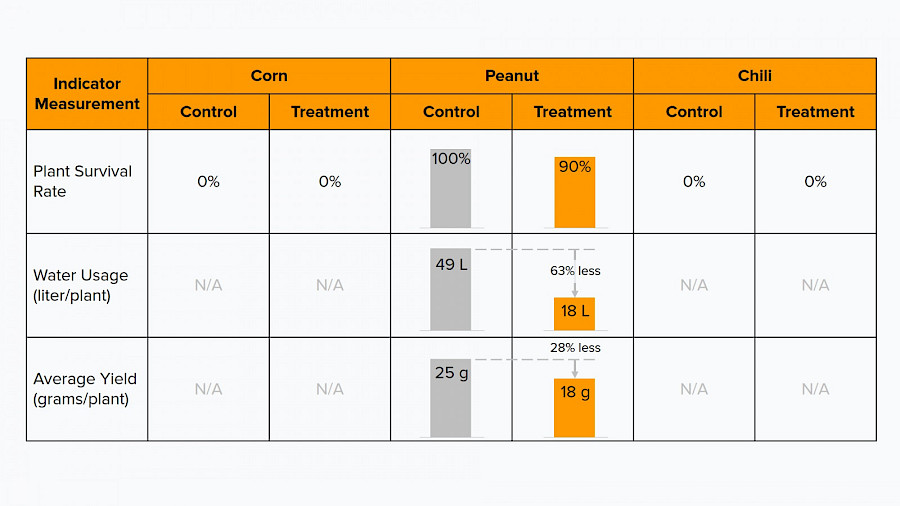
We found that the plastic bottle drip irrigation system enabled farmers to grow some crops throughout the dry season, during which they don’t normally grow anything. Of the three crops (corn, peanuts and chili), peanuts grew with a survival rate of 100% for the control group and 90% for the treatment group. The yield of the peanuts in the treatment group was 28% lower than that of the control group (18g versus 25g per plant respectively), however this was achieved using 63% less water than the control group. The corn and chili crops did not survive for both the control and treatment groups, most likely due to insufficient amounts of water from the drip irrigation system.
Conclusion
The experiment showed that the plastic bottle irrigation system enabled farmers in Maumere to grow peanuts in the dry season using 63% less water but resulting in 28% less yield as compared to the control group which was watered manually. The plastic bottle irrigation system was not successful in growing corn or chili. Given the relatively high cost of investment to purchase the components needed for the system and lower yield rates as compared to the control group using manual watering, we conclude that this is not a viable solution for farmers.
Additional considerations
We estimated the cost of growing peanuts using the plastic bottle drip irrigation system by calculating the cost of the technology and water. Growing peanuts using the plastic bottle method resulted in a cost of IDR260,000 (US$18.24) per kilogram, which is 21 times more expensive than buying the same amount of peanuts from the market in Maumere (the price of peanuts (with skin) per kilogram is IDR12,000 (US$0.84).
Read more
Reports and references
Ningrum, Nanis S. and Riesa Putri. (2019). Improving Irrigation System: Plastic Bottle Drip Irrigation Project Report.