

Rubber Tapping Rain Guards
Loss of rubber harvest in the rainy season
Summary
We tested the performance of rain guards for rubber trees to protect latex collected during the rainy season in Sanggau, West Kalimantan.
Why we rated it this way
Two designs of rain guards were found to be effective in reducing latex yield losses of rubber harvesting during the rainy season.
The problem
What we found
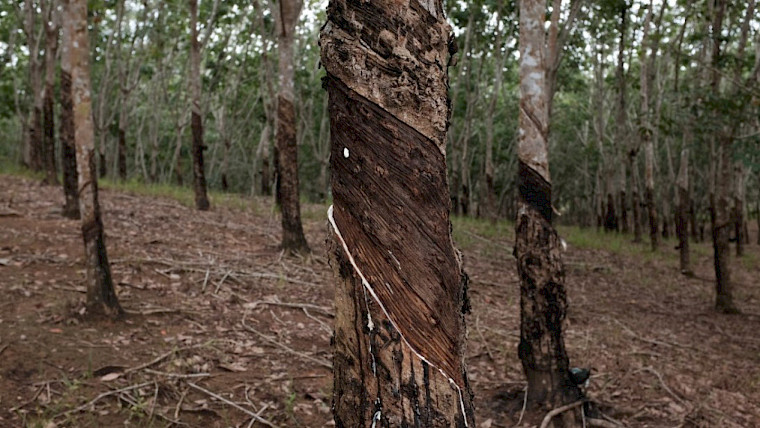
Indonesia produced 3.3 million tons of rubber in 2019, making it the second largest rubber producer in the world. 83 percent of total rubber production in Indonesia is from smallholder farmers. In 2018, as part of the Unmet Needs Research conducted by Kopernik in Sanggau, West Kalimantan we identified that weather had a major impact on the harvest yields of rubber. The farmers find it especially difficult to harvest during the rainy season due to heavy rainfalls, which spoils or washes away the collected latex. Therefore, a simple and easy-to-use solution is needed to protect the rubber harvest during the rainy season.
The solution
What we tested
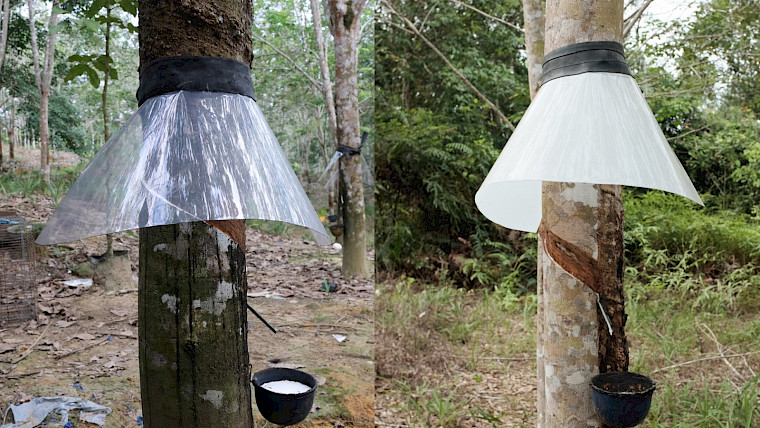
Kopernik developed two rain guard prototypes for rubber trees to protect the latex collected during the rainy season by diverting rainwater from the latex collection container so that it would not get inside. Similar rain guards have been developed in other rubber producing countries such as Thailand, India and Malaysia, and we learned from these initiatives to develop our own prototypes. To understand the efficacy of the rain guards, we measured the amount of latex collected during the rainy season using the rain guards, and compared this to the amount of latex collected using the current practice (no rain guards).
Project design
How we ran it
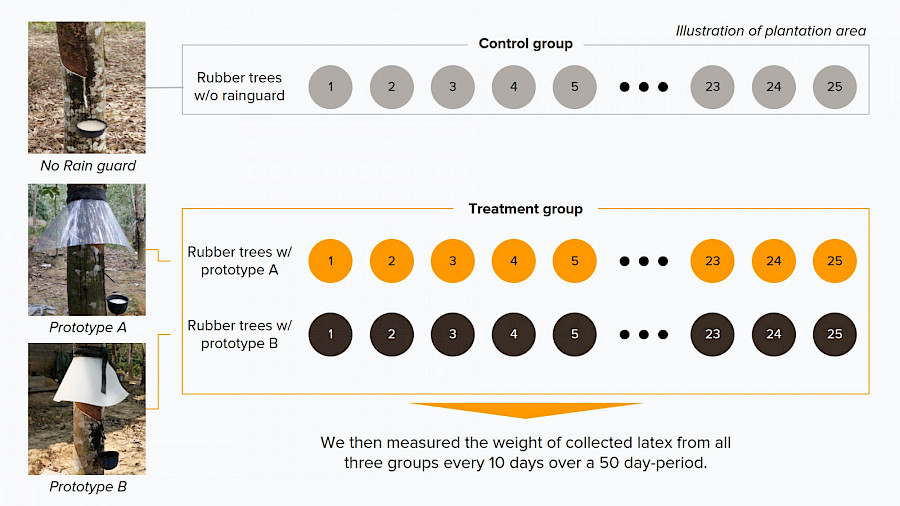
For this experiment, we partnered with a smallholder rubber farmer in Sanggau. We developed two prototypes using locally available materials, PVC (as the hood) and used an inner tire tube (as the fastener), to be tested during the rainy season from October 2019 to January 2020. Data on the amount of latex collected was captured every 10 days over a 50 day-period. We used two types of PVC, one transparent and one white-colored PVC, with different prices and minimum order quantity requirements.
We tested the performance of the rain guard prototypes by measuring the weight of collected latex from three groups (there were 25 rubber trees in each group):
- Control group: Rubber trees without rain guard
- Treatment group A: Rubber trees with prototype A (transparent PVC)
- Treatment group B: Rubber trees with prototype B (white-colored PVC)
The latex was collected into small cups attached to individual trees. Every 10 days the latex from the small cups from each group is poured into buckets. We then weighed each bucket to obtain the weight of latex collected in each group.
The technology
Results
What we learned
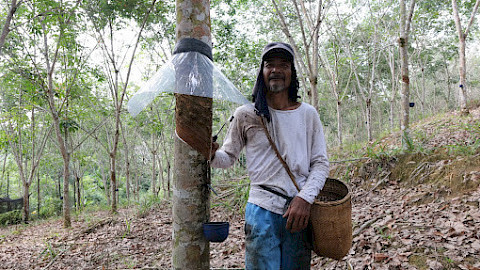
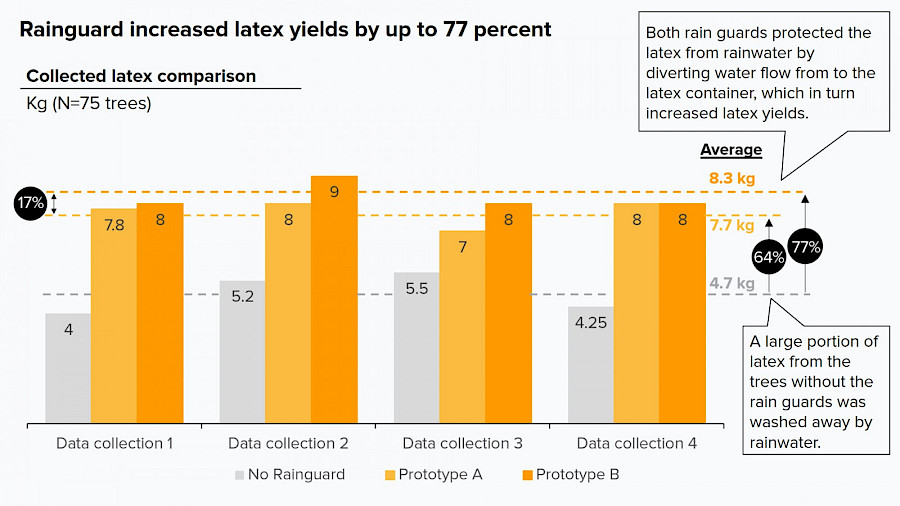
The rain guards were effective in protecting the latex yields. On average, the latex yield from the control group was 4.7 kg, while treatment group A and B resulted in a yield of 7.7 kg (64 percent higher than the control group) and 8.3 kg (77 percent higher than the control group) of latex, respectively.
Conclusion
The experiment showed that rain guards for rubber trees are effective in protecting latex yields during the rainy season, increasing latex yields by up to 77 percent as compared to when no rain guards were used. Based on the results of this experiment, Kopernik is planning to conduct a larger scale pilot.
Read more
Reports and references
Putri, Riesa and Mochamad Ergianto. (2020). Protecting Harvest: Rubber Tapping Rainguards.