

Salt Cooling Coating (2)
Urban poor and elderly endure increasing indoor heat amplified by heat islands
Summary
We tested the effectiveness of Salt Cooling Coating (SCC) as a passive cooling solution to enhance heat resilience in homes, particularly for the urban poor and elderly.
Why we rated it this way
Ineffective because the SCC 10% was unable to reduce indoor temperatures when compared to both the control (no intervention) and the commercial coating.
The problem
What we found
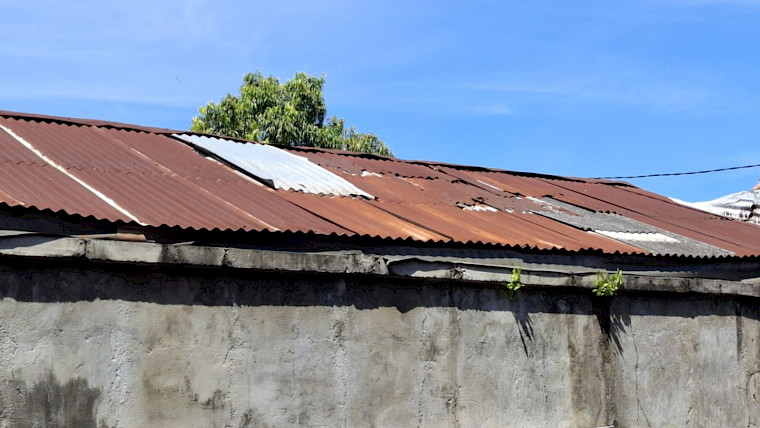
The World Meteorological Organization (WMO) has confirmed that 2024 was the warmest year on record, based on a synthesis of six international datasets. Record-high land and sea temperatures have major consequences for both people and ecosystems. In tropical countries such as Indonesia, higher temperatures combined with persistently high humidity increase heat stress, while urban heat-island effects can further intensify exposure in densely populated, low-income neighbourhoods. According to the World Health Organization (WHO), these conditions elevate health risks including heat exhaustion, heatstroke, and dehydration, especially for the urban poor and older adults.
Based on Varquez et.al research in 2020, in Jakarta, heat-related deaths among the elderly are projected to rise by 12 to 15 times between the 2010s and the 2050s. Through the Unmet Needs Report for the Elderly Populations (2024), Kopernik also observed that many elderly people struggle to cope with rudimentary and taxing home environments. Creating cool zones at home can strengthen heat resilience, but improving ventilation is often technically difficult.
Several studies have proven that another approach, reflective coatings, can reduce indoor temperatures by 5–8°C on metal sheet roofs in good condition. However, these commercial options remain expensive and beyond the affordability of vulnerable populations such as the urban poor and the elderly. The cost exceeds IDR 3 million for a standard application (20 kg of primer and 20 kg of topcoat).
The solution
What we tested
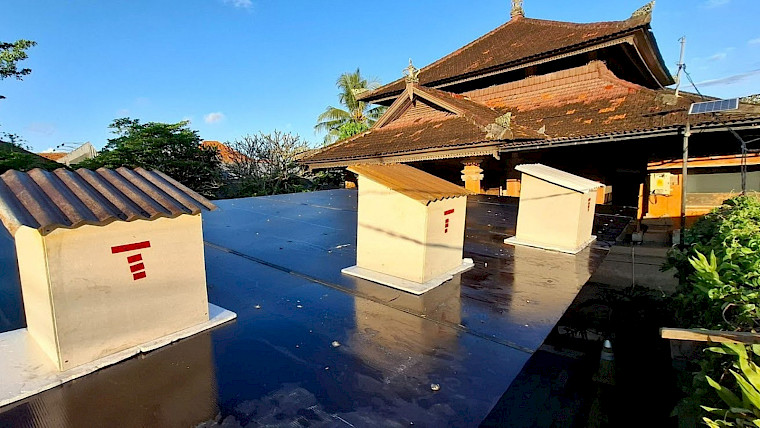
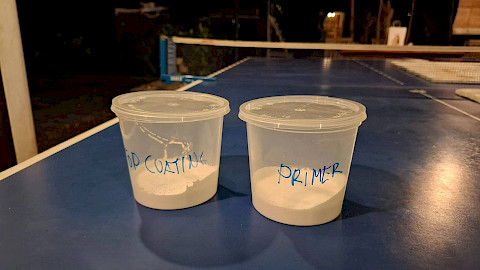
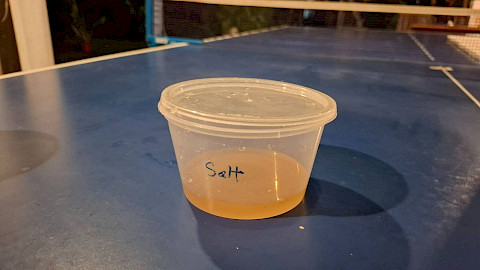
Based on the initial experiment, despite minimal observed differences and a subsequent cost-benefit analysis, the Salt Cooling Coating (SCC) mixture with the lowest KCl concentration (10%) was selected for this phase. SCC 10% is a low-cost passive cooling concept that utilizes salt-based coatings to increase solar reflectance when the surface is dry and salt-rich. This solution was expected to serve as an alternative to commercial solar-reflective coatings.
Project design
How we ran it
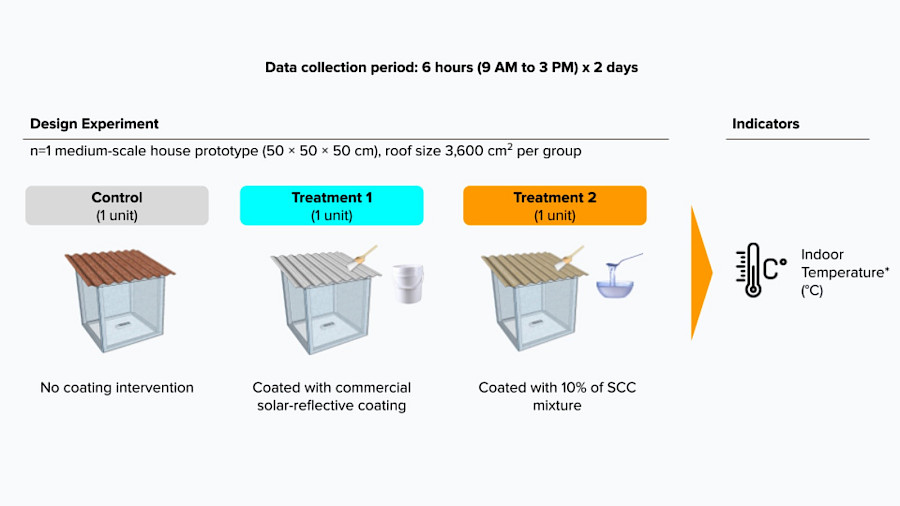
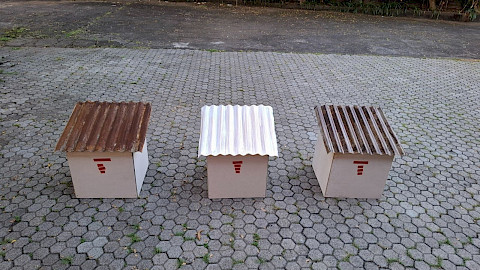
To further assess its potential as a passive cooling solution for enhancing residential heat resilience, in this phase of experiment we utilized one control group and two treatment groups:
- Control Group: No coating
- Treatment 1: Commercial solar-reflective coating
- Treatment 2: SCC 10%
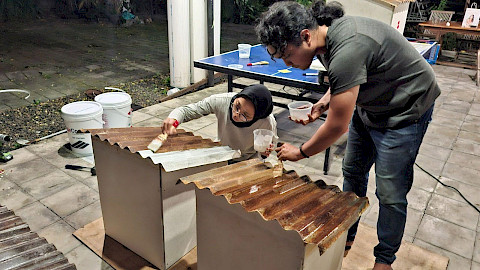
For Treatment 1 (Commercial Coating), the coating was applied as two layers of primer followed by two layers of topcoat. For Treatment 2, two layers of SCC 10% were applied directly to the roof (area: 3,600 cm²) of the medium-scale house prototypes (50 x 50 x 50 cm). These prototypes were constructed with concrete walls, steel frames, and metal-sheet roofs. To better represent the aged roofing conditions typical of low-income housing, the roofs were pre-rusted to reduce their initial reflectivity. Furthermore, ventilation openings were omitted to isolate the thermal impact of the coatings by minimizing the cooling effects of wind and internal airflow.
Monitoring was conducted for 6 hours per day (09:00–15:00) over a two-day period from April 29 to 30, 2025. The primary indicator was indoor temperature (°C), which was evaluated against the defined thermal comfort range of 23.1°C to 29.6°C.
To ensure data accuracy, two temperature and humidity sensors were placed inside each prototype. Before deployment, these sensors were co-located for 30 minutes to calibrate baseline readings and ensure reliability. Both sensor-to-building assignment and physical building placement were randomized to minimize bias and improve interpretability. Additionally, an external sensor was utilized to monitor ambient conditions. The hypothesis is that Treatment 2 will achieve a greater reduction in indoor temperature compared to both the control and Treatment 1.
The technology
Results
What we learned
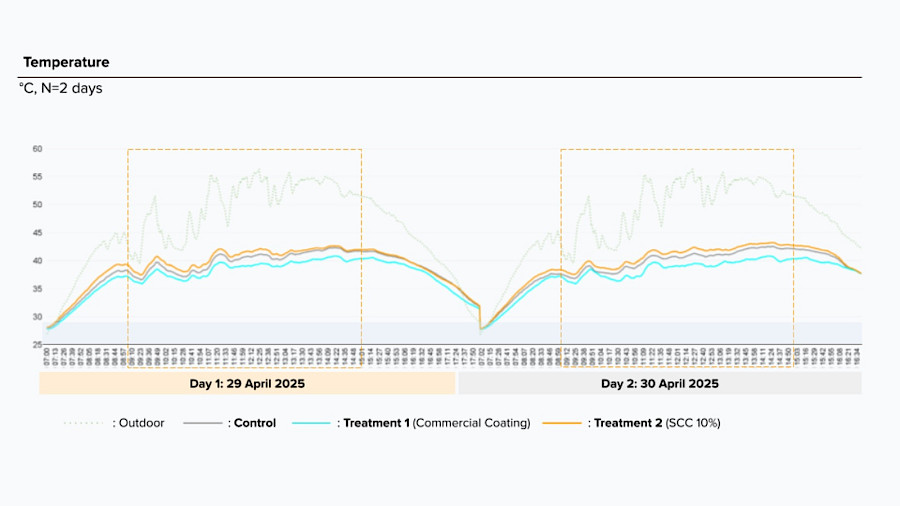
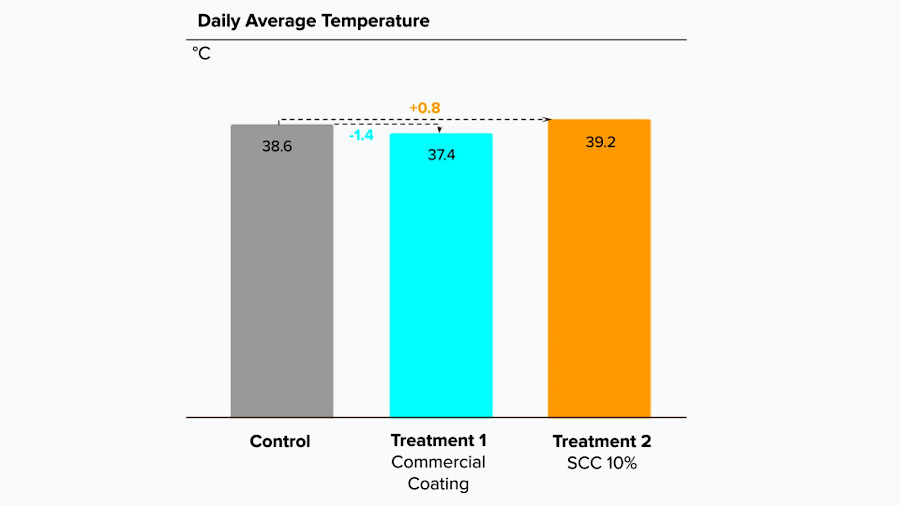
Both Day 1 and Day 2 demonstrated a similar pattern, where Treatment 2 (SCC 10%) consistently showed the highest indoor temperature. This was followed by the Control group in the middle, while Treatment 1 (Commercial Coating) indicated the lowest indoor temperature compared to all other groups. The daily average temperature showed that Treatment 1 recorded the lowest indoor temperature at 37.4°C, while Treatment 2 showed the highest at 39.2°C, even higher than Control 38.6°C. Compared to the Control group, Treatment 1 achieved an indoor temperature reduction of 1.4°C. However, this difference is much smaller than those findings from previous commercial paint studies, which reported reductions of 5–8°C on good condition metal sheet roofs.
In this experiment, a rusty metal roof was used to simulate the taxing housing conditions of low-income households, which likely influenced overall performance. Notably, Treatment 2 unexpectedly increased indoor temperatures by up to 0.8°C relative to the Control group. This underperformance may be attributed to the physical state of the material: salt functions as a cooling agent primarily when dissolved in liquid via an endothermic reaction. In its dry, crystallized form, salt lacks cooling properties under normal ambient conditions.
Conclusion
The 10% Salt-Cement Coating (SCC) failed to reduce indoor temperatures relative to both the untreated control and the commercial coating. This phase reinforces findings from the initial experiment: when applied as a dry roof coating, the mixture provides no meaningful thermal mitigation. While salt possesses cooling potential through the enthalpy of dissolution in liquid form, it remains thermally inert in its dry, crystallized state. Furthermore, the commercial coating significantly outperformed the SCC, as it is a specialized product engineered with solar-reflective technology specifically optimized for high-performance thermal management.
Additional considerations
For future research, it is recommended to extend the data collection period beyond two days to a minimum of one full week to capture a broader range of ambient conditions. Additionally, establishing a pre-intervention baseline for all three units is essential. This calibration period is necessary to account for any inherent inter-unit temperature variance prior to treatment. Incorporating a "before-and-after" comparative analysis would significantly strengthen the results, providing a more robust evaluation of the coating's efficacy and ensuring that observed changes are attributable to the intervention rather than pre-existing structural differences.
Read more
Project profile
- World Meteorological Organization. (2025, January 10). WMO confirms 2024 as warmest year on record at about 1.55°C above pre-industrial level. World Meteorological Organization.
- World Health Organization. (2024, May 28). Climate change, heat and health. World Health Organization.
- Varquez, A. C. G., Darmanto, N. S., Honda, Y., et al. (2020). Future increase in elderly heat-related mortality of a rapidly growing Asian megacity. Scientific Reports, 10, 9304. https://doi.org/10.1038/s41598-020-66288-z
- Kopernik. (2023, December). Aging better: Pathways to enhance wellbeing of elderly population in Indonesia: Unmet needs report. Kopernik.
- Newton, K. A. (2023, November 2). 5.9: Enthalpy of solution. Chemistry LibreTexts.
- Salt Cooling Coating (1)