

Solar Dryer for Cacao
Ineffective cacao drying process
Summary
We tested the effectiveness of a Solar Dryer as an alternative drying method to improve drying performance and product quality, while reducing labour requirements for smallholder farmers in Sabeyab, Papua, Indonesia.
Why we rated it this way
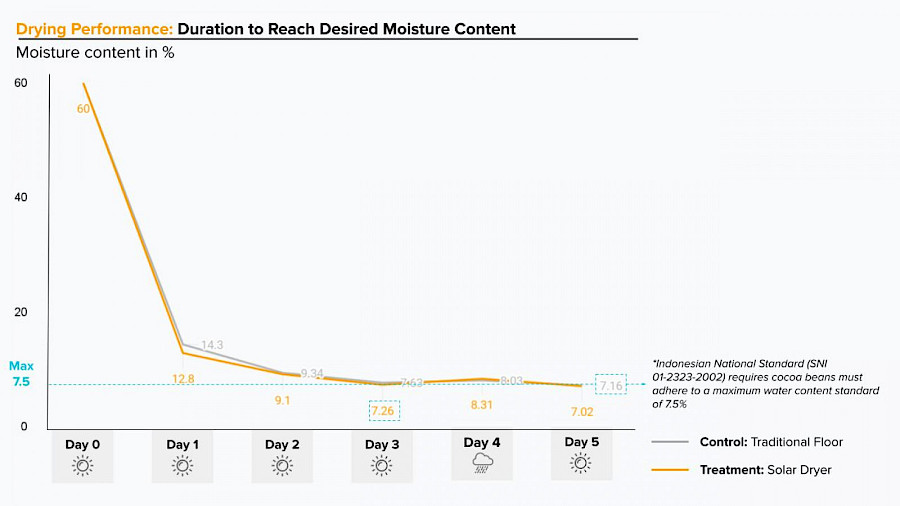
The Solar Dryer outperformed traditional floor drying by creating hotter, drier conditions that helped beans reach the Indonesian National Standard moisture target (<7.5%) in three days, while cutting labour time by 40.45% and keeping beans slightly cleaner.
The problem
What we found
Jayapura is one of the main cacao-producing areas in Papua Province. In 2020, Jayapura produced up to 5,140 tonnes of cacao annually from 6,342 hectares of cacao plantations. In 2024, Jayapura sold 10 tonnes of dried cacao beans to Surabaya, showcasing cacao bean quality that is acceptable to the market. Sabeyab is one of the cacao-producing villages in Jayapura, with 15,516.60 km² of cacao plantations and a population of 125,975 in 2017. This village is located in Kemtuk District, one of nineteen districts in Jayapura, with an agroclimate suitable for cacao cultivation.
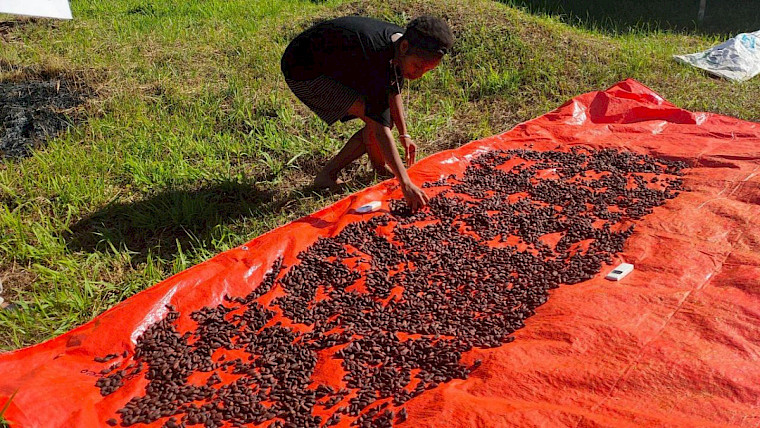
However, smallholder cacao farmers in Sabeyab face major post-harvest challenges, especially limited access to proper drying technology. Most farmers still dry beans on tarpaulins using traditional floor drying that depends entirely on consistent sunshine. During rainy periods, drying can take much longer, and beans may be stored before they are fully dry, increasing the risk of mold. As a result, farmers often have to sell their cocoa beans at a lower price.
The solution
What we tested
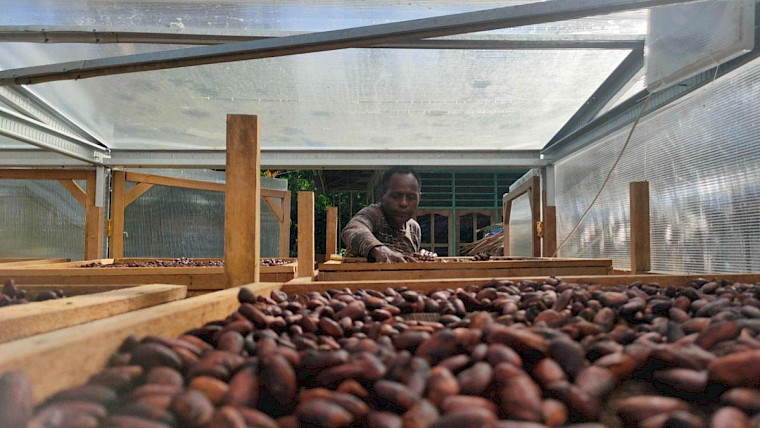
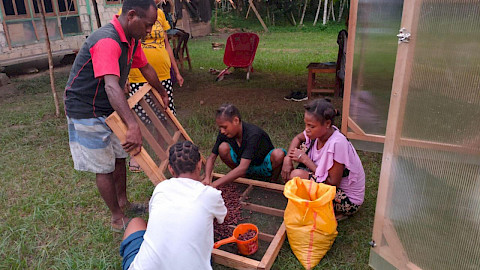
The Solar Dryer for cacao is an enclosed drying rack made of wood and polycarbonate. It features three main components to maximize drying efficiency: exhaust fans, removable racks, and lateral doors. The solar dryer is equipped with a chimney to enhance air circulation for passive drying and even heat distribution. An exhaust fan helps remove air, improving the drying process. The removable racks facilitate easy mixing of the commodities, while the doors allow for easy access to spread out cacao beans on the racks and monitor the drying process, optimizing the use of available space.
Project design
How we ran it
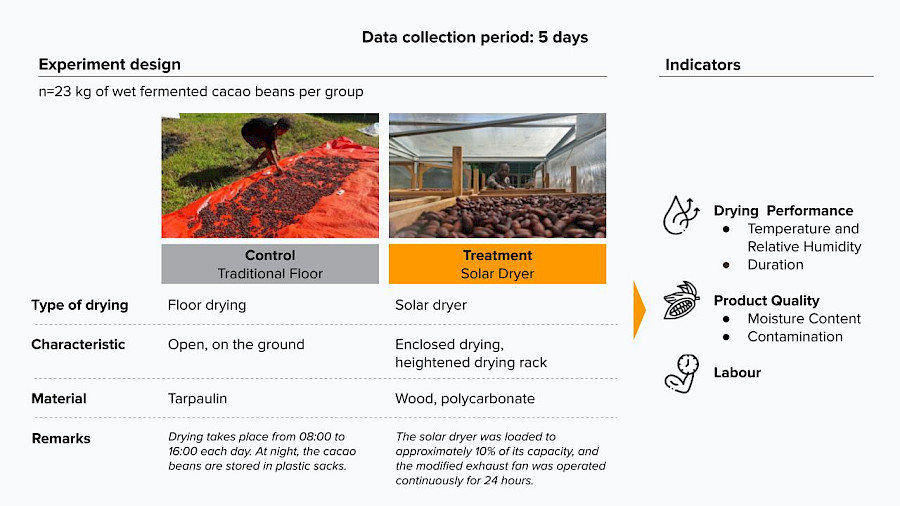
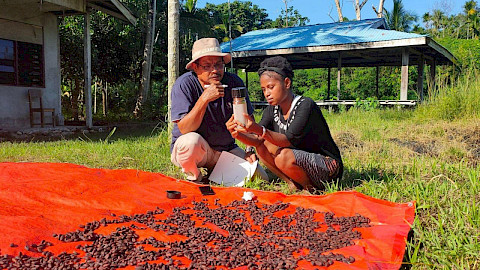
We compared two groups: a control group using the traditional floor drying method, which is the current practice for cacao drying in Sabeyab community, and a treatment group using a solar dryer as an alternative drying method. The experiment was conducted over 5 days in June 2023.
The control group used the traditional method, drying cacao beans on a tarpaulin laid on the ground and exposed to the sun. In contrast, the treatment group used a solar dryer, drying the beans on a wire-mesh rack inside a polycarbonate structure with walls and a roof.
To assess the effectiveness of the solar dryer in improving the cacao drying process, we compared the following three indicators:
- Drying Performance
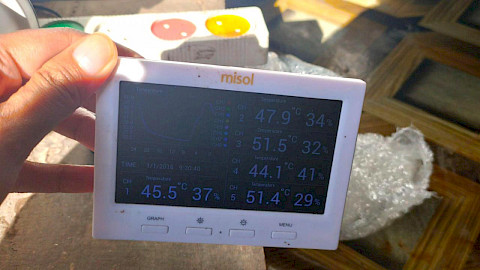
We measured temperature and relative humidity to evaluate drying performance. Two temperature and humidity sensors were placed on top of the drying surface in each group, spaced apart, and readings were recorded at 30-minute intervals. We also measured the number of days required for the beans to reach the target moisture content of <7.5%, in line with the Indonesian National Standard for cocoa beans (SNI 01-2323-2002). - Product Quality
We assessed moisture content and contamination to compare product quality between the two groups. Moisture content was measured daily from samples from each group using a Wile moisture meter. To validate these measurements, we sent samples from both groups to a laboratory in Jember, East Java, for testing, using the oven-dry gravimetric method. Contamination was assessed through laboratory tests using three indicators: foreign matter, mouldy bean content, and waste content. - Labour
We tracked the activities performed and the time spent on each task during the drying process in both groups during five days of the experiment.
The technology
Results
What we learned
After experimenting over five days, we observed the following results:
1. Drying Performance
Temperature and Relative Humidity
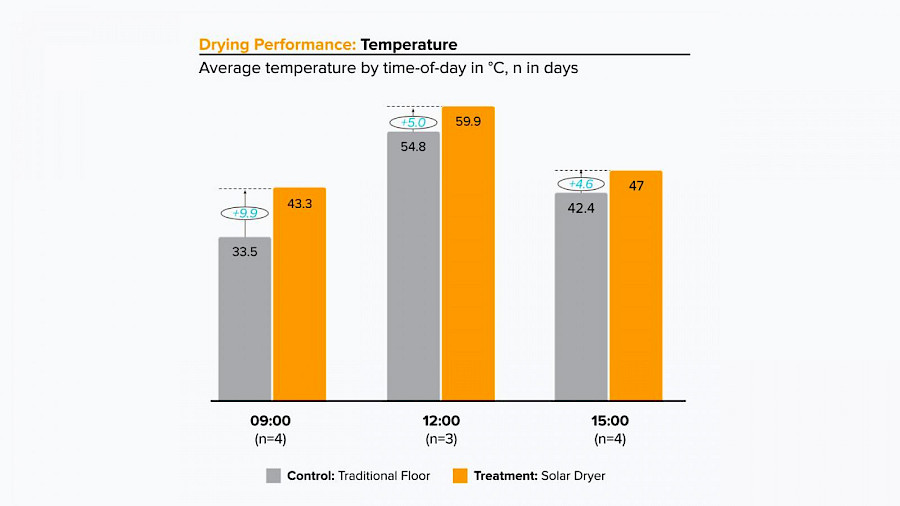
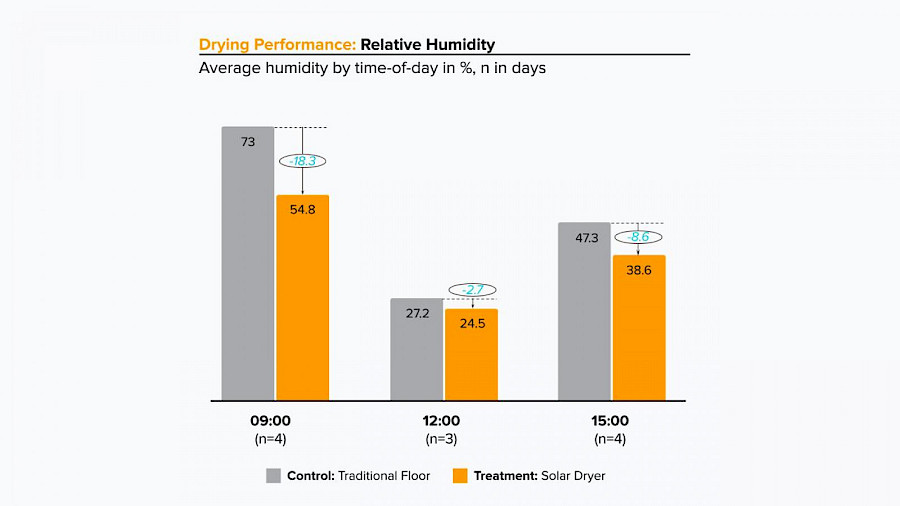
- We tracked temperature and relative humidity during the hottest parts of the day at 09:00, 12:00, and 15:00 over five experiment days. Sensors recorded data every 30 minutes from 08:00 to 16:00, matching the usual duration of traditional floor drying. Some readings were missing due to power disruptions that affected the sensors, and we did not fill in these gaps. We analysed only readings where the control and treatment group were recorded at the same time on the same day, resulting in 11 matched pairs out of 15 expected (four pairs at 09:00, three at 12:00, and four at 15:00). Then, to compare the drying performance, we calculated the temperature difference (ΔT = Solar dryer − Traditional Floor) and humidity difference (ΔRH = Solar dryer − Traditional Floor).
- The solar dryer consistently produced higher temperatures than traditional floor drying at all measured times. At 09:00 (n=4), the solar dryer averaged 43.3°C compared with 33.5°C for the control, a +9.9°C lift. At 12:00 (n=3), temperatures peaked, with the solar dryer reaching 59.9°C versus 54.8°C on the floor (+5.0°C). By 15:00 (n=4), the solar dryer remained warmer at 47.0°C compared with 42.4°C (+4.6°C). Overall, the largest temperature difference occurred in the morning, while midday and afternoon gains were smaller but consistently positive.
- The solar dryer also maintained lower relative humidity (RH) than traditional floor drying at all measured times, which supports faster drying conditions. At 09:00 (n=4), RH averaged 54.8% in the solar dryer versus 73.0% on the floor (a −18.3 percentage-point difference). At 12:00 (n=3), RH was lowest overall, with 24.5% in the solar dryer compared with 27.2% for the control (−2.7 percentage points). By 15:00 (n=4), RH increased again, but the solar dryer remained lower at 38.6% versus 47.3% (−8.6 percentage points).
- Therefore, across 11 paired observations, the solar dryer increased temperature by an average of 6.46°C compared with floor drying and reduced relative humidity by 10.5 percentage points.
- Ambient temperature and humidity were not used for direct comparison because the ambient sensor was hung and placed in the shade, while the control and treatment sensors were placed on top of cacao beans and likely captured additional heat from the bean surface and reflected radiation. In addition, unfortunately, the ambient sensor had more missing readings.
Drying Duration
- We tracked how many days the control (traditional floor drying) and treatment (solar dryer) needed to reach the target moisture content of <7.5%, in line with the Indonesian National Standard for cocoa beans (SNI 01-2323-2002). Moisture content was measured daily from bean samples in each group using a handheld moisture meter. Assuming both groups started at a similar moisture level (around 60% for wet beans), the solar dryer dried faster than floor drying. By Day 3, the solar dryer reached 7.26%, while the traditional floor drying was still slightly above the target at 7.63%. The traditional floor drying reached the target on Day 5 at 7.16%.
- The beans remained in the solar dryer while waiting for the traditional floor drying beans to meet the SNI standard. However, rainfall on Day 4 caused the solar dryer moisture content to increase and become higher than the control, indicating likely water leakage into the dryer.
2.) Product Quality
Moisture Content
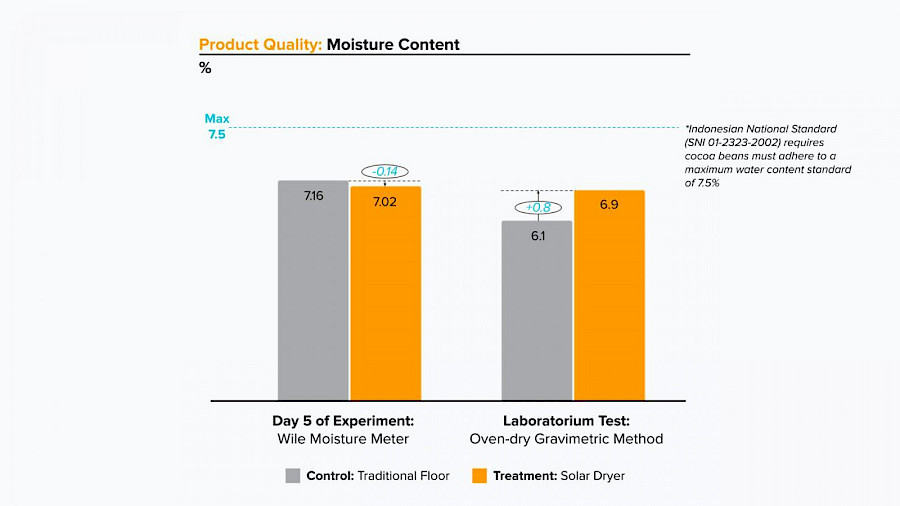
- We measured moisture content every day using a handheld moisture meter. By Day 5 (the last day of the experiment), both groups met the <7.5% standard. The solar dryer beans were 7.02%, slightly lower than the traditional floor drying beans at 7.16%. To validate these results, we shipped samples from both groups to a laboratory in Jember, East Java for testing using the oven-dry gravimetric method. The lab results did not match our field readings as the solar dryer sample was 6.9%, slightly higher than the floor-dried sample at 6.1%, although both were still below the required <7.5%. The exact cause of this discrepancy is unclear. However, variations in transport conditions or measurement methods may account for the results, despite the use of airtight storage for both samples.
Contamination
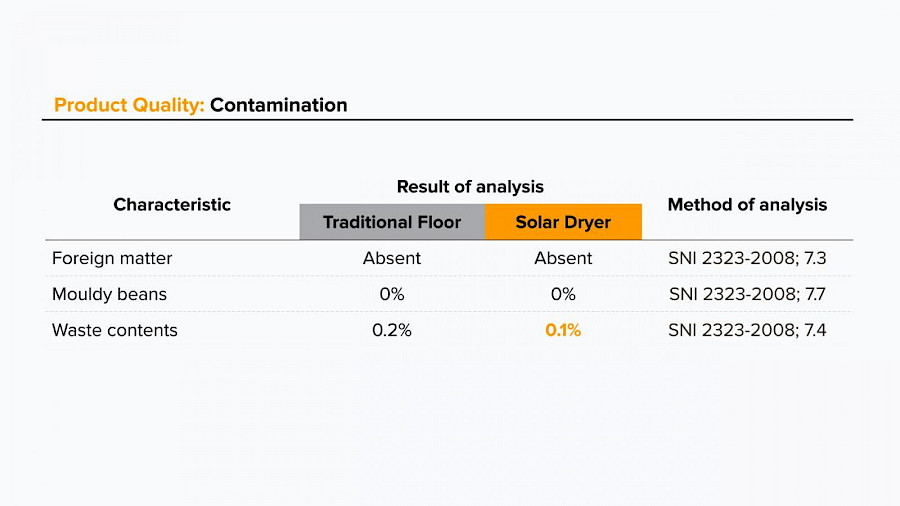
- Contamination was assessed using three laboratory indicators: foreign matter, mouldy bean content, and waste content. The lab results showed that no foreign matter or mouldy beans were detected in either the control or treatment group. However, waste content was 2% in the control traditional floor drying group, compared with 1% in the solar dryer group. Waste can include items such as placenta, clustered beans, broken bean or shell pieces, flat beans, and small twigs. The lower waste content suggests the solar dryer helps keep beans cleaner during drying, while open floor drying is more exposed to dirt and debris.
3.) Labour
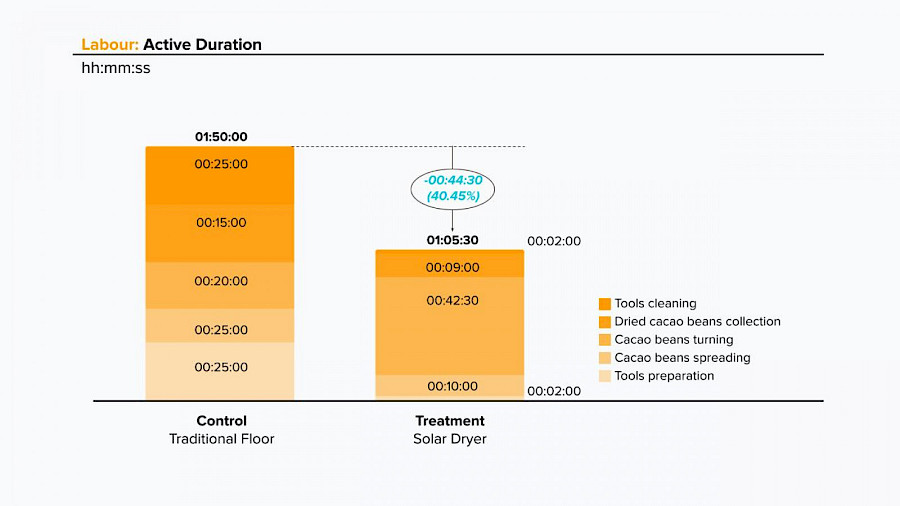
We measured labour by recording the time spent completing the required activities. Both groups involved similar tasks, but the time required differed over the five-day experiment. In the control group (traditional floor drying), activities such as preparation, drying, and post-drying had to be repeated each day. In contrast, in the treatment group (solar dryer), the main daily task was turning the beans, while preparation and post-drying were only needed at the start and end of the process. Overall, the solar dryer required 1:05:30, saving 44 minutes 30 seconds (about 40.45% less time) compared with the traditional floor drying, which required 1:50:00.
Conclusion
Overall, the solar dryer demonstrated clear operational advantages over traditional floor drying. It created better drying conditions, such as higher temperatures and lower relative humidity, allowing cocoa beans to reach the Indonesian National Standard (SNI) moisture target (<7.5%) in 3 days instead of 5, while also reducing labour time by 40.45% and slightly improving cleanliness. Importantly, both methods still produced beans that met the national moisture standard, indicating that the solar dryer’s main value is improving efficiency and reliability rather than changing final quality. For smallholder farmers, this makes the solar dryer a practical option to shorten drying time, reduce daily effort, and maintain acceptable bean quality.
Additional considerations
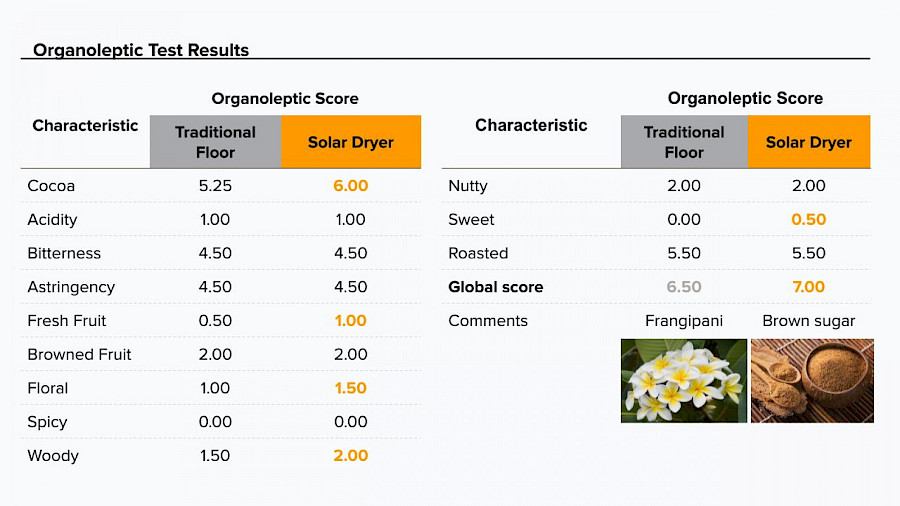
Laboratory results showed that the treatment sample achieved a higher overall score in the organoleptic test. This suggests that drying in the solar dryer not only kept the beans cleaner, but also helped preserve flavour and aroma, resulting in a higher global organoleptic score (7.0) compared with the control (6.5).