

Solar Dryer for Copra
Inefficient agricultural drying processes
Summary
We tested drying copra using a solar dryer as a simple solution to improve farmers’ drying process.
Why we rated it this way
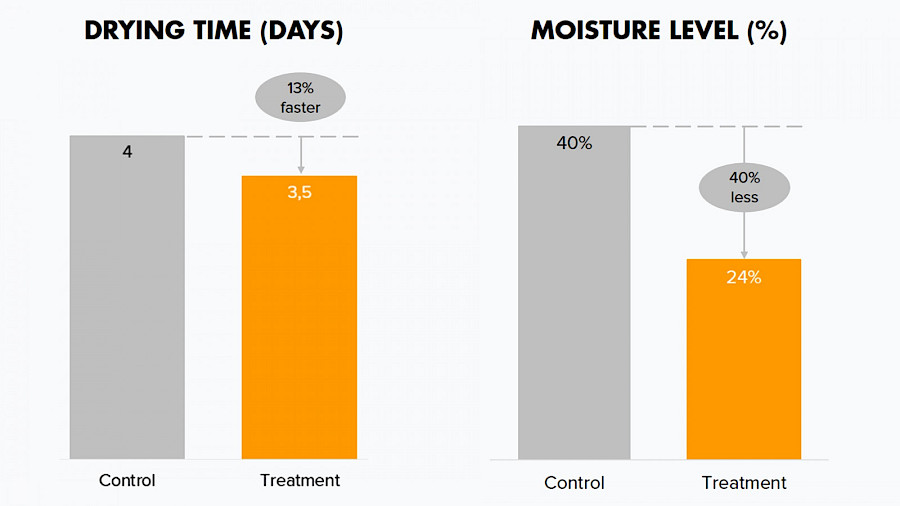
The solar dryer enabled farmers to dry copra during the rainy season and was able to dry copra 15% faster than the traditional drying method. The solar dryer also produced higher quality copra with a 24% moisture level compared to a 40% moisture level using the traditional drying method.
The problem
What we found
Indonesia is the largest coconut producer in the world, producing more than 18 million tons of coconut in 2018. More than 99 percent of coconut plantations in Indonesia are owned by smallholders. One of the common ways to add value to coconut is to produce copra, which is valued for the coconut oil extracted from it and for the resulting residue, coconut-oil cake, which is used mostly for livestock feed. Copra is obtained by spreading coconut kernels on the ground and exposing them to the air and sun. This method of drying is still extensively followed, however, this method exposes coconut to rain which requires additional drying time during the rainy season. Furthermore, this method of drying makes the coconut prone to contamination by dirt, insects and mould. Therefore, improved drying methods are needed to protect copra from rain and contaminants to maintain crop quality.
The solution
What we tested
Kopernik built a simple solar dryer made from locally available materials to test the drying of copra. Results from drying copra using the solar dryer were compared to results from the traditional drying method to measure the crop quality and drying performance during both dry and rainy seasons.
Project design
How we ran it
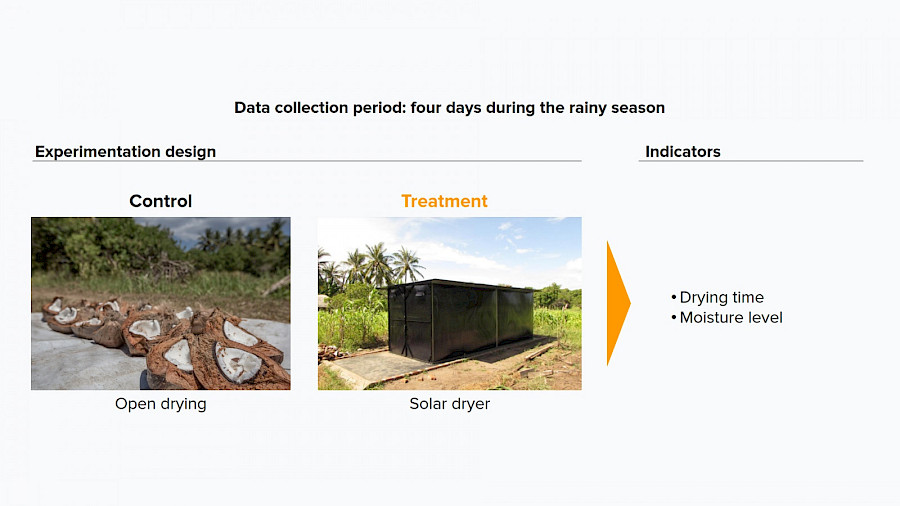
In 2016, we built a solar dryer in Pajinian village, Adonara island, East Nusa Tenggara for copra with a maximum capacity of 1,000 kg. We compared the solar dryer (treatment) to the traditional open drying method (control) to measure drying time to reach the ideal moisture levels during the dry and rainy seasons.
Results
What we learned
We found that the copra dried using the solar dryer (treatment) was able to reach a more optimal moisture level (which is between 22-26% according to three buyers we interviewed) compared to traditional drying (control), with reduced drying time, and resulting in improved crop quality according to buyers.
In the treatment group, the moisture level of copra reached 24%, while the copra in the control group did not go lower than 40% (the ideal moisture level is between 22-26%). In terms of time efficiency, the drying time of the treatment group was 3.5 days or 15% faster as compared to the control group (4 days) during the dry season. The farmers found the solar dryer to be very useful during the rainy season when traditional drying methods cannot be used at all, meaning that they are unable to sell copra during the rainy season, impacting their incomes. During the rainy season, the drying time of copra in the solar dryer was 5 days, in order to reach the optimal moisture level of 24%.
Conclusion
The experiment shows that the solar dryer results in copra reaching the optimum moisture level which cannot be achieved using the traditional drying method. Importantly, the solar dryer enables farmers to dry copra during the rainy season, which is not possible using the traditional drying method.
Read more
Project profile
Reports and references
Rachman, Abdul. (2016). Increasing Farmer Incomes: Solar Drying Solutions Phase One Project Report.