

Storing Green Coffee Beans Using Desiccants (2)
Difficulty in maintaining adequate green coffee bean moisture during storage
Summary
We tested the effectiveness of silica gel for storing green coffee in Tabanan, Bali.
Why we rated it this way
The effect of silica gel on maintaining optimal moisture content of green coffee beans is negligible.
The problem
What we found
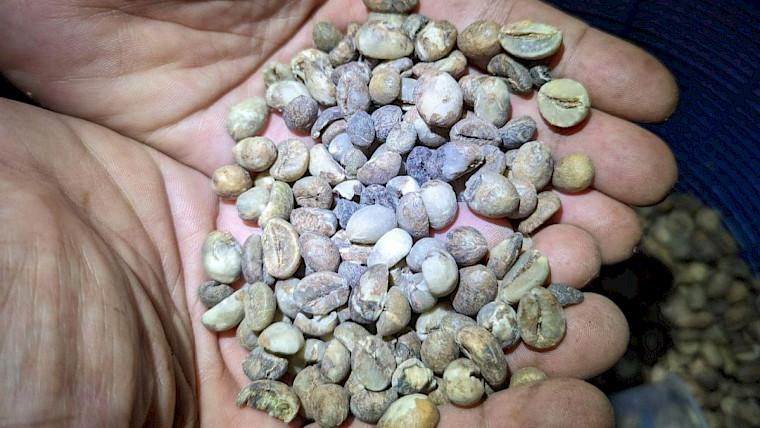
Indonesia has more than 2 million farmers who rely on coffee cultivation for their livelihood. As Indonesia is located in a tropical area, smallholder coffee farmers face challenges in maintaining proper storage of green coffee beans due to high temperatures and relative humidity, leading to deterioration of the coffee beans.
Smallholder farmers commonly use plastic bags, plastic woven sacks, or a combination of both as the current storing method of green coffee beans, due to the accessibility and affordability of these items (at USD 0.16 for 100kg beans). However, these sacks are permeable, allowing air to enter. As a result, the accumulation of air within the sacks elevates relative humidity levels and raises the moisture content of the green coffee. The Indonesian National Standard or SNI 01-2907-2008 standard requires green coffee to adhere to a maximum water content standard of 12.5%. The increased moisture content creates a conducive environment for the proliferation of pests, molds, and fungi, which pose a significant threat mainly to degrading bean quality and price.
In contrast, materials such as hermetic packaging, which are impermeable and airtight, offer a potential solution. Nonetheless, the adoption of such impermeable and airtight materials comes at a higher cost (approximately USD 3.28 for 75kg beans).
The solution
What we tested
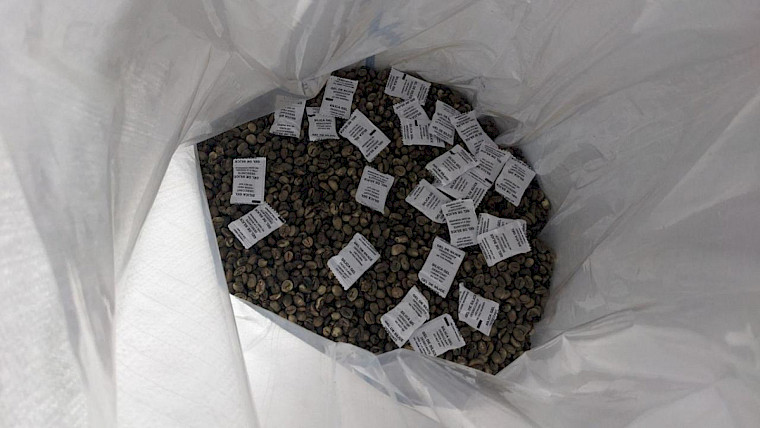
Following our in-house experiment conducted in Kopernik’s storage room, we conducted a field experiment in Tabanan, Bali, to improve the current storage methods used by smallholder farmers. This involved combining desiccant and hermetic principles with different types of sacks. We selected silica gel, which performed better than natural clay in reducing relative humidity during our five-day test. We also compared two types of storage methods: a plastic bag and a hermetic zipper bag, to store the green coffee beans before covering them with permeable plastic woven sacks.
Project design
How we ran it
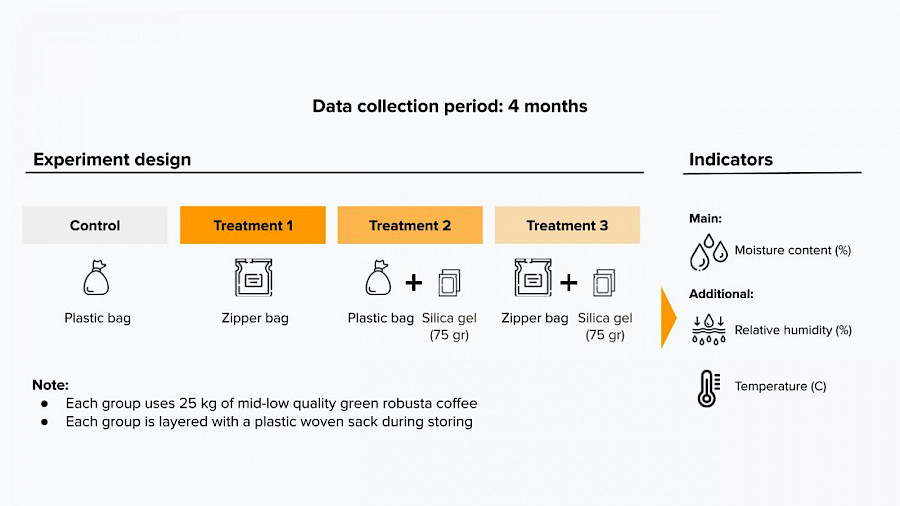
We tested the effectiveness of desiccant in the storage process of green coffee beans for four months from 5 September 2023 to 4 January 2024. In this experiment, there was a control group and three treatment groups with the following composition:
- Control group (C): 25 kg of green coffee in a plastic bag covered with a plastic woven sack
- Treatment 1 (T1): 25 kg of green coffee in a zipper bag covered with a plastic woven sack
- Treatment 2 (T2): 25 kg of green coffee in a plastic bag with 75 gr of silica gel covered with a woven sack
- Treatment 3 (T3): 25 kg of green coffee in a zipper bag with 75 gr of silica gel covered with a woven sack
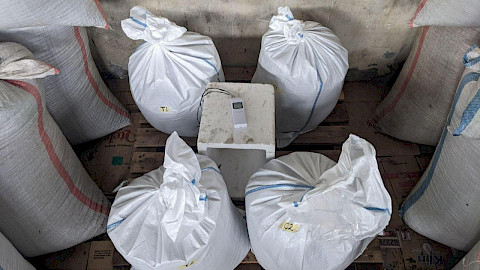
All groups were placed on a wooden pallet inside a farmer’s storage room in Tabanan, Bali.
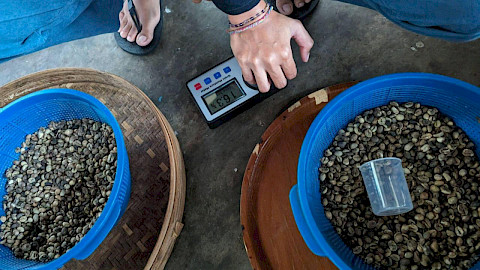
The main indicator measured in this experiment was the moisture content of green coffee beans (%), which indicates the average water content of the green coffee. This indicator was collected using a grain moisture meter. The data was collected twice, during the baseline and endline.
Other than moisture content, we also measured two additional indicators:
- Relative Humidity (%): indicates the amount of water vapor that is relative to the temperature of the air inside the sack.
- Temperature (°C): indicates the average heat or thermal energy inside the sack.
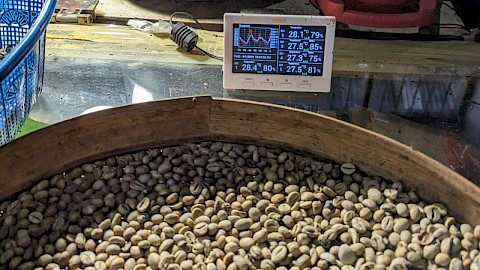
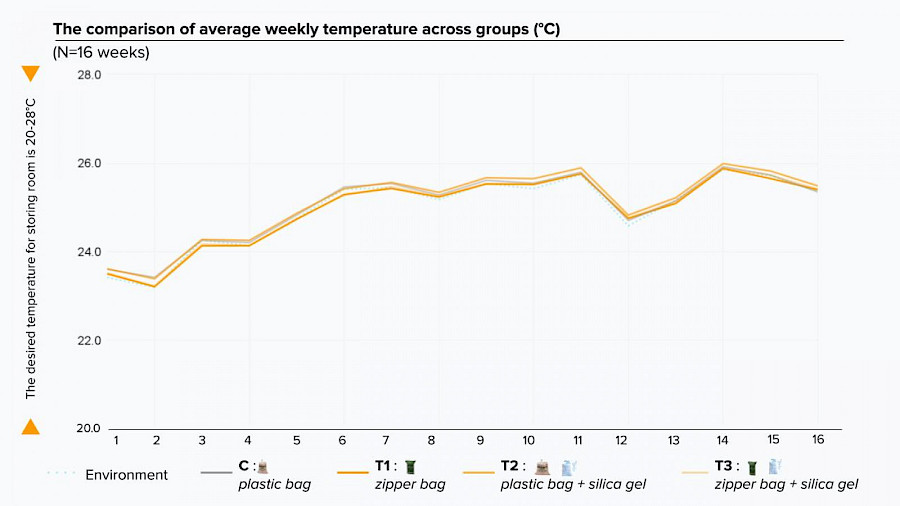
Both indicators were collected using five Misol sensors. Four sensors were placed inside each sack and a sensor was placed inside the storage room. Every sensor recorded both relative humidity and temperature data hourly for four months.
The technology
Results
What we learned
Moisture content of the green coffee beans
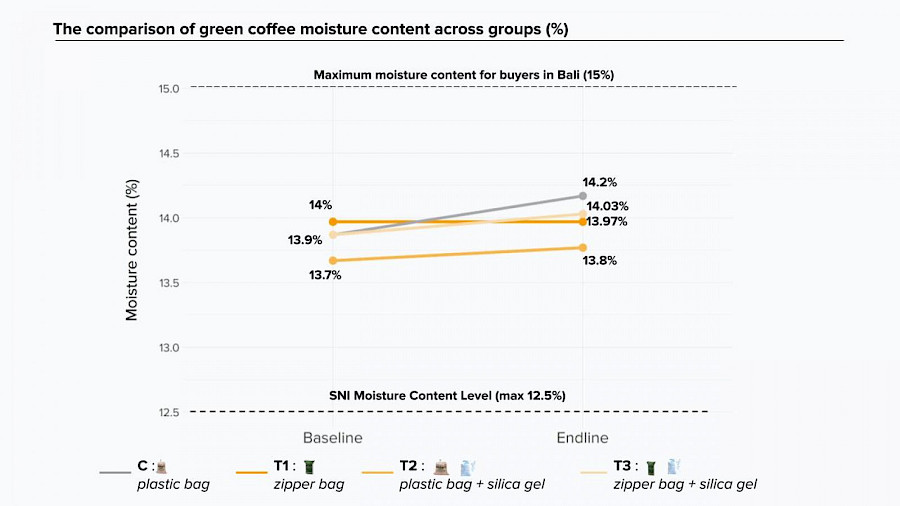
The silica gel had a minimal overall effect on the moisture content. In plastic bags (C vs. T2), it positively influenced moisture reduction, as the group with silica gel (T2) had a lower endline moisture content (14.0%) compared to the control group (14.2%). However, in zipper bags (T1 vs. T3), silica gel negatively affected the moisture content, with the silica gel group (T3) having a higher endline moisture content (14.03%) than the one without desiccant (13.97%). Individually, only the zipper bag group T1 showed a minor decrease in moisture at the endline.
All groups exceeded the SNI standard of 12.5% at the endline. However, they remained within the desired moisture content from green coffee buyers in Bali, which is a maximum of 15%.
Relative Humidity (RH)
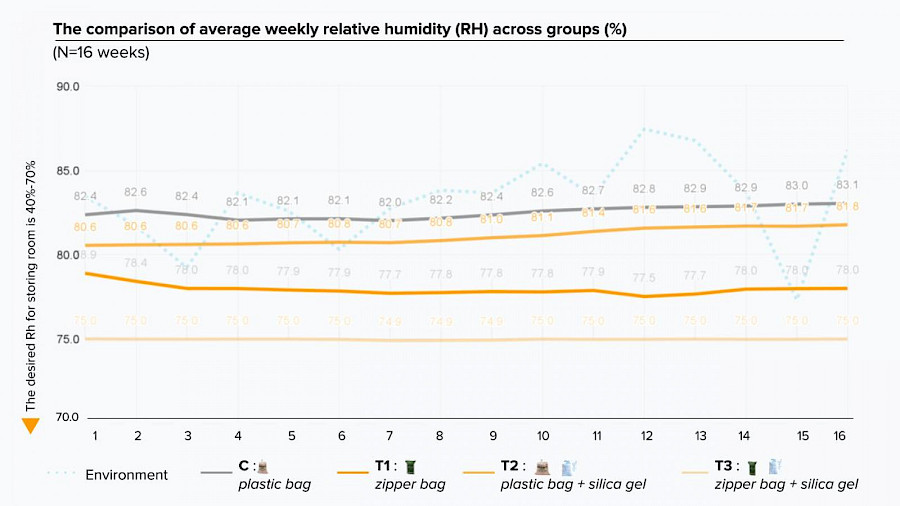
Throughout the experiment, groups with zipper bags (T1 & T3) consistently had a lower RH level compared to the groups with plastic bags (C & T2). Comparing the groups with and without silica gel (T1 vs. T3 and C vs. T2), results showed that groups with silica gel (T2 and T3) had lower RH levels compared to groups without silica gel (C and T1). This might indicate the effectiveness of silica gel in reducing relative humidity. Regarding consistency, the group using zipper bag and silica gel (T3) demonstrated the most stable relative humidity levels, as indicated by its lowest standard deviation (0.158).
The RH level of the group with plastic bags and silica gel (T2) gradually increased over time. It is plausible that the increase in RH could be attributed to the silica gel adsorping humidity from the outside, given an imperfect seal of the plastic bag. The use of a zipper bag with better sealing properties significantly lowers humidity compared to a plastic bag. This conclusion was supported by the significant test (p-value) in the comparison between plastic bag (C) and zipper bag (T1).
The use of silica gel significantly decreased RH levels. This was supported by the significant results in the t-tests comparing the groups without silica gel (C, T1) to those with silica gel (T2, T3).
Temperature
The average internal temperature of all groups during the storage time was between 23 - 26°C, which is within the required storing temperature in Indonesia (20-28°C). The lack of significant temperature variation across all groups and the environment indicates that neither sack type nor silica gel significantly affects internal temperature, as they are not designed for temperature control.
Conclusion
Silica gel's impact on maintaining optimal green coffee moisture content is minimal. Hermetic zipper bags alone, without desiccants, offer slightly better moisture preservation than traditional plastic bags. Adding silica gel to plastic bags provides some improvement, but the difference is negligible. None of the tested solutions consistently reduced moisture content to the SNI standard of 12.5%, but all remained within the acceptable range for Bali buyers (15%).
Additional considerations
For optimal green coffee moisture management with a limited budget, hermetic zipper bags without desiccants are recommended. However, if the budget is extremely tight, smallholder farmers can continue using plastic bags without desiccants. While hermetic zipper bags and desiccants offer some benefits, the difference in moisture content may not justify the additional cost for most farmers.