

Rubber Tapping Rain Guards - Pilot Testing
Loss of rubber harvest in the rainy season
Summary
We tested the performance of rubber tree rainguards in protecting latex yields during the rainy season through a pilot testing in Sanggau, West Kalimantan.
Why we rated it this way
The large-scale pilot showed that rubber tree rainguards effectively protect latex yields during the rainy season, increasing latex yield by up to 46.4% and average revenue by 45.26% compared with trees without rainguards.
The problem
What we found
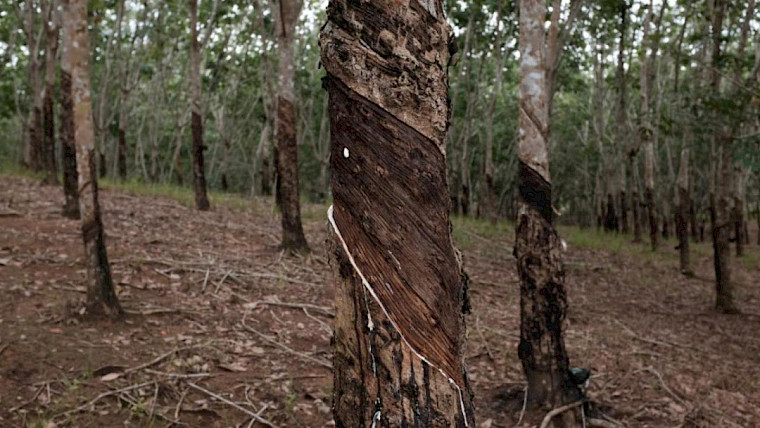
Indonesia produced 3.3 million tons of rubber in 2019, making it the world's second-largest rubber producer. Approximately 83 percent of Indonesia's total rubber production comes from smallholder farmers. In 2018, as part of the Unmet Needs Research conducted by Kopernik in Sanggau, West Kalimantan, we identified that the weather had a major impact on the harvest yields of rubber. The farmers find it especially difficult to harvest during the rainy season due to heavy rain, which spoils or washes away the collected latex. Therefore, a simple and easy-to-use solution is needed to protect the rubber harvest during the rainy season.
The solution
What we tested
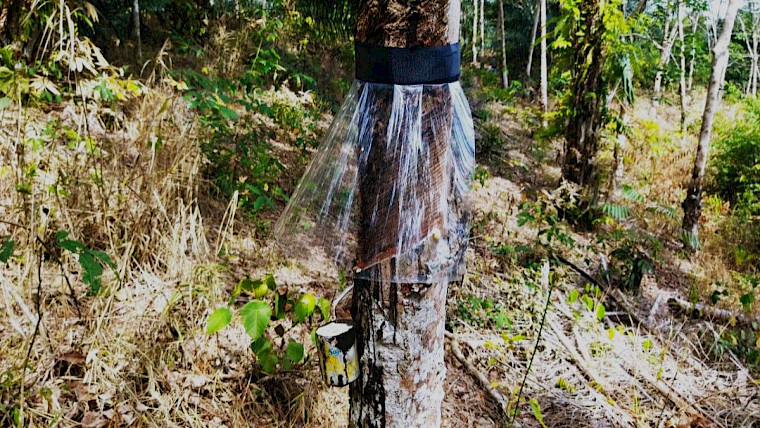
In 2020, Kopernik tested two rain guard prototypes for rubber trees to protect latex during the rainy season. The prototypes used transparent and white PVC hoods, secured with the inner tubes of recycled tires. Both designs effectively protected the latex and increased yields compared to trees without rain guards.
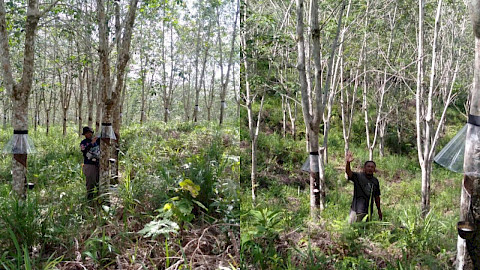
To further validate their performance at scale, we piloted the rain guards on 1,500 rubber trees. Based on material availability in Sanggau and Pontianak (the nearest provincial capital to Sanggau), we selected transparent PVC for the hood material. We also replaced the inner-tube fasteners with velcro tape, which is easier to source in large quantities.
Project design
How we ran it
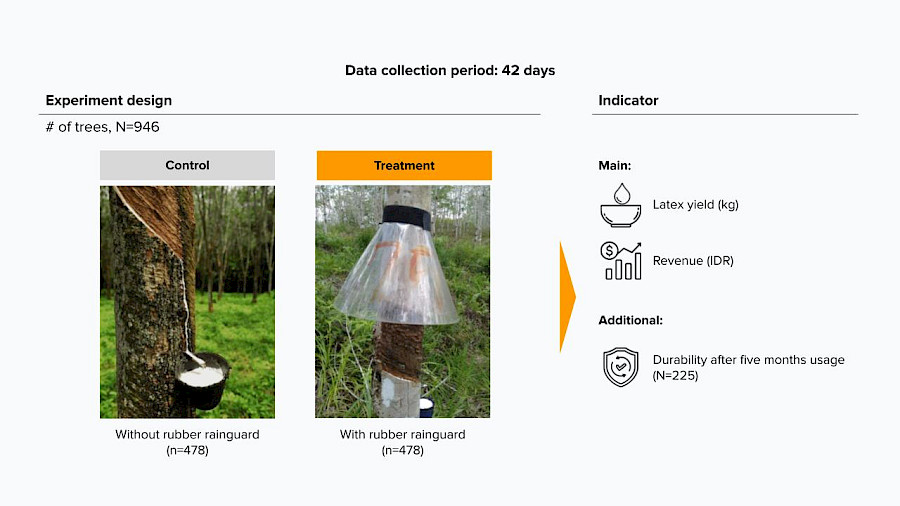
In this pilot testing, we deployed 1,590 rubber rainguards across the plantations of 15 smallholder farmers (approximately 100 rainguards per farmer). Rainguards were marked with numbers and randomly installed on rubber trees that were at least 8 years old, healthy, and free from pests and diseases.
For data collection, each farmer monitored approximately 30 treatment trees selected using a lottery-based numbering system, along with an equal number of randomly selected control trees without rainguards. This resulted in 478 trees per group (control and treatment).
During data collection, farmers recorded latex yield (kg) and revenue (IDR) from latex sales and reported these data to the local coordinator. Two local coordinators supported the process by compiling the average latex yield and revenue per farmer for each data-collection round. Each round comprised five tappings using the 1-0-1 method (tapping every two days). We conducted four rounds of data collection between December 2021 and January 2022 during the rainy season.
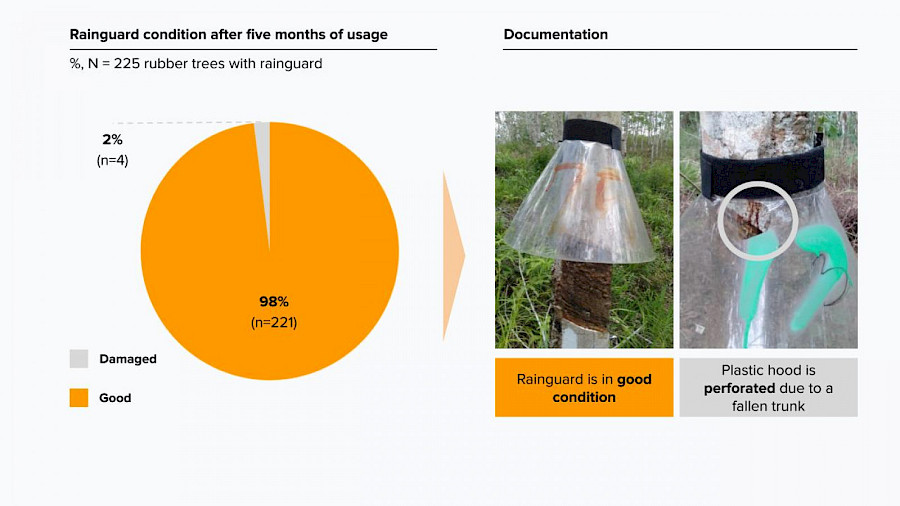
In addition, we collected data on the condition of the rubber rainguards after five months of use. For each farmer, 15 trees were randomly selected from the total treatment trees for assessment, totaling 225 trees. Each farmer inspected the selected rainguard-fitted trees and reported their condition in April 2022.
The technology
Results
What we learned
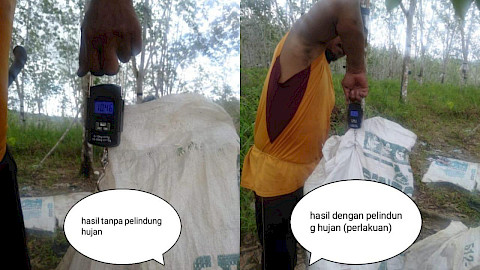
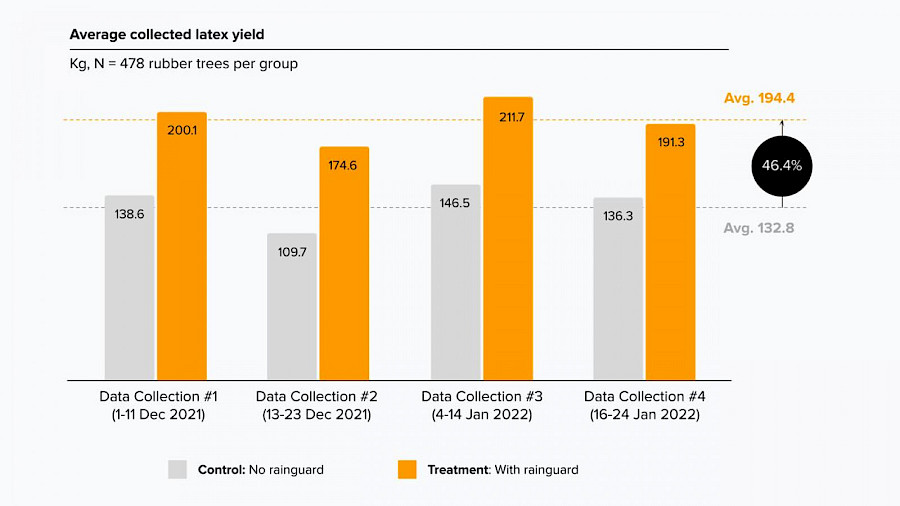
After 42 days across four data-collection rounds, results were consistent: the treatment group produced higher latex yields compared to the control group. On average, the treatment group yielded 46.2% more latex, indicating that the rubber rainguard effectively reduces latex losses and increases harvestable latex compared to trees without rainguards. This yield improvement is lower than in the prototype testing (77%), likely due to the change in fastener material from inner-tube rubber to Velcro tape. Although Velcro is easier to source for large-scale deployment, it is less flexible and can leave small gaps around the trunk. In contrast, inner-tube rubber conforms more tightly to the trunk, creating a better seal and reducing the chance of rainwater entering the tapping area.
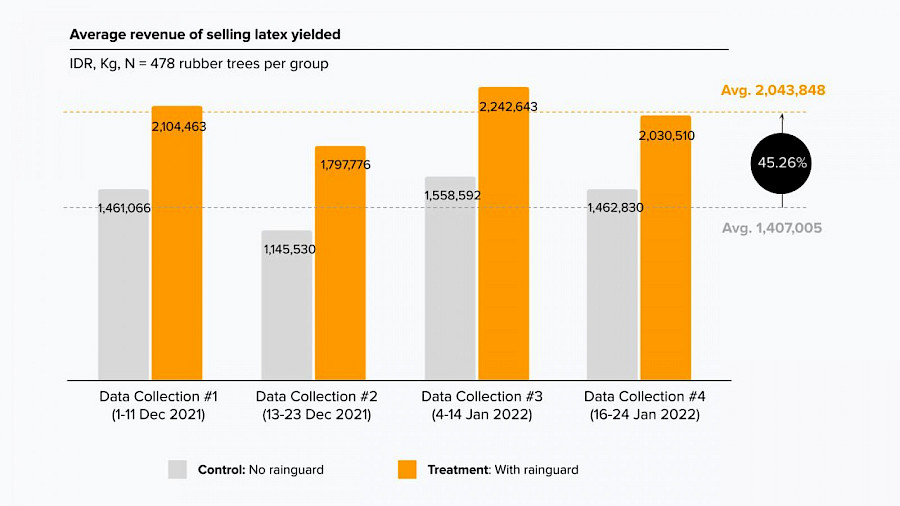
Because latex yields were consistently higher in the treatment group throughout the pilot testing period, farmers’ revenue from latex sales was also higher. On average, revenue in the treatment group was 45.2% higher than in the control group, showing that rainguards are financially beneficial, particularly during the rainy season.
Conclusion
The large-scale pilot showed that rubber tree rainguards effectively protect latex yields during the rainy season, increasing latex yield by up to 46.4% and average revenue by 45.26% compared with trees without rainguards.
Additional considerations
Five months after installation, 98% of the rainguards remained in good condition and functioning well. Only 2% were reported as damaged, mostly torn or perforated after being struck by falling branches or trunks. This suggests the rainguards are durable for longer-term use in rainy conditions.
One smallholder farmer expressed a positive response to the rainguards: “I can clearly see the difference between trees with and without rubber rainguard. The trees covered with rubber rainguard produce more latex during the rainy season.”