

Solar Dryer for Seaweed (2)
Difficulty in drying seaweed during the rainy season
Summary
We tested the effectiveness and efficiency of two solar dryer prototypes for drying seaweed during the rainy season.
Why we rated it this way
The solar dryer with elevated trays achieved better drying performance than both floor and vertical hanging methods, while also requiring the least amount of effort among the three.
The problem
What we found
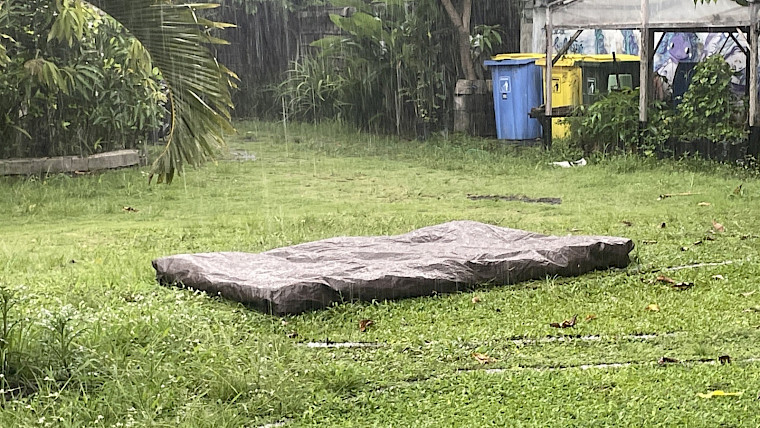
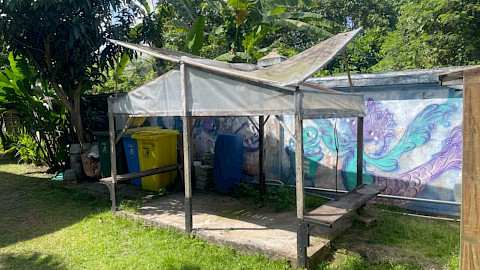
Kopernik has been working with seaweed farmers in Nusa Lembongan (Bali), Lembata (East Nusa Tenggara), and Biak (Papua). Across these sites, farmers typically dry seaweed using traditional floor drying, spreading wet seaweed on nets or on top of tarpaulin laid on the ground.
Drying becomes difficult during unpredictable weather and rainy seasons. These weather conditions interrupt drying and require farmers to repeatedly cover and uncover seaweed with tarpaulins. When farmers are engaged in other activities such as fishing, they worry about sudden rain because delayed protection can lead to seaweed quality deterioration and spoilage, including through moisture reabsorption and dissolution of valuable compounds. During heavy rains, farmers may stop drying entirely because they cannot adequately protect the product.
To address these challenges, in 2019, Kopernik conducted an experiment1 in Lembata, East Nusa Tenggara, testing an enclosed solar dryer for seaweed. The experiment indicated the enclosed dryer could dry seaweed faster and reduce farmers’ time and effort during drying by providing better protection from weather exposure and reducing the need for constant supervision.
Following the experiment, farmers in Lembata provided feedback to elevate the drying trays. Shaded space near homes is limited and must be shared with seaweed-related work and storage of fishing tools. An elevated drying structure could allow the space underneath to be used for storage or work, improving its functionality without requiring additional land or shade.
Separately, farmers in Biak, Papua suggested exploring a hanging drying method, based on the assumption that hanging seaweed may support faster water drainage through gravity and improve drying consistency, while potentially reducing contact with soil and minimizing contamination.
The solution
What we tested
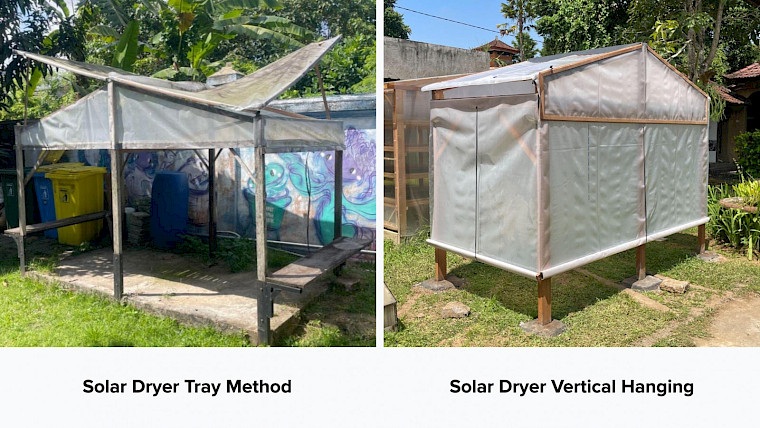
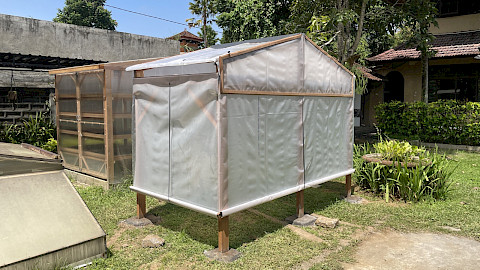
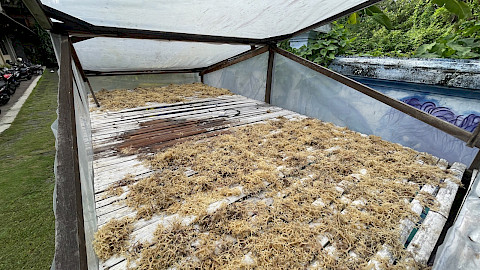
To improve the existing design of the seaweed solar dryer, Kopernik developed two prototypes. The first prototype features an elevated bamboo tray enclosed with UV plastic. The drying chamber inside the solar dryer is accessible by lifting the roof, allowing farmers to put in, flip, and take out the seaweed easily. The tray is elevated approximately 160 cm, providing enough space below for farmers to carry out activities while standing.
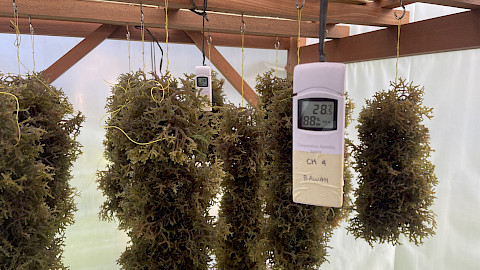
The second prototype has a similar structural design, but the area beneath the elevated tray is enclosed with UV plastic, creating a separate drying chamber for the hanging method. Hanging hooks are attached to the upper wooden beam structure under the tray, facing downward to hang wet seaweed. To facilitate air circulation, an opening is incorporated into the plastic sidewall, approximately a quarter of the solar dryer’s height, allowing wind flow and improving ventilation inside the hanging chamber.
Both prototypes were constructed at Kopernik’s Bali office using locally available materials suitable for the project site. They were designed to be easily replicable by farmers.
We hypothesize that the improved dryer design can retain the benefits of weather protection while integrating elevated trays and/or hanging mechanisms, thereby addressing farmers’ additional needs, including limited space, reduced monitoring requirements, and practical usability for fishing households.
Project design
How we ran it
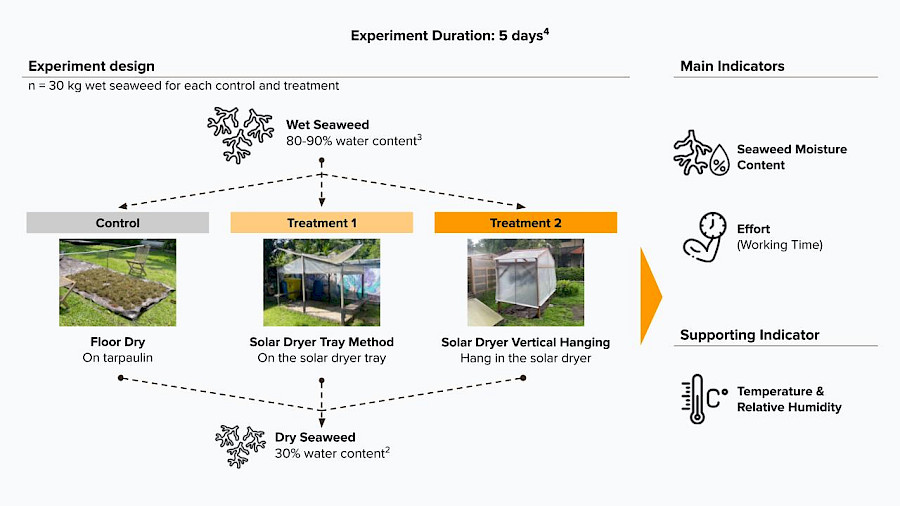
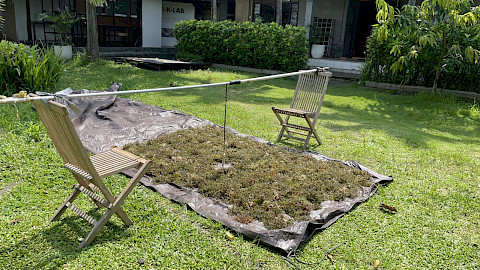
We tested two solar dryer prototypes and compared them with the existing practice. The control was traditional floor drying, where wet seaweed was spread on a tarpaulin on the ground. Treatment 1 used a solar dryer tray method, where seaweed is placed on an elevated tray inside an enclosed solar dryer. Treatment 2 used a solar dryer vertical hanging method, where seaweed is hung inside an enclosed drying chamber.
To assess and compare the performance of these drying methods, we set up and used two main indicators. First, we measured seaweed moisture content, using a target of 30%2 moisture content to define “dry” seaweed, based on the Indonesian National Standard (SNI) for dried E. cottonii. Second, we assessed farmer effort, measured as the total time spent and the number of drying-related tasks completed.
At the start of the experiment, we prepared wet seaweed with an initial moisture content of approximately 80–90%3. For each group, we used 30 kg of wet seaweed for the control and 30 kg for each treatment. Because seaweed moisture content could not be monitored in real time during the experiment, we set five days4 as the trial duration, based on desk research and literature references on common seaweed drying time .
To support the interpretation of the results, we also recorded temperature and relative humidity. These environmental conditions were monitored throughout the experiment to understand how heat and humidity influenced drying outcomes across the control and both treatments.
The technology
Results
What we learned
After five days of drying, none of the groups reached the 30% moisture target. The control group (floor drying on tarpaulin) reached 34.94%, and Treatment 1 (solar dryer tray) reached 34.06%. These two methods performed similarly and were closest to the target. Both were within 5% above 30% (control: +4.94 pp; Treatment 1: +4.06 pp). In contrast, Treatment 2 (vertical hanging solar dryer) reached 75.48%, meaning the seaweed remained largely wet and did not dry effectively within the same duration. Overall, Treatment 1 slightly outperformed the control, while Treatment 2 underperformed and would require significant design changes and/or a longer drying period.
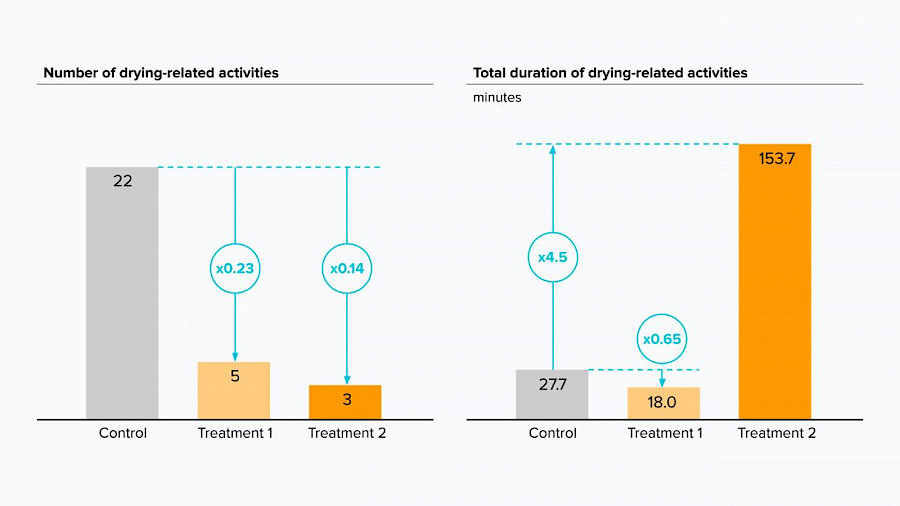
For effort, both treatment 1 and 2 reduced the number of drying-related activities compared with the control. The control required 22 activities, mainly due to repeatedly opening and closing the tarpaulin at night and when it rained. Treatment 1 required 5 activities (x0.23), and Treatment 2 required 3 activities (x0.14). This reduction reflects the enclosure benefit, which minimizes the need for frequent covering and uncovering.
However, the trend differs for total time spent. The control took 27.7 minutes, while Treatment 1 took 18.0 minutes (x0.65). Treatment 2 took 153.7 minutes (x4.5) because preparation was time-consuming. Seaweed had to be arranged one by one into vertical bundles before hanging, which increased total working time even though the number of activities was low.
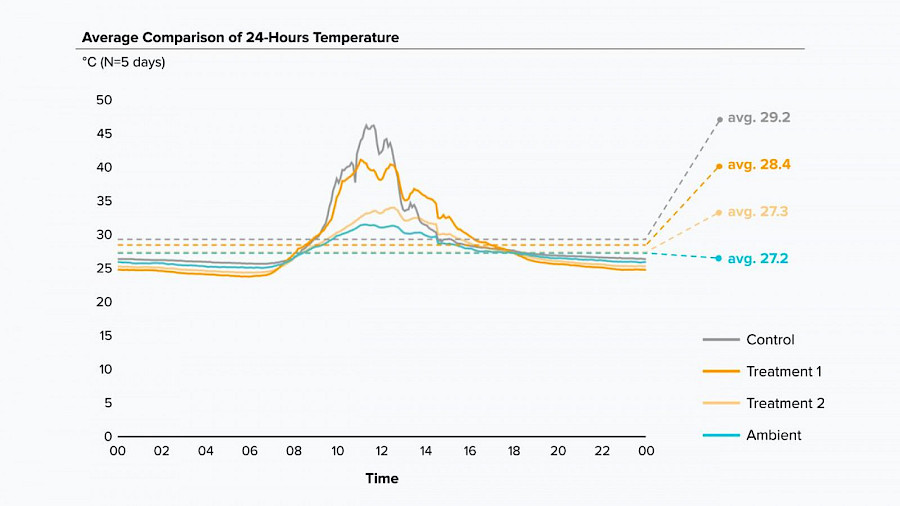
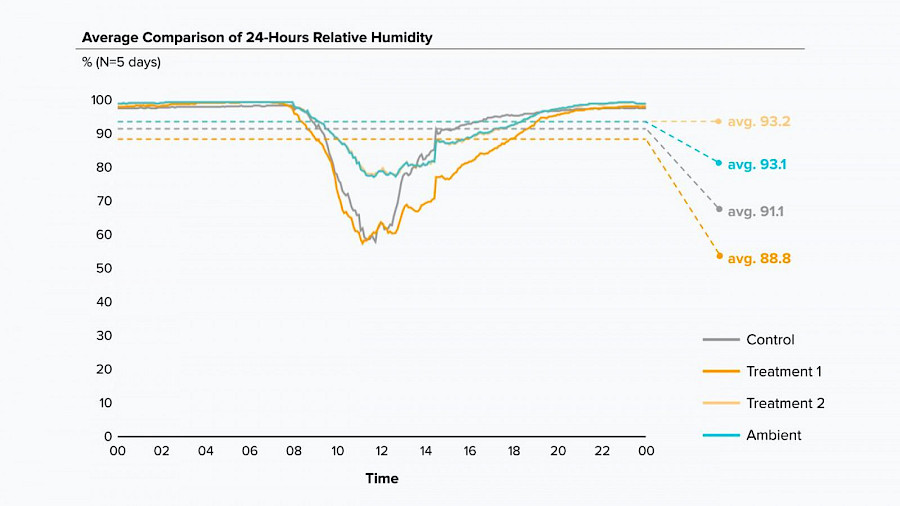
To interpret these outcomes, we also analysed average 24-hour temperature and relative humidity profiles over the five days. Average temperatures were 29.2°C (control), 28.4°C (Treatment 1), 27.3°C (Treatment 2), and 27.2°C (ambient). Average relative humidity was 91.1% (control), 88.8% (Treatment 1), 93.2% (Treatment 2), and 93.1% (ambient). The ambient (blue line) and Treatment 2 showed very similar patterns, indicating limited heat retention and limited humidity reduction inside the hanging chamber. In contrast, the Control and Treatment 1 showed stronger daytime heat gain and lower daytime humidity than the ambient. Treatment 1 also retained heat longer than the control, with a slower temperature decline after the midday peak and a corresponding slower rebound in humidity.
Conclusion
The experiment showed the solar dryer with the elevated tray method (Treatment 1) remains the most practical option, as it delivered the best drying performance while requiring the least effort during the drying period. The elevated tray design offers an additional benefit by creating usable shaded space underneath, which can support farmers’ storage and daily activities. However, this elevation introduces a clear trade-off: lifting wet seaweed onto the tray can become labour-intensive, especially at higher drying volumes.
As a next step, the application of the elevated design should be adapted to farmers’ priorities. Where shaded space is a strong need, the elevated tray remains suitable. Where additional space is not required, the tray should be lowered to improve access to the chamber and reduce physical workload during loading and handling.