

Supporting Coral Regeneration with the Coral Spider Method
Mar 21, 2019 Project Leader sania.saraswati Duration: 10 Months
コペルニク・ソリューションズが、プロジェクトを実施する現地パートナーと提携して実施しています。
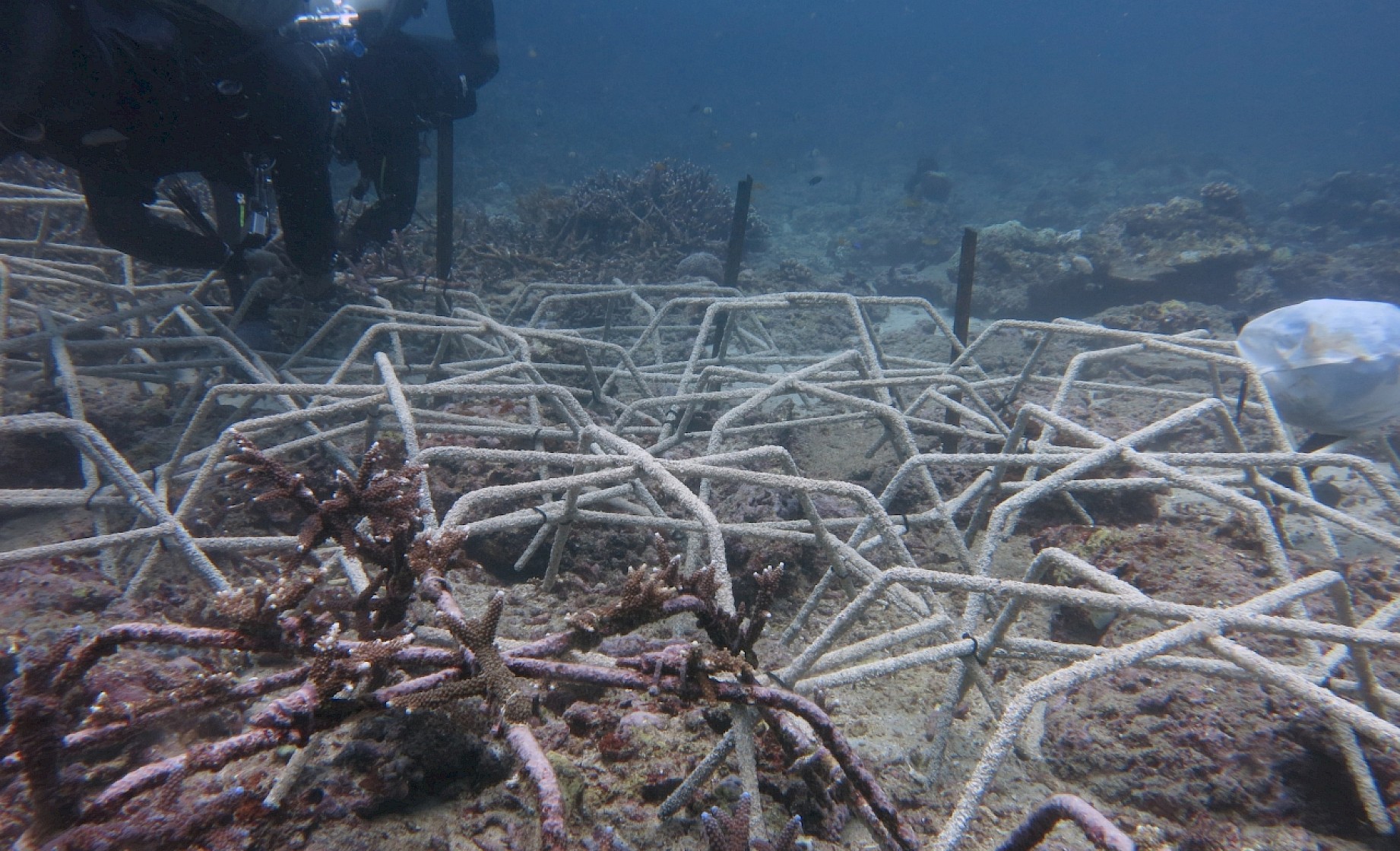
We are testing the coral spider restoration technique to develop and validate a system to regenerate damaged coral reefs in eastern Bali.
Project type
- 革新的な解決策をテストする
- 14. Life Below Water
Partners

The problem
Indonesia is home to 14 percent of the world’s coral reefs, covering a total area of 2.5 million hectares largely concentrated in Sulawesi, Maluku, Papua, Nusa Tenggara and Bali.1 The reefs have huge ecological-economical functions such as being a feeding ground and habitat for marine animals, providing coastal protection, and attracting tourism. A study conducted by Bogor Agriculture Institute in the northern part of Bali, suggested that the total economic value of coral reef ecosystems in this area amounts to US$54,000 per hectare per year, with the highest value contribution coming from tourism activities (97 percent).2
Unfortunately both coral bleaching and man-made activities are threatening the coral reef ecosystem. A 2018 report released by the Indonesian Science Institute indicated that only 6.5 percent of Indonesia’s coral reefs are in excellent condition (live coral covering above 75 percent) while 34 percent are in a poor condition (live coral covering below 25 percent). Immediate action is needed to reduce the threat to coral habitats and regenerate damaged reefs.
There have been many reef restoration projects globally, and while they do not address the causes of coral reef damage, they do give reefs the best chance to recover and adapt to changing conditions.
In 2012, Livingseas Bali, discovered a patch of damaged reef surrounded by coral colonies, about one kilometer from Candidasa beach. Six years later they noticed that still no coral colonies had grown on the damaged site despite it being surrounded by a healthy coral reef. Livingseas Bali attempted to restore this damaged reef using the coral spider restoration technique but has faced funding challenges in scaling up their work to regenerate the whole damaged area.
2 Economic valuation of coral reef ecosystem in Menjangan island - Bali. IPB. 2006
The solution
With the coral spider method, pieces of the coral are attached to modular frames secured to the reef, stabilizing the damaged reef and providing a site for natural coral settlement. This method was selected due to its success in the Makassar Coral Rehabilitation project (MARRS), where it increased live coral coverage from less than 10 percent to 60 percent in two years.3
In addition to low-cost design and simple materials, this solution is easily replicable and adaptable to different sites, and can be easily extended.
We hypothesize that the transplanting of coral fragments on to hexagonal ‘spider’ structures in a damaged area, will allow the coral to survive and help to regenerate the reef. We will aim for an average survival rate of above 80 percent after eight months.
Kopernik will assist Livingseas Bali in manufacturing, installing and monitoring 40 coral spiders in two locations near Candidasa beach and Padangbai.
There will be 18 coral fragments of Acropora sp. gathered from areas near the site and transplanted onto each spider frame to ensure optimum coral growth.
We will monitor the survival rate of the coral pieces each month over a period of eight months.
The expected impact
The damaged coral reef’s ability to regenerate will be improved with the installation of coral spiders. The outcome of this project will be the initial transformation of a coral rubble field into an area covered by living coral fragments, growing over time and restoring the natural reef ecosystem. If this method proves to be effective then we intend to seek more funding and expand the restoration area.
The project results
We changed the experiment to testing the potential of the ‘Reef Star’ and compared it to two commonly used methods -repurposed glass bottles and limestone statues- to regenerate coral reefs.
The experiment found that the ‘Reef Star’ (previously known as coral spider) had a higher coral survival rate after 11 months (up to 74%) in comparison with the limestone statue (up to 55%) and repurposed glass bottle (up to 44%) methods. The survival rates were linked to the structures’ ability to keep coral fragments attached to their surface.
In terms of ease of installation, the ‘Reef Star’ was the preferred method, followed by repurposed glass bottles and then limestone statues. The shape of the Reef Star reduces the space needed for transportation and allows for the binding of several pieces. This makes a stable network of structures that are less prone to movement as a result of ocean currents. The repurposed glass bottle system is labor-intensive to make, but the attachment of coral fragments to it is relatively easy. The limestone statues were the hardest to install, transport, and attach coral fragments to their surface.
Additionally, the ‘Reef Star’ resulted in the lowest cost per fragment, at US$ 10.04. The repurposed glass bottles had a cost per fragment of US$ 12.14, while the limestone statues’ cost was US$ 20.32. This is in part due to the ‘Reef Star’ ability to have more coral fragments attached to the steel structure.
Show project location
Project cost
| Type | Description | Amount |
|---|---|---|
| Solution & Project Implementation | Costs associated with the purchase of the solutions tested and project coordination | $2,494 |
| Monitoring & Evaluation | Costs associated with data collection, analysis and reporting | $2,110 |
| Administration Fee | Cost of transferring payments internationally, processing online donations (5%) and a contribution to Kopernik's operational costs (15%) | $956 |
| Total | $5,560 |
01 / 01