

Salt Cooling Coating (1)
Urban poor and elderly endure increasing indoor heat amplified by heat islands
Summary
We tested the effectiveness of Salt Cooling Coating (SCC) as a passive cooling solution to enhance heat resilience in homes, particularly for the urban poor and elderly.
Why we rated it this way
Ineffective because salt cooling needs active dissolution with moisture, but the coating dried into crystals so no endothermic cooling occurred.
The problem
What we found
The World Meteorological Organization (WMO) has confirmed that 2024 was the warmest year on record, based on a synthesis of six international datasets. Record-high land and sea temperatures have major consequences for both people and ecosystems. In tropical countries such as Indonesia, higher temperatures combined with persistently high humidity increase heat stress, while urban heat-island effects can further intensify exposure in densely populated, low-income neighbourhoods. According to the World Health Organization (WHO), these conditions elevate health risks including heat exhaustion, heatstroke, and dehydration, especially for the urban poor and older adults.
Based on Varquez et.al research in 2020, in Jakarta, heat-related deaths among the elderly are projected to rise by 12 to 15 times between the 2010s and the 2050s. Through the Unmet Needs Report for the Elderly Populations (2024), Kopernik also observed that many elderly people struggle to cope with unconducive home environments. Creating cool zones at home can strengthen heat resilience, but improving ventilation is often technically difficult, while reflective coatings cost IDR 41,250–105,000 per m² and are commonly sold in bulk 20 kg packages, making them unaffordable and impractical for small-scale use among the urban poor and elderly

The solution
What we tested
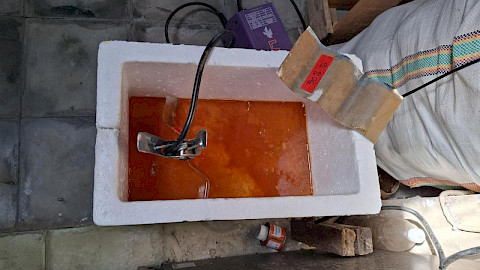
Salt Cooling Coating (SCC) is a low-cost passive cooling concept that uses salt-based coatings to increase solar reflectance when the surface is dry and salt-rich, and to provide temporary cooling when the salts absorb moisture and dissolve via the endothermic heat of dissolution. Our early proof-of-concept tests showed that dissolving sodium chloride (NaCl) reduced water temperature from 27°C to 25°C, whereas dissolving potassium chloride (KCl) reduced water temperature from 27°C to 13°C. KCl can generate a larger cooling effect during dissolution due to its higher enthalpy of solution—the amount of heat absorbed or released during a process—(~17.6 kJ/mol) compared with NaCl (+3.9 kJ/mol) (LibreTexts Chemistry). In this in-house experiment, we will formulate potassium chloride (KCl) into a gel-based coating by mixing it with waterglass and water, and then apply the coating to small-scale house prototypes.
Project design
How we ran it
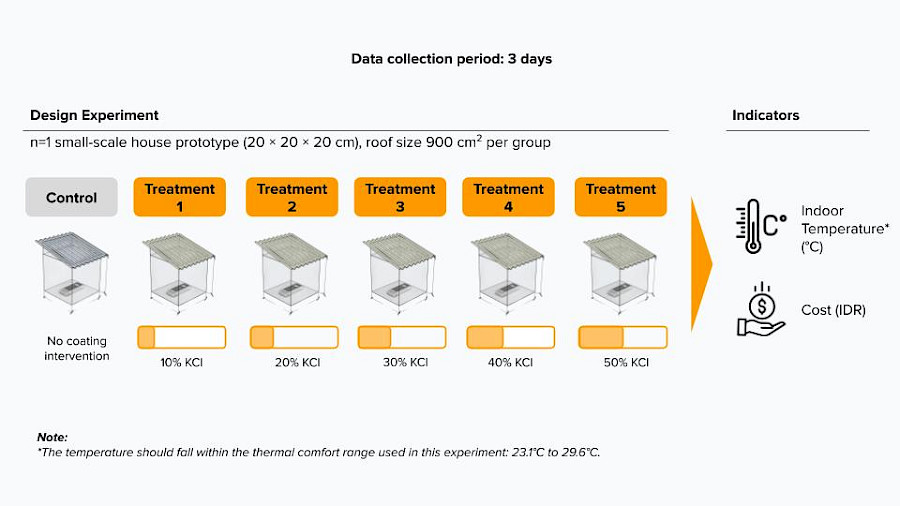
Because SCC performance depends on the salt-to-water ratio and the test setup, we conducted a performance test to identify the optimal SCC mixture by varying the KCl concentration in the treatment groups (10%, 20%, 30%, 40%, and 50%) and comparing the results with a no-intervention control group. Our hypothesis is that increasing the KCl proportion in the coating mixture will progressively reduce indoor temperature, although this improvement may come with higher material costs.
For this experiment, we used one control (no coating) and five treatments coated with standardized SCC batches for each concentration with the same total mixture mass of 217 gr. Those 5 treatment groups with different KCl composition was mixed as follows:
- Treatment 1: KCl concentrations of 10% (21.7 gr of KCl + 175.77 gr of Waterglass + 19.53 gr of water)
- Treatment 2: KCl concentrations of 20% (43.4 gr of KCl + 156.24 gr of Waterglass + 17.36 gr of water)
- Treatment 3: KCl concentrations of 30% (65.1 gr of KCl + 136.71 gr of Waterglass + 15.19 gr of water)
- Treatment 4: KCl concentrations of 40% (86.8 gr of KCl + 117.18 gr of Waterglass + 13.02 gr of water)
- Treatment 5: KCl concentrations of 50% (108.5 gr of KCl + 97.65 gr of Waterglass + 10.85 gr of water)
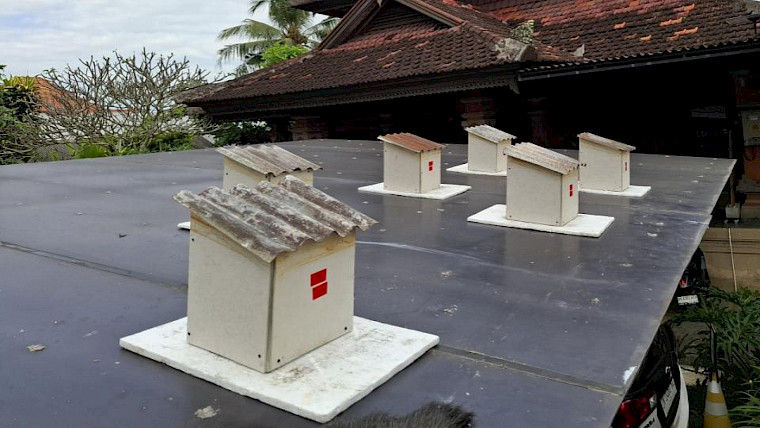
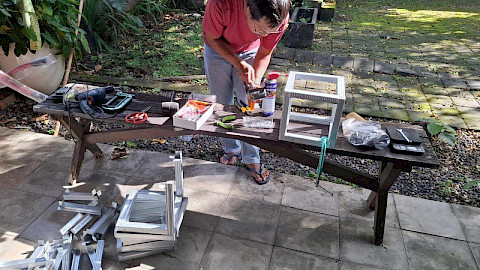
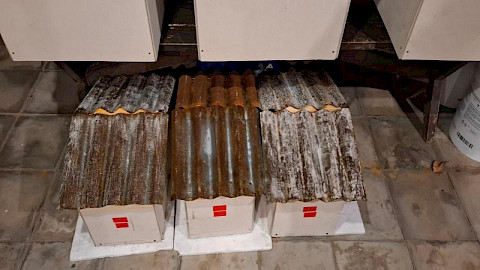
These mixtures were applied as two layers on the roofs (area: 900 cm²) of small-scale house prototypes (dimensions: 20 × 20 × 20 cm). The prototypes were constructed using concrete walls, a steel frame, and metal-sheet roofs, without ventilation openings to minimize wind and airflow effects. The roofs were pre-rusted to reduce reflectivity and better represent aged, low-income roofing conditions.
Each group was monitored for 12 hours per day (06:00–18:00) over three days from 26 to 28 April 2025. The main indicators were indoor temperature (°C) which was assessed against the thermal comfort range used in this study (23.1°C to 29.6°C), and the SCC cost (IDR).
During the experiment, temperature and humidity sensors were placed inside each small-scale house prototype. To ensure sensor reliability, multiple sensors were co-located for 30 minutes to compare baseline readings before being assigned. Sensor-to-building assignment and building placement were randomized to improve fairness and interpretability. An additional temperature and humidity sensor was placed outdoors to capture ambient conditions.
The technology
Results
What we learned
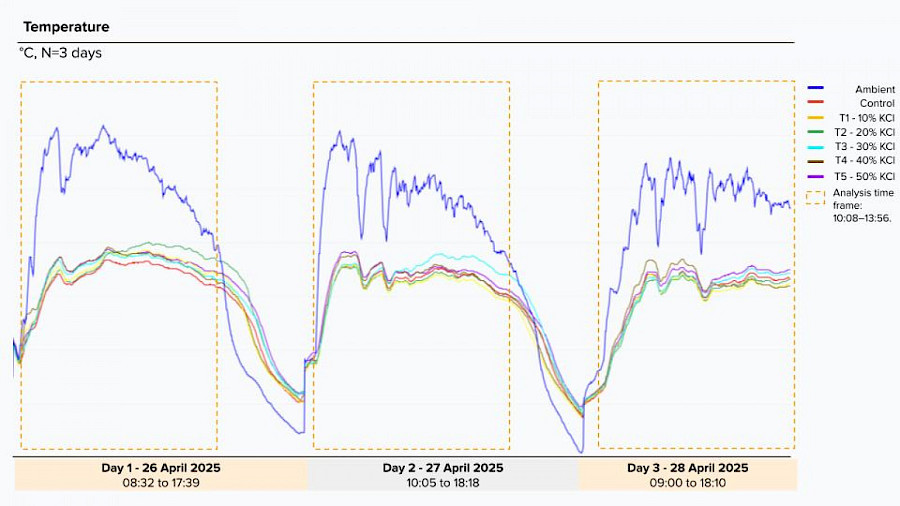
On Day 1, sensor readings fluctuated noticeably during the first half of the day (before 13:00), with T2 (green) initially close to the Control (red). After 13:00, T2 increased and became the hottest group, while the Control remained the lowest. In the late afternoon (after 16:00), T1 (yellow) showed a sharp temperature drop, and T4 (brown) followed a similar cooling pattern.
On Day 2, T1 (yellow) recorded the coolest temperatures from the start, followed by T2 (green) and then the Control (red). In the late afternoon (around 15:00), T1 again showed a drastic temperature drop, with T4 mirroring the same late-afternoon behavior observed on Day 1.
On Day 3, patterns were less stable. Around 10:00, the Control appeared cooler, while T2 and T3 were also relatively low. Between 11:30 and 14:30, the coolest group shifted multiple times (notably between T2 and T1), making Day 3 trends inconsistent with Days 1–2.
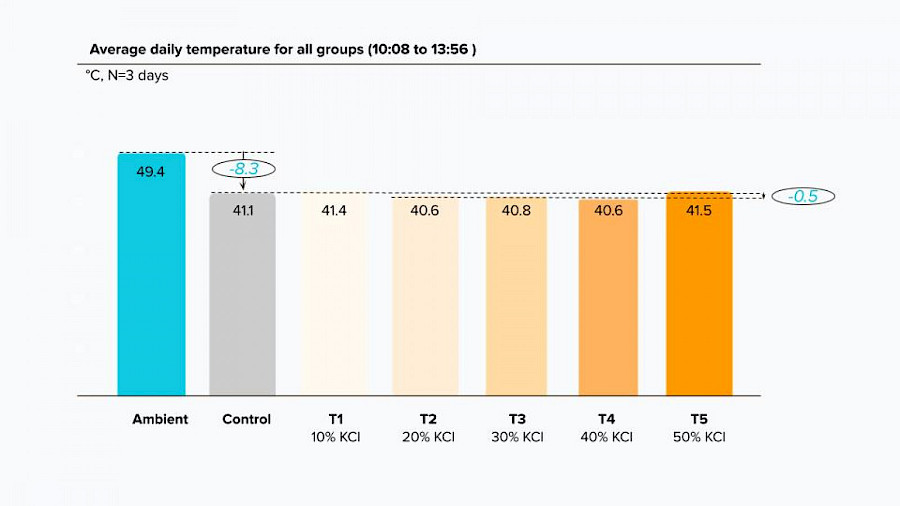
Because of these inconsistencies across the three days, we restricted the analysis window to 10:08–13:56, based on data availability and the daytime peak-temperature period. The ambient temperature averaged 49.4°C, while the Control averaged 41.1°C (about 8.3°C cooler than ambient). All treatment groups clustered tightly between 40.6°C and 41.5°C, equivalent to only −0.5°C to +0.4°C relative to the Control. We observed no consistent dose–response across 10–50% KCl, which does not support our hypothesis that increasing KCl concentration would progressively reduce temperature.
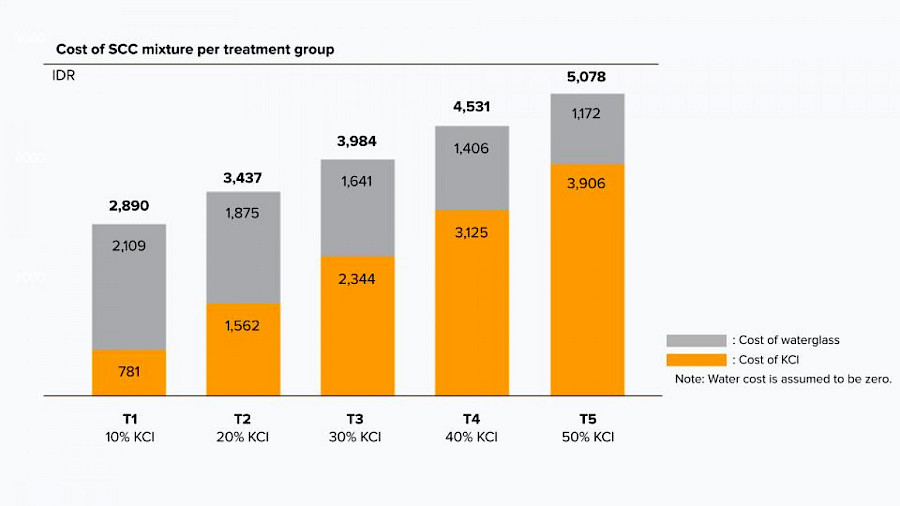
Given the minimal differences observed and the cost calculations, we selected the lowest KCl concentration (10%) for the next phase, to be tested against the Control and a commercially available reflective coating.
Conclusion
The proof-of-concept tests showed that salt-based cooling can work when the salt dissolves in water KCl gave the biggest temperature drop in the water test. However, when we applied it as a dry coating on the roof, it did not meaningfully cool the space indoors. In the rooftop trials, all coated areas stayed at almost the same temperature as the control (around 40.6–41.5°C), and using more KCl did not consistently make it cooler. This suggests the cooling effect was not “activated” because the coating stayed dry, and any small differences were likely influenced by roof reflectivity and uneven shading. Overall, this approach likely needs a different application or way to keep the coating moist so the salt can dissolve and produce cooling.
Additional considerations
For future work, it would be helpful to include indicators beyond air temperature. For example, measuring heat flux through the roof (W/m²) using a heat-flux sensor would provide direct evidence of how much heat is transmitted indoors. To improve data quality, sensors should be validated or calibrated together before and after each trial against a reference instrument, and the resulting correction factors should be applied to each sensor to ensure the measurements are reliable. Finally, tests could be conducted over more days to confirm that the observed patterns are consistent and reproducible.