

Small Scale Coffee Bean Size Sorter (1)
Inaccurate and time-intensive coffee bean sorting process
Summary
We tested the effectiveness of two prototypes of a small-scale coffee bean sorters designed to accurately sort coffee beans in Bali, Indonesia
Why we rated it this way
One of the prototypes, with a circular shape, achieved a sorting error rate of less than 5% and increased the uniformity of green coffee bean batches
The problem
What we found
Coffee beans grown at higher altitudes tend to be more dense than those at lower altitudes, and range in size and quality. When beans of varying sizes are roasted together, this can result in inconsistent roasting levels: with some beans being over-roasted, while others are not sufficiently roasted due to the uneven distribution of heat during the roasting process. The inconsistent roasting level impacts the coffee's taste and flavor. This is why buyers are willing to pay a 5.6% higher price for coffee beans that are sorted into even sizes. (The Specialty Coffee Association of America (SCAA) has established a classification standard for specialty-grade green coffee, where a deviation of a maximum of 5% above or below the indicated size is acceptable.)
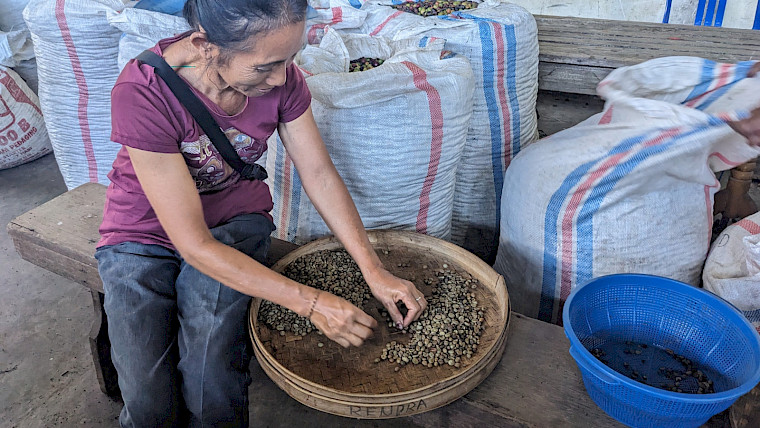
Approximately 570 robusta coffee farmer households in Tabanan, Bali, currently do not sort their beans by size, only focusing on the removal of defective beans and debris (such as coffee husks, small sticks, and stones). They do this manually, by hand. This process is time-consuming and by not sorting the beans by size also limits a potential increase in their income. Efficient large-scale machinery to sort coffee beans is available on the market but this is not accessible by average smallholder farmers, largely due to cost. There is a need for smaller-scale and more affordable tools that are effective in sorting coffee beans.
The solution
What we tested
The initial concept for this solution originated from the Fab Island Challenge, organized by the Fab City Foundation in Bali in October 2022, which aimed to tackle local challenges by bringing together international and local multi-disciplinary teams. One of the winning teams, in collaboration with Kopernik, developed the initial concept to assist smallholder farmers in bean sorting.
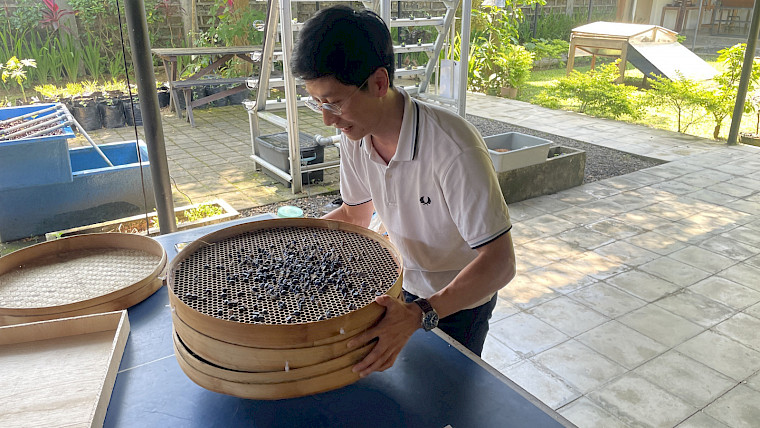
Kopernik then developed two prototypes of small-scale coffee bean sorters. The prototypes consisted of sorters that featured several layers, each designed to sort a specific range of bean sizes. During the design phase, we also paid attention to the retention area — the space between the holes in the sorting screen (we set the distance between each hole at 1/6 of the hole's diameter, as we hypothesized that a smaller retention area would increase the speed of bean flow through the screens). These prototypes used locally available materials and were designed to be easily replicable by farmers.
Project design
How we ran it
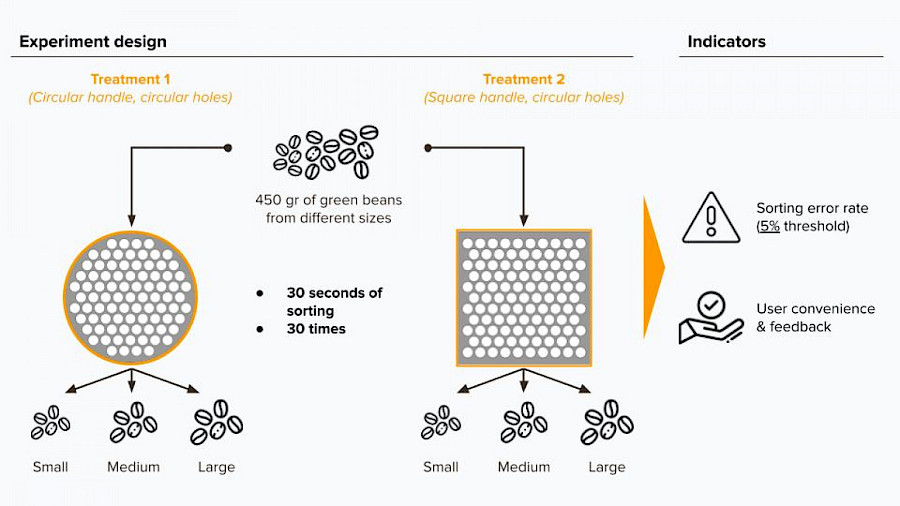
To assess and compare the efficiency of the bean sorters, we evaluated sorting accuracy, aiming for a maximum 5% error rate, and user convenience.
The first design features a circular handle and circular holes, drawing inspiration from 'ngiu', an existing tool used for sorting. The rounded handle emphasizes ergonomics by mimicking the natural curve of a relaxed palm. The second design features a square handle with circular holes; this design is a more efficient use of materials to build the sorter. This design uses an industry-standard MDF board that originally has a square shape. Both designs have two sizes: 9mm and 8mm holes.
In this experiment, we pre-measured and categorized the green coffee beans into three size groups, and painted them in different colors according to size:
- Beans larger than 9 mm, were painted blue;
- Beans between 8 and 9 mm, were painted yellow;
- The smallest coffee beans and shells, were painted black.
At the start of the experiment, we combined 150 grams of beans from each of the three colored groups, resulting in 450 grams of mixed-sized beans for each trial. The error rate is calculated by the total rate of coffee beans that does not belong to the correct screen size divided by 450 grams. Using this formula, we obtained the error rate percentage, with lower values indicating better sorting performance.
We conducted 30 trials for each bean sorter to obtain an error rate distribution. Each sorting trial was completed within 30 seconds to ensure consistent trial duration.
Results
What we learned
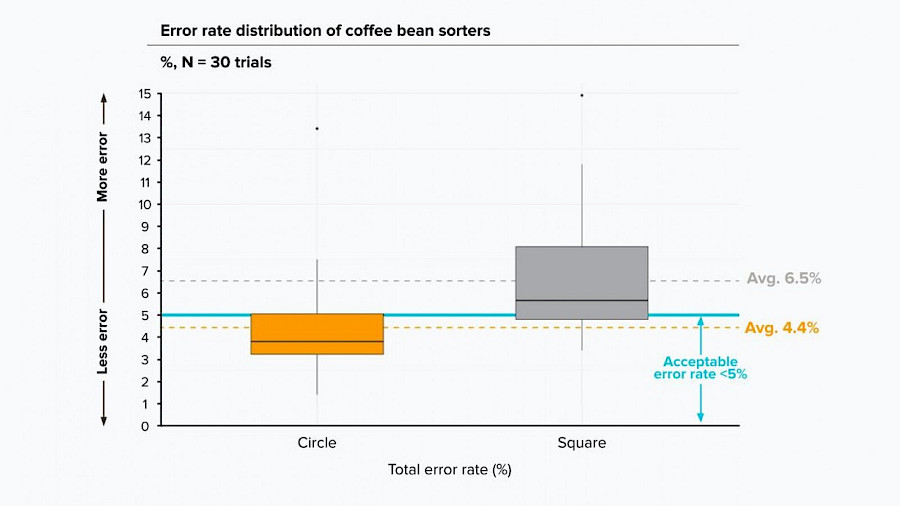
The coffee bean sorter with the circular handle successfully met the accuracy requirements, achieving a low 4.4% error rate, which is below the target of 5%. Meanwhile, the square handle prototype failed to meet the threshold due to a higher error rate of 6.5%. This result is statistically significant at 1%. Additionally, the distribution of error rates highlights that the circular handle demonstrated greater consistency in sorting coffee beans, as indicated by its lower standard deviation of 2.28 compared to the square handle's 2.67. In summary, the circular handle surpassed the accuracy threshold and also resulted in more consistent performance in correctly sorting coffee beans by size.
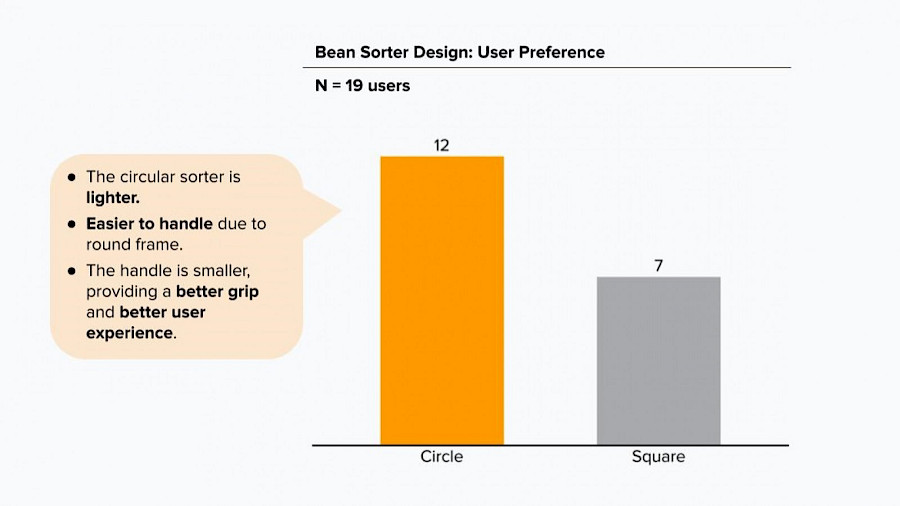
In terms of user feedback, 63% of 19 users preferred the circular handle bean sorter over the square handle. This was because the circular handle is lighter due to the use of bamboo material, while the square handle is made of heavier plywood. Additionally, the circular handle was easier to use than the square handle as it provided a better grip.
Conclusion
The circular handle sorter proved to be an efficient sorting tool to standardize the coffee bean sizes. It achieved a sorting error rate of 4.4%, which is lower than the 5% target, and performed better than the square handle sorter (which had an error rate of 6.5%). The circular handle sorter also showed greater sorting consistency, indicated by a lower standard deviation (2.28 for the circular handle vs 2.67 for the square handle). In terms of user feedback, 63% of 19 users preferred the circular handle due to its lighter weight and a better hand grip.